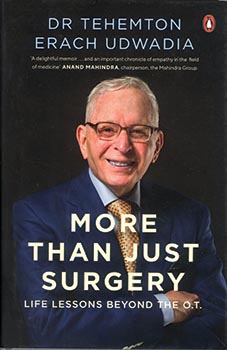
More Than Just Surgery: Life Lessons Beyond The O.T. by Dr Tehemton Erach Udwadia. Published in 2021 by Ebury Press, an imprint of Penguin Random House India Private Limited, 4th Floor, Capital Tower 1, M. G. Road, Gurugram 122002. Pp: xiii + 191. Price: Rs 799.
Be warned! With a nimbus of silver hair framing his smiling face on the cover, Dr Tehemton Udwadia could be everyone’s favorite uncle. At times, his stories seem like a script out of the famous late 1960s British comedy series Carry on Doctor produced by Peter Rogers that introduced the world to what actually goes on behind the scenes and the doors of the Operating Theater, or OT as Udwadia calls it.
 The early 1950s were the days when young Udwadia started his practice as an aspiring surgeon. If at all there’s a resemblance to the "Carry On” team, minus perhaps the luscious charms of the young Barbara Windsor as a nurse, it’s only that conditions in Bombay’s finest hospitals were far more primitive even by those standards.
Yet, by the end of the book, Udwadia has cajoled even the most reluctant of readers, and I count myself as one of them, to peer into the innermost recesses of the human body and not just look at the lumps, the fissures, the abnormalities caused by accidents of birth and those on the race-track and Indian roads, but wallow in the details that he uncovers while performing one of his surgical routines. Equally amazing is that you still love him at the end of the journey that has taken him 70 odd years from the time he first peered into the still fresh wound of the tonsillectomy of the young boy who lay bleeding on the operating table wondering what to do at the Bai Jerbai Wadia Hospital for Children in Bombay, as it was known in the early 1950s.
There is no one else he can consult that evening at the Hospital since it is New Year’s eve, except for a senior theater superintendent at the OT, Sister Alvares, and Laxman, the theater assistant. As Udwadia watches, Nurse Alvares as he remembers her, places a face mask over the boy’s face, sprays it briefly with ethyl chloride, as a disinfectant, swirls the ether over the gauze in a pattern popularly known, as he tells us, as a jalebi (a sweetmeat). She waits for him to start the procedure. She realizes he is still clueless. She quietly but firmly guides him to use a harpoon shaped needle with a thread in the recesses of the still bleeding throat of the child and says "surgical knot” — or words to that effect. He is on auto-surgeon mode, but he does know his knots. The miracle is achieved as we watch with him. He then caps the story by recalling how the second patient in the room is himself. He crumbles under the shock of his first successful procedure and has to be revived with cups of tea.
What lifts the episode in its retelling is that it is Nurse Alvares who commends his action. And he informs us: "From her, I learnt the lesson that if you are helping someone, you should do so with grace...The very first mentors in my surgical career were a nurse and a theater assistant.”
As with each one of the anecdotes that he relates, and not all of them are as successful in the way they end, some of them are heart rending — particularly in the case of a young jockey Karl Umrigar, who is thrown off his horse and trampled underfoot in the lung area — there is still a remembrance of the grace displayed by the boy’s parents, that Udwadia is able to convey in his telling of the case history.
Part of it is because while the "Carry On” series poked fun at everyone irrespective of class or gender, Udwadia takes pot shots at himself as a raw student not just of medicine, but of human nature in all its multitudinous variety. Even in the latter phase of his life, after he has collected his Padma Bhushan, though he does not mention it himself, the several accolades that he has received as teacher, researcher, early explorer of the now common procedure known as laparoscopy, he remains that young house-surgeon about to perform his first surgical procedure.
This may be why the book is as important to those who are surgeons themselves, as it is to the lay-person. The technical details are conveyed with the precision of the teacher, but the context in which the drama unfolds before our eyes is what makes it possible for us to be a witness to the complexities with which a surgeon trains himself, or herself, to deal with the human being whose life has been entrusted to him.
There are also sharp and vivid vignettes of the famous surgeons under whom Udwadia cut his surgical teeth. Not just in Bombay of the mid-20th century, but in Ireland and England where he also apprenticed as most surgeons did in that era. There are familiar stories of how his young wife Khorshed and he had to struggle to survive on their meager salary in Ireland; the journeys they also made in a car rattling through Europe marveling at the sights before tourism became a group activity, returning to Bombay and their two young children. Udwadia does not make it a personal saga of his family life, or even his own medical travails. All we hear is that he too has had to undergo at least seven surgical procedures, some for cancer.
Perhaps the most telling aspect of Udwadia’s book is when he compares the hugely successful achievements of the Indian medical fraternity, or conglomerates today, with the almost invisible multitudes that languish in pockets of the country that we call rural India.
He suggests that we need to be as inclusive and open to all methods; whether recommended by the ancient Indian practices of Sushruta, or trained Ayurvedic practitioners and combinations of professionals working in the field of medicine to reach out to those unable to avail of the increasingly techno-medical advances in the more fortunate urban areas of the country.
He saves the more serious recommendations in his book for talking about his own father’s dedication as a general practitioner working amongst the poor of the city’s areas of darkness. With each of these anecdotes there is still a lesson to be learnt, mostly on the importance of seeing how even those in the throes of utmost poverty with nothing left to lose, still manage to retain their sense of dignity.
To conclude as Udwadia does we can only repeat what he learnt from Dr Erach Rustomjee Udwadia. "My medical college professors taught me the science of surgery. Through the life he lived, my father taught me humility and compassion, the art of medicine, and what it takes to be a good doctor.”
The good doctor has also demonstrated that with the same grace and empathy, he has what it takes to be a good writer.
It’s a wonderful book.
GEETA DOCTOR
Doctor, a longtime contributor to Parsiana, is a writer and critic.