For his struggle to help the disadvantaged, Kobad Ghandy
was jailed as an undertrial
for 10 years
Marxist ideologue Kobad Ghandy came to the Parsiana office on July 7, 2021 for an interview two days after the 84-year-old, incarcerated Jesuit priest Fr Stan Swamy died. Swamy, like Ghandy, had been imprisoned under the draconian Unlawful Activities (Prevention) Act (UAPA) which virtually presumes a person guilty till proven innocent. While Ghandy was imprisoned as a "high risk” undertrial for 10 years before finally securing bail in 2019, Swamy had been arrested on October 8, 2020. Cases had
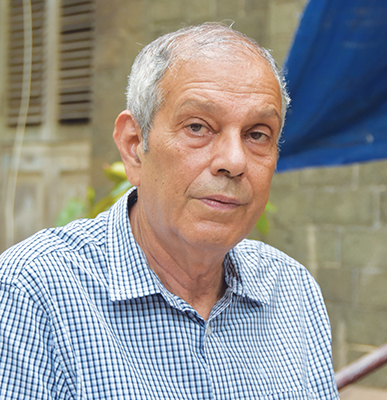
been filed against Ghandy in states which he says he never even visited. So determined was the government to keep him behind bars. Swamy suffered from Parkinson’s disease and when his sipper and straw were misplaced in jail, he had to move the court to get replacements. He was finally admitted to the Holy Family Hospital in Bombay where he was diagnosed with Covid and died within a month. He never received bail.
Swamy’s crime was to try and "guarantee the land rights of Adivasis” in Jharkhand state, noted Gandhy when asked about the priest. "He was really well respected…He had done so much for them.” But he earned "the ire of the state government” when he stopped the exploitation of the tribal lands by those who wanted to mine the state’s rich mineral resources. The government "had it in for him, besides his being Christian,” noted Ghandy. Being a priest probably made it worse for the aging activist.
The National Investigation Agency (NIA) that functions under the auspices of the central government arrested Swamy and 16 other intellectuals, lawyers, academicians and social activists. The NIA initially focused on Islamists, "now it’s everywhere,” observed Ghandy. Like many other policing bodies in India, it is used by the ruling Bharatiya Janata Party (BJP) to quell dissent.
The Congress party, when in power, did likewise, but with less intensity.
Ghandy had been picked up by the Andhra Pradesh Intelligence Bureau on September 17, 2009 and handed over after three days to the Delhi special cell who officially recorded his arrest. As he states in his Fractured Freedom: A prison memoir: "half a dozen toughs” alighted from a Sports Utility Vehicle and "pounced on me…This marked the beginning of a 10-year-long journey, as an undertrial, through seven jails in five states across the country.” He was 62 at the time and had "serious prostate/urinary problems, as well as orthopedic and hypertension issues.” He was finally granted bail on October 16, 2019. Bail had also been granted on December 2017 but he was rearrested after three days by the Jharkhand police while attending a court hearing in Hyderabad.
He says he was "not a member” of the Maoist party. He was associated with "a number of youth and trade unions and anti-caste movements in Maharashtra throughout the period.” As for violence, he states, "No humane person would tolerate violence of any type.”
In her book, The Tatas, Freddie Mercury & Other Bawas: An Intimate History of the Parsis received by Parsiana on the day Ghandy visited, author and journalist Coomi Kapoor likened Ghandy to freedom fighter Bhikaiji Cama who first unfurled the Indian flag abroad: "If Bhikaiji was the best-known Parsi revolutionary of the 20th century, Kobad Ghandy is probably her closest 21st century counterpart… As if to underline the connection, Kobad was arrested in the Bhikaiji Cama complex in Delhi, named after Bhikaiji whom the British had, of course, branded as a notorious seditionist… There are similarities between Bhikaiji and Kobad, even if one supported a far-right Hindutva icon in Vinayak Damodar Savarkar and the other was a far-left ideologue. Kobad himself acknowledged their connection. ‘Patriotism was the guiding force for both of us,’ he acknowledged to me, ‘and we have much in common. Only the times and conditions were different. Marxism was, and is, only a tool.’ As with Bhikaiji, Kobad came from a wealthy Parsi family. But unlike her family, his backed him to the hilt.”
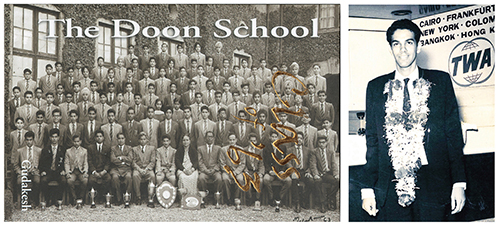
L: Ghandy (2nd row from front, 4th from l) at The Doon School; r: flying out to London for further studies
Kobad and Anuradha Ghandy
Four days after Ghandy’s visit to Parsiana, poet Keki Daruwalla, a former law enforcement officer who served in the central cabinet secretariat, sent his poem, Swamy and Friends (see pg 98) wherein he refers to Swamy and Ghandy as "modern saints.” Noted lawyer Fali Nariman appeared for Ghandy before the Supreme Court but met with resistance from a judge known to side with the executive. Maja Daruwala, the executive director of the Commonwealth Human Rights Initiative, assisted Ghandy in availing of his rights in jail as an undertrial.
Born to Nergis and Adi Ghandy, Kobad was the second of three siblings (Farrokh being elder and Mahroukh, younger). The family lived in Worli as tenants of Dr Pestonji Warden, a medical practitioner, sandalwood retailer (Warden’s Sandalwood) and Parsiana founder. Kobad had no interaction with him but "remembered he wore a Parsi topi (cap) and was plump.” The children had their navjotes done and would on occasion visit the Vachaghandhy fire temple on Hughes Road. Kobad, however, stopped wearing the
sudreh and kusti at some time in the 1960s. His parents were prize winning golfers, playing at the Willingdon Club of which they were members. Kobad never took up the sport. His grand aunt Shirinbai Katrak was the major donor to Delhi’s Kaikhushru Pallonji Katrak Dar-e-Meher. Her sprawling flat at Babulnath was willed to Kobad who used the proceeds to fund his social causes.
After passing out from the prestigious Doon School in Dehradun, Kobad "drifted into science,” obtaining a bachelor of science degree in chemistry from St Xavier’s College, Bombay in 1968. Adi who was the finance director of the pharmaceutical giant GlaxoSmithKline in India arranged for his son to do his chartered accountancy (CA) articles with Jackson and Pixley, the auditors of Glaxo in the UK. He passed his intermediate exam; the firm was "impressed by my work.”
While a resident at the Young Men’s Christian Association in London he became aware of "discrimination against” people of color, "though not me personally.” This bias, "opened my mind.” The Marxist movement, based on the writings of the 19th century German philosopher and economist, Karl Marx was "very vibrant” at the time. There was a lot of "ferment in the later 1960s,” noted Kobad, with the protests against the Vietnam War, the movements for civil rights, black power and women’s rights... The activist said he began to understand the underlying scientific basis for discrimination and other social ills through the study of Marxism. Around this time Kobad became an atheist.
He took part in a street corner meeting in 1971 "in a working class locality giving speeches against racism and the capitalist system,” he stated in his book. He was arrested and sentenced to three months in jail. While awaiting trial he decided that "CA was not my vocation and that I needed to get back to India to work for the oppressed of our country.”
Having donated much of his wealth to the causes he and his wife Anuradha (née Shanbag) undertook, Kobad now wants to devote his time to writing books and making analyses "based on my half century of grass roots activism” and also to be self-reliant. While his wife who held an MPhil in sociology was alive she worked as a lecturer in various colleges, providing the couple — who decided not to have children — a source of income. His book is dedicated to her.
He remains a firm believer in Marxism and views the capitalist system as exploitative. As to what can best replace it without infringing on human rights, he answers, "a form of socialism is the only model that can give people justice.”
Parsiana had sent Ghandy a list of questions to better prepare him for the interview. He thoughtfully presented us a printout with his answers which follow. The answers have been edited for purposes of style and brevity.
Parsiana: What advice would you give to someone going to prison?
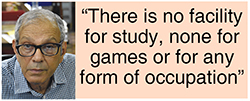
Ghandy: Do not expect quick justice as the courts are heavily biased in favor of the police, the government and the moneyed. This seems to be particularly so in some states, though perhaps not everywhere. That is why I had to spend over a decade in jails despite being acquitted in case after case, even though I had good judges and top lawyers (the latter worked mostly pro bono). Be mentally prepared for this. If you are a social activist worse is in store, as can be seen in the case of Fr Stan Swamy.
To survive it is important to keep physically fit and mentally occupied. The Indian jail system has no mechanism to utilize prisoners’ time fruitfully and reform them. In Tihar, mental depression affects nearly 70% of inmates: they were desperate for sleeping medication, joints (cigarettes containing drugs, at huge cost as they are smuggled in) or just tobacco which too is illegal and extremely expensive. There is no facility for study, none for games or for any form of occupation. While those convicted have to work in the factories for a pittance, the bulk of prisoners are undertrials and not allowed to work.
I tried to keep physically fit by doing yoga and other exercises every morning and remaining mentally active by studying and writing on contemporary affairs during the day. In Hyderabad jail we would play chess not because the authorities provided it but because there were other chess players in the ward. In spite of this jail life took a heavy toll on my memory.
Parsiana: What are the differences between the jail in England you were locked in and the ones in India?
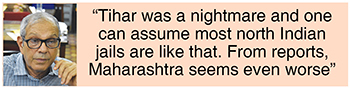
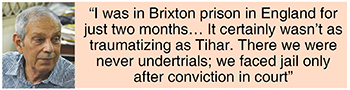
Ghandy: Indian jails are very different. For example, Tihar was a nightmare and one can assume most north Indian jails are like that. From reports, Maharashtra seems even worse. But then Hyderabad and Vizag were more like hostels than jails. Conditions and food were exceedingly good, facilities existed for meeting people, making telephone calls, etc. They were far more accommodating. Other jails in India where I was sent were somewhere in between. I was in Brixton prison in England for just two months serving a three-month sentence. It was so long back (1972) and I cannot remember much. But it certainly wasn’t as traumatizing as Tihar. There we were never undertrials; we faced jail only after conviction in court. The tension of court cases was never there.
Parsiana: Any tips on how to survive in jail with and without money?
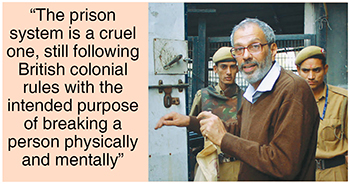
Ghandy: As mentioned earlier, physical and mental activity. By no means fall sick as there is no worthwhile facility in Indian jails for proper treatment as has been brought out in my book Fractured Freedom and as the case of Fr Stan Swamy indicates. The prison system is a cruel one, still following British colonial rules with the intended purpose of breaking a person physically and mentally. Legal procedures and the Indian Penal Code still remain the colonial ones, designed for a subject people. To this has been added draconian laws like UAFA in 1967. Subsequently there was MISA (Maintenance of Internal Security Act) and POTA (Prevention of Terrorism Act). Lengthy legal procedures and heavy expenses also add to the tensions within the jail.
Parsiana: You mentioned in the Federation of Zoroastrian Associations of North America Zoom interview with journalist Porus Cooper on April 10, 2021 that the Indian government was consulting you on the Maoist movement?
Ghandy: I have told the government that in Bastar, Chhattisgarh, the Naxals seem to be doing positive developmental work and the authorities need to initiate peace talks with them. If it is at all possible, and both sides are willing, I am ready to help to the extent I can. After all, the newly elected Assam chief minister immediately declared readiness to hold peace talks with the ULFA (United Liberation Front of Assam). The Center showed willingness as well. If they can do so with those demanding a separate nation why not hold discussions with the Bastar radicals who are merely seeking a different model of development? Earlier as an observer and later cut off from any movement for over a decade, I am unlikely to know anything more than what the government already knows. And after my release I have been devoting my time to Fractured Freedom, which is now being translated into seven or so Indian languages.
Parsiana: The future for the Maoist movement?
Ghandy: In Fractured Freedom I have brought out how the present world capitalist system is in severe crisis and how unjust it is. In fact, it has never been able to fully recover from the global 2008 subprime financial crisis. It is virtually a decade of stagnation and lost opportunities, and in the quarter just before the pandemic (January-March 2020) the major economies of the world had already gone into a recession, the likes of which we have not seen since the 1930s and far worse than the Great Recession that followed the 2008 crash. To survive this crisis the western powers and their financial wizards have resorted to many maneuvers to extract the wealth of countries in Asia (including India), Africa and Latin America, with mostly compliant governments in these countries. The present capitalists are destroying people’s lives and the environment.
The only solution is to go for a socialist alternative. But, as I say in my book, while this is the only alternative to a just and humane society, I also say this is nowhere on the horizon — whether Maoist or any brand of communism.
Parsiana: How has your book fared?
Ghandy: The first 3,000 copies sold out in just a month after the release, and the publishers plan a paperback edition towards the end of the year. Also, the book was reviewed in over 20 odd newspapers and online portals. It was a staggering success and the bulk of those who seem to appreciate it are not leftist but justice-loving people. It is very popular amongst Parsis and also amongst my Doon School crowd and their associates. This heartens me. There is hope for society. This is a silver lining amongst the present dark clouds. The publishers, Roli, put in a lot of effort to promote it, but even so I did not expect the type of response it has received. In fact, it has been on Amazon’s bestseller list for months and had it not been for the second Covid wave the reprint of 2,000 hardback copies would probably have sold out by now. Thus far Amazon has been marketing my book only in India. They will start international marketing around September this year and the book will be available at around $ 10 (Rs 747).
Parsiana: Which country’s economic system would you like India to emulate?
Ghandy: India has its own specificities and we cannot copy other societies. We have seen this to be the case of all socialist revolutions in the world. None was a copy of the other. In Latin America today, there is a surge to the Left and we also have the Cuba model. China too needs to be studied. Though we may learn from others’ experience, in the final analysis, we must have our own model based on our own realities, history and culture.
Parsiana: Your thoughts on the Communist Party of China’s (CPC) centenary?
Ghandy: No doubt the CPC has much to celebrate on its centenary. From being one of the poorest countries of the world before the revolution in 1949, China today is the second largest economy in the world. In purchasing power parity, they have even surpassed the USA. China’s condition was probably worse than India’s as they had to face over a decade of war and Japanese occupation.
They have lifted 800 million people out of absolute poverty over the past 40 years, a feat unheard of in the history of mankind. Today most of their infrastructure is world class and matching any western country. If we compare China with India, which also acquired independence about the same time, in fact two years earlier, the contrast couldn’t be sharper. While the per capita annual income of China in 2020 was $ 10,000, in India it was around $ 1,700 and would have fallen further due to the pandemic. China’s GDP (gross domestic product) in 2020 was $ 14.7 trillion to India’s $ 2.5 trillion.
There is no doubt the economic gains have been stupendous but I am not sure about the quality of life. China has the largest number of billionaires in the world and inequality is increasing even more than in the West. Freedoms are limited and every individual is monitored. I am not sure how communist the CPC is on its centenary; that requires more study. What needs study is why the economy had to change course after the death of (Chairman) Mao (Zedong) and what were the factors retarding growth earlier. There is no doubt, however, the subsequent growth was on the strong foundation laid during the Maoist era.
Unlike the elite Indians who tend to grovel before the West, the Chinese are a proud nation and have always stood against their enslavement.
Parsiana: Your future activities? Your personal finances?
Ghandy: Well, I am 74 now. I have a vast depth of experience. I would like to collect that in a number of books with which I hope to inspire future generations so they need not repeat the same mistakes we made. At present I am researching the state of the world economy to predict what we should expect in the future as only if we know what is coming will we be able to properly prepare how to counter it. After that I hope to develop the themes in Fractured Freedom.
I am glad you asked regarding finances. I have none as I have contributed the bulk of my wealth/property to the poor. Though my sister and brother-in-law (Mahrouk and Feroze Vevaina) have very kindly taken me under their wing, I need to be self-sufficient. At this age, for example, it can be very tiring travelling in a bus in Bombay in or second class train compartments for court cases in other states. I need to earn, but I also need to fulfill my life’s mission through my forthcoming books. Both cannot go together; there is hardly any monetary return from writing a book. So I have prepared an appeal for grants to cover my minimum expenses (which are not much) so that I can focus on my study and writing and not waste time on earning. This will be a great help.
Parsiana: Views on the Parsi community?
Ghandy: I don’t think the Parsi community is homogenous, but basically there is a liberal upbringing. This results in what I have found to be a very positive approach towards myself and my activities, though people may not necessarily agree with my political views. I was taken aback at the level of sympathy from Parsis, both old and young. I would have expected the old to be more traditional and so at best consider me a good Samaritan gone astray. The young I thought would be more westernized and absorbed in consumerism. As the South African author, Laurens Van der Post said, "There is nothing wrong in searching for happiness. But of more comfort to the soul is... meaning. Because meaning transfigures all.” I see elderly Parsis being very positive about my work. I also see youngsters like my nieces and others who are also very progressive in their thinking. Except for the reactionary few who one reads about in Parsiana (on the issue of interfaith marriage, entry to an agiary, etc), I think the bulk of the Parsis are liberal and would appreciate good work being done among the poor. A large number of Parsis give to charity, even if only to poor Parsis.
Parsiana: Reflections on your Parsi upbringing?
Ghandy: There are two aspects on my Parsi upbringing. My father, Adi, a CA, who became the finance director at Glaxo, I recollect as being scrupulously honest. This would have no doubt influenced us. Then both my parents were like other Parsis, liberals and not at all orthodox. We had our navjotes done and went to the agiary when young, but only once a year on our birthdays. In those early days I would wear the sudreh and kusti, but cannot recollect when I gave it up. I remember mechanically saying the prayers after a bath while tying the kusti. When I was to marry Anuradha, my parents welcomed her with open arms; they were also close to her parents. This liberal upbringing and atmosphere of honesty no doubt facilitated my future course when my eyes opened out to the world in the UK. My father was such an open-minded person that he was not only convinced by my arguments against the capitalist system when I was in London, but after my return he read communist literature and became a strong supporter. One drawback (if we can call it that) of our upbringing was the super cleanliness maintained at home since childhood. So when I became active and worked and ate in the bastis (shanty towns) my stomach could not tolerate the food and I would have terrible bouts of amoebic dysentery. But that was small collateral damage for a big cause.
Parsiana: Your advice to the young who want to serve a purpose?
Ghandy: First, I feel the new generation must be aware of what is going on and the machinations behind the scenes. They should not be taken in by media propaganda but should seek the truth.
Second, there is need for empathy for the oppressed and the weak.
Third, we need to brace ourselves for a terrifying future where a Fr Stan Swamy could be merely a beginning. We may have to face insurmountable hurdles in the days to come — not only economically, but also socially and medically. Stand upright and start by at least building a circle of like-minded people who understand the reality and act as a unifying force in the face of calamity and disaster by helping each other. While commune living may not be a possibility, given the extreme individualism we have been brought up in, some via media is essential as a survival kit for the future.
Fourth, everyone’s contribution to building the new humane social order is important — it may be small or large, depending on individual capacity, but it is only such drops that go to fill an ocean of change.
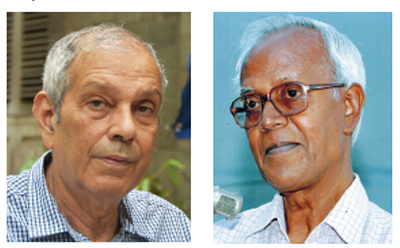
Kobad Ghandy (l); Father Stan Swamy Photo: Wikipedia
Swamy and friends
Keki Daruwalla
Beyond the Gangetic plain and the Jumna,
they had their world, women dancing in the night
tapping their earth-and-sky-world into rhythm;
their days ruled by taboo and totem
long before Freud had heard of them;
cults flowered, and shamans held the long stick.
Civilization advanced with Surf and powdered milk;
amulets and talismans were plucked
from their hair, a rout of the adivasi,
and they were told that the cosmos was ruled
by a trinity: Brahma, Vishnu and Shiva;
others came, white-skinned, and their trinity had
a Holy Ghost jungle-folk didn’t know what to do with.
(the state knew what to do: it shot their King, Pravir Chandra Bhanj Deo).
Socialists jumped in and told them of their rights
to land and livelihood — trouble was they
didn’t know what rights were. Then guns came in,
and modern saints — Kobad Ghandy, Stan Swamy.
Kobad was kept in jail for 10 years in the
days of Sonia G and Somnolent Singh.
The anti-secessionist state was born
as Modiji came into power, strong state.
If you had no mai-baap, you were left to fate;
no bail, more jail. If accused, you fried.
Only votaries of human rights cried.
Young women of Pinjra Tod spent 13 months in Tihar.
Stan Swamy died.
Nothing will happen; those who wrote lies
in charge sheets, those who denied him bail,
those who were heartless in jail
and didn’t let him have a straw to drink
they just let him sink.
On his death bed, let it be noted
they’ll all be promoted.
Keki Daruwalla is a poet, short story writer and former Indian Police Service officer.