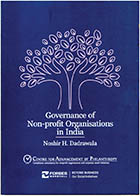
Governance of Non-profit Organisations in India by Noshir H. Dadrawala. Published in 2024 by Centre For Advancement of Philanthropy, Mulla House, 4th floor, 51, M. G. Rd, Flora Fountain, Bombay 400001. Pp: 175, Price: For free distribution.
The book starts with an explanation of the twin concepts of charity and philanthropy. Charity is akin to almsgiving and addresses the symptoms, whilst philanthropy strikes at the root of various issues facing society. Philanthropy helps people and society over an extended period of time, instead of one moment in time. Philanthropy is not about giving of one’s wealth alone. It includes giving of one’s time, experience, expertise and labor.
Noshir Dadrawala:
simplified laws
In his book Noshir Dadrawala has defined the various types of non-profit organizations (NPOs) such as a public charitable trust, charitable society, company licenced as a non-profit, co-operative societies and trade unions. He further goes on to elucidate the tenets of good governance, why it is necessary, as well as the attributes required to ensure it. The criteria one should consider before becoming a trustee is to study the trust deed, be familiar with the trust’s objectives and to ensure that there are no real or perceived conflicts of interest.
One of the key aspects covered are the various compliances, the terms and modes of investment, keeping updated with changing tax laws and specific laws for public charitable trusts. For NPOs receiving funds from outside India, the chapter on Foreign Contribution Regulation Act (FCRA) highlights the various modalities of receiving funds from overseas and the manner in which these funds are to be utilized. It is crucial that the book be constantly updated (at least annually) for any changes in laws and regulations that could impact the setting up and funding of these NPOs from overseas.
This book places a lot of emphasis on the need for good governance and being transparent which will not only assist in fund raising but improve public perception and attract suitable trustees and board members whose concern would be a risk to their reputation. Some of these concerns emanate from non-compliance with complex regulatory requirements with various laws and acts, most of which are adequately covered in this book.
While the book is an extremely helpful resource for people setting up NPOs in India, the section on setting up NPOs overseas is sketchy.
The book highlights how the income earned by way of interest can be utilized for fulfilling the objects/purpose of the NPO. A minimum of 85% should be utilized for their objectives and the remainder of 15% can be set aside to build an unrestricted reserve fund.
Dadrawala is the chief executive officer of the Centre for Advancement of Philanthropy and has been working in this field for over 40 years. His expertise in this sector is widely recognized and he offers advisory to NPOs on a wide range of issues, especially on compliance related matters with various regulatory authorities. He is a trustee of the Forbes Foundation and serves on the boards of many NPOs. He is a former trustee of the Bombay Parsi Punchayet.
Throughout the book, Dadrawala has amply demonstrated his deep understanding of NPOs.
PORUS DOCTOR
Porus Doctor, a chartered account, was a partner at Deloitte for 20 years of his 40-year career. Earlier, he was Asia Pacific regional leader and part of the Global Leadership for Internal Audit. He has also served on the boards of several companies in India, Singapore and Dubai.