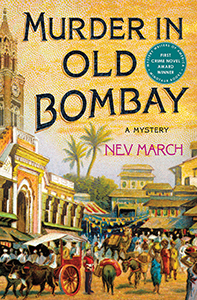
Murder in Old Bombay: A Mystery by Nev March. Published in 2020 by Minotaur Books, an imprint of St Martin’s Publishing Group, 120 Broadway, New York, NY 10271, USA. Pp: 389. Price: Rs 1,608 (hardcover).
"I say Holmes, here’s a rum thing. Nev March (Nawaz Merchant, pictured), who calls herself an Indian American author and has won the Minotaur Books for Mystery Writers of America First Crime Novel Award for her debut novel. And would you believe it!  She credits her hero Captain James Agnihotri, a cross-breed from the Indian subcontinent, if I may be so bold as to describe him, as one of your most ardent followers.”
Sherlock Holmes who had immersed himself behind a smokescreen of the finest tobacco from the colonies, Dindigul, if you must ask, took his clay-pipe out of his mouth and said: "I suppose we must expect another Netflix spin-off from this young woman’s exertions on the trail of my former methods. You may continue, Watson.”
"Nev March has involved him in solving what can only be called a murder of monumental complexity that took place in real life from the Rajabai Clock Tower that rises in isolated splendor from the stone-faced walls of the University of Bombay,” Watson continued.
He was relieved that Holmes had shown some interest in the subject. As time-travelers who were expected to roam into whichever age or situation that their presence was required Watson, like Holmes, had no qualms in reaching out from their celebrated if somewhat old-fashioned Victorian quarters at 221B, Baker Street in London. Sir Arthur Conan Doyle, their creator, had died in 1930. Holmes however lives. His abilities for deduction and deception, not to mention his unique lifestyle, have ensured him an almost permanent place in the annals of crime.
"I believe it is based on a true story involving two young women from the most elite of communities in 19th century Bombay, known as the Parsis. It’s spelt Parsees in the book. I do wish you’d take a look Holmes, it’s right up your alley, along with The Sign of Four, your 1888 potboiler,” said Watson, getting into stride. "Just like that account, the background of Ms March’s story takes place with events stemming from what our chaps call the Indian Mutiny, but what Agnihotri and his lot would define as the First Indian War of Independence. Agnihotri had been discharged from the Army as a result of a previous engagement in the environs of Karachi that had left him with what we would now call post traumatic stress disorder, or PTSD.”
"Do get on with it Watson. I do recognize that having been on the battlefield on the North Western frontier and been struck down by a jezail bullet at the Battle of Maiwand during the Second Afghan War, you tend to get inexplicably steamed up when it comes to India. Where’s the mystery?”
 "The two young women, Bacha and Pilloo as they are named here, were the unfortunate victims of a crime that has never been adequately explained. They were both virgins. Bacha was married to a young lawyer named Adi Framji. Pilloo, his adopted sister, was soon to be married,” Watson resumed.
"Is that germane to the mystery Watson?” queried Holmes rather testily. "Aren’t you reflecting what one might call a tabloid mentality?”
"I mentioned it merely since you have observed that deduction lies in the details. We shall let it pass for the moment. Suffice to say that when Captain Agnihotri who is working as a journalist with a Bombay newspaper called The Chronicle of India gets a letter from Adi Framji to investigate the tragic events that have been dismissed by the local court due to lack of proper evidence, he finds himself drawn into battle again. He clutches at pages of The Sign of Four as if it were his personal bible.”
"I have to warn you that being a veteran of the British armed forces in late 19th century India, Agnihotri has an unfortunate tendency to cry ‘Bollocks!’ when under extreme stress. That I believe is a term that has not yet been used by any of your film and small screen avatars. His methods may reflect more of Sylvester Stallone in his role of the champion boxer who is keen to get into a boxing ring when the occasion demands, than Sherlock Holmes, the gentleman detective who prefers a quiet evening with his violin.”
"Bollocks! A rather colorful usage, if not exactly a part of my vocabulary,” mused Holmes. "Not having served with the 5th Northumberland Fusiliers under the British forces in India as you have Watson, I have had no need for such a term. But now that you mention it, I notice that even Jim Agnihots-whats-his name stops using it as he goes along his journey from Bombay to the Punjab and thence to Simla, that delightful by all accounts summer capital of the Raj, before haring off in search of some beleaguered members of the British Army holed up in Pathankot.”
"Pshaw!” replied Watson. "I have to hand it to Nev March. She certainly has a head for details. That’s another old-fashioned exclamation that she has unearthed. She puts it into the mouth of the patriarch of the Framjis, the marvelously portrayed Burjor. I tell you, Holmes, one of the great joys of the account is how splendidly the lives of those grand old Parsis were conducted in the latter part of the 19th century. The manors, the gardens on Malabar Hill bordered by trees, dripping with sweet scented blossoms that are compared to the equally delicate saris worn by the Framji women, the old-fashioned insistence on dressing up for dinner, are all so wonderfully brought to life. Even Barbra Cartland would be impressed and she’s been dead for quite a while now.”
"Enough, Watson, or I shall have to Pshaw you myself,” remarked Holmes with a weary look.
"As I have put it down in writing in Scandal in Bohemia, detection ought to be an exact science and should be treated in the same cold and unemotional manner. You have attempted to tinge it with romanticism.”
"That’s all very well for you to declaim Holmes. I would submit that Ms March is most clinical when it comes to history, particularly in her passion for setting forth the appalling horror of lost lives and crossed loyalties post the so-called Indian Rebellion, and romantic. Why you only have to read the Epigraph that she has appended to her novel. At the same time, she does get highly emotional when it comes to dealing with her heroine whom she has named Diana.”
"I shall leave you to deal with Diana the huntress, Watson. Dealing with the female species has always been a source of interest to your type of individual has it not?” remarked Holmes. He was perhaps referring to Mary Morstan, who had first appeared in the very same The Sign of Four mentioned earlier to become a more permanent feature in Watson’s life, as readers might remember.
"Certainly, Diana, the Framji daughter, educated in Britain and newly returned after the untimely demise of the two young women in the Framji family is a feminist icon for all reasons. She rubbed shoulders with Cornelia Sorabjee in her London days, as well as some others of a less reputable connection who turn up at the appropriate moment in the narrative. This proves to be extremely convenient as far as Agnihotri is concerned. She’s also a fan of yours Holmes. I would not be flattering myself if I were to suggest that she takes it upon herself to become a part-time Watson to Agnihotri’s Holmes.”
"At other times, she’s the reason that Agnihotri tramples by horse, train, foot and carriage across such a wide terrain that a map would have been helpful to track his movements. If not visiting the Christian Father of an orphanage in Poona, where as a cross-breed orphan he was abandoned by a destitute mother, he’s depicted as travelling to Lahore, Pathankot, Simla and a dangerously seditious princely state ruled over by a decrepit Rani and her ferociously ambitious nephew named Prince Nur Suleiman, whom I have already identified as an Asian Stallone prototype.”
"I thought you were going to describe Lady Diana Framji in a more fetching manner, Watson! I must say I am disappointed,” murmured Holmes.
"I did want to spare you one of my theories, Holmes. I do believe that March has managed to confuse her with the real-life Diana, whose face launched a million tabloid tributes after her tragic demise. The clothes that Diana Framji wears, barring of course the occasional sari, the jewels with which she adorns herself, but best of all the moment she sweeps across the floor in the arms of Agnihotri, the man she has been forbidden to marry because she is a high born Parsi, and he is after all, well you know the rest, is a pure recap of a familiar scene. It’s Diana, Princess of Wales taking the floor with John Travolta!”
"I do not want to be unduly critical of Ms March’s credentials as a mystery writer, Watson, but would you agree that she’s more of a writer of what used to be termed as Orientalist fantasy? Your Agnihotri could be the equivalent of Rodney Savage in John Masters’s novels The Night Runners of Bengal or the even more popular Bhowani Junction who set pulses of the wives of tea planters and retired majors racing as they contemplated the remains of the Raj in their clubs.”
"Bollocks Sherlock! You may be dead right as usual. Then again, Ms March has managed it with such verve and skill, we might well congratulate her as deserving of her prize!”
"Hear! Hear!” replied Holmes, retreating into his armchair.
GEETA DOCTOR
Geeta Doctor, a longtime contributor to Parsiana, is a writer and critic.
Epigraph
Grenadier’s Lament
Two hundred mutineers we called to assembly,
My brothers came, and lined up proper.
They had rifles but no cartridges from ordnance that day.
The command was given. We turned and fired.
Like soft wax, they dropped, still in their ranks,
The rest we tied to cannon, and tore to shreds.
[Based on a Gujarati poem by Bejan Ferdon Jhansiwala (1858, Jhansi, India)]