The pun in the headline refers to the location of the holy Iranshah Atash Behram in Udvada while pointing out the problems associated with its vicinity to the sea. Once again the increasing salinity in the wells around the Iranshah premises is in the news. The well in the compound of the Damanwala Dispensary had to be emptied of brackish water in early June to accommodate the fresh monsoon water. I remember even in the 1940s with the approach of summer the water in the wells in the compounds of buildings and bungalows facing the sea used to turn salty and one had to use water from the wells located some distance away.
The backyard of the Iranshah premises is particularly prone to the ingress of brackish water. The low-lying land that extends from the now defunct gymkhana towards the town gets flooded by sea water brought in by the Pariali creek which rises above the watermark during storms and also by the monsoon overflow. To block the entry of the creek into the low-lying land, a very high cost dam is required with a two-way sluice gate system to prevent the inflow of salt water while at the same time allowing the exit of the monsoon overflow which would otherwise flood the area.
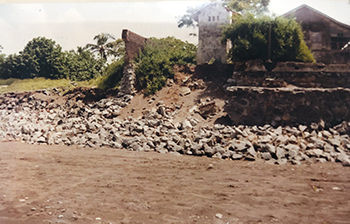
Damage done to property in Udvada due to sea erosion
A simpler, more effective and much less expensive alternative would be to plant the low-lying area with a "back-mangrove” species, Salvadora persica (pilou in Gujarati) that can withstand both saline and fresh water. Remnants of this species have been observed at a periphery of the low-lying land. It would be worth trying to plant this species of mangrove as a remedy for the salinity problem before it goes out of control. The small sized tree is also of economic value as it is a source of the dentifrice, meswak (used as a powder, paste or liquid for cleaning teeth and as a natural polish for teeth).
A problem related to the ingress of salinity is sea erosion that poses a threat to properties along the seafront. During monsoon storms, the atmospheric pressure (that keeps the height of the tidal waters in control) falls and the sea water level rises, resulting in giant waves. Increased wind speed during storms adds to the fury of the waves. If the storms take place on no moon or full moon days, the damage is greater as the length of the tide is greatest on these days.
To counter the erosion, the late politician Homi Taleyarkhan launched the Save Udwada Project and worked out a program for the construction of seawalls by the Government of Gujarat and the Central Water and Power Research Station, Poona. These sea walls need periodic repairs after heavy storms, an aspect that has been neglected for the past several years since Taleyarkhan’s demise. As a result the sea walls are in a poor shape and in need of repairs.
Dr V. M. MEHER-HOMJI