The rejection by the Gujarat High Court of the Surat Parsi Panchayat (SPP) appeal to permit dakhmenashini for Covid afflicted Parsi corpses may serve as a dampener to a similar petition being prepared by the Bombay Parsi Punchayet (BPP). On July 14, 2021the BPP trustees had agreed to move the Bombay High Court to consign bodies of Covid-19 victims to the dakhmas. In light of the Surat judgment BPP trustee Noshir Dadrawala cautioned his co-trustees: "The BPP can choose to read the writing on the wall (of the Indian judiciary) or read the writings of our very learned and wise High Priest (Dr Jamasp JamaspAsa) and the devout orthodox. I had been saying all along that if we go to the courts let’s go with strong and convincing arguments. Are we still anxious to commit harakiri in Bombay?”
On July 23, the Gujarat High Court ruled that safety is supreme and the ordeal of coronavirus has "substantially subsided.” Citing the delay in the filing of the petition, the bench of Justices Bela Trivedi and Bhargav Karia stated that the "Covid-19 guidelines on dead body management (were) issued by the Ministry of Health and Family Welfare on March 15, 2020… The present petition (is filed) in May 2021 when the severity or the ordeal of Covid-19 had substantially subsided.” Till late April 2021, 26 Parsis had died in Surat due to the virus, with 22 in neighboring Navsari and seven in Ahmedabad (see "Death by Covid,” Events and Personalities, Parsiana, May 7-20, 2021). SPP contended that the central government guidelines made no reference to dakhmenashini.
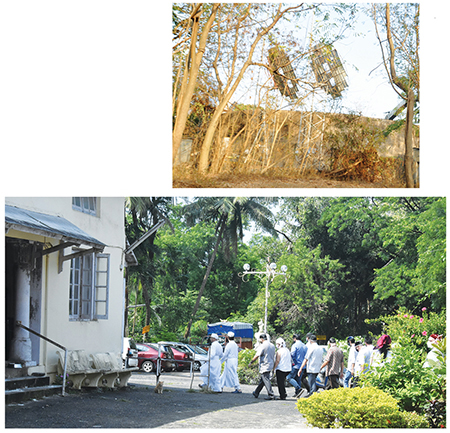
Mourners at Doongerwadi; above: dakhma with solar concentrators
(File pictures)
"It is well settled proposition of law that the High Court does not undertake to decide an issue unless it is a living issue. If an issue has become purely academic, the Court would not engage itself in deciding it,” stated the Justices.
The Justices found "no substance in the merits of the petition” adding that the union government’s guidelines on management of dead bodies of the Covid afflicted were designed to "to prevent the further spread (of) Covid-related infection… Such guidelines, issued in the larger public interest considering extraordinary circumstances prevailing in the country, would take precedence over the individual interest as also over the religious faith and belief of a particular class (or) community.” The Court observed that "the safety and the welfare of the State is the supreme law… Even the fundamental rights to profess, practice or propagate religion, and the right to manage religious affairs, as enshrined under … the Constitution of India, are subject to public order, morality and health.”
The Justices stated that the union government’s guidelines, considering the prevailing situation of Covid-19, in the larger public interest for the disposal of dead bodies by cremation or burial, could not be said to be violative of any fundamental rights of the Parsis, more particularly when alternative means of disposal of dead bodies "is also in vogue in all parts of the country and when it is not anathematic and sacrilegious to the religious practices being followed by the Parsis.”
The Gujarat High Court judgment relied on the decision of the Supreme Court dated July 16, in disallowing the Kanwar Yatra, quoting, "The health of the citizenry of India and their right to life are paramount. All other sentiments, albeit religious, are subservient to this most basic fundamental right.” The Kanwar Yatra is an annual pilgrimage of devotees of Lord Shiva to places in Uttarakhand and Bihar. While hearing a petition to allow the pilgrimage, a bench of Supreme Court Justices Rohinton Nariman and B. R. Gavai had stated that "We are of the prima facie view that this is a matter that concerns every one of us as citizens of India and goes to the very heart of Article 21 (right to life) which has the pride of place in the Fundamental Rights Chapter of the Indian Constitution (The Hindu, July 16).”