As second in command at the Central Railway, Bakhtiar Dadabhoy’s new post as additional general manager will require him to explore uncharted territories
Parinaz Gandhi
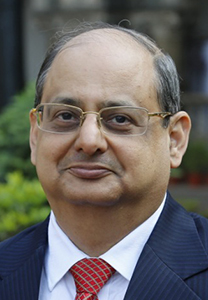
Passenger earnings for Indian Railways that were about Rs 55,000 crore last year are now virtually non-existent… Till July, the passenger earnings for Central Railway was negative due to the refunds given. We earned about Rs 5,700 crore in 2019-20,” revealed Bakhtiar Dadabhoy, the newly appointed additional general mangager, Central Railway, when responding to Parsiana’s queries between August 31 and September 9, 2020. Realizing he would be pressured after taking over his latest post in July, a month later we offered to interview him at his office at the landmark heritage building that is now known as the Chhatrapati Shivaji Maharaj Terminus. Not surprisingly, the reputed author of eight books preferred to give his initial responses in writing, with subsequent clarifications over the phone and in person.
"Frantic attempts are being made to compensate with freight earnings by attracting additional and new traffic, but obviously that will also be very difficult in the current scenario,” he noted. To pull out the Railways from the financial mire, "support will have to come from the government, now that the Railway budget is merged with the government’s,” he mentioned. Although in the grip of an economic recession, no salary cut has been imposed on Railway employees for that requires the sanction of the cabinet and if ordered by the central government would apply to all government employees. "Such a step would mean a virtual declaration of a financial emergency in the country. This luckily has not happened so far, and we hope it never does,” added the optimist.
Still finding his bearings in a scenario where the senior cadres of the Indian Railways are confronting "the ruinous impact of Covid-19” and awaiting orders from the state government for restoration of rail services, Dadabhoy has yet to determine his priorities and modus operandi for his current assignment. "One thing that the pandemic has taught us is that work from home is possible,” even for a gargantuan organization like the Railways. Comfortable with the "e-office and digital files” where one neither needs to be present at the office daily nor handle physical files that could be carriers of coronavirus, the "second in command” at the Central Railway declared, "I certainly plan to take it further to ensure that we reach a day when no physical files will be required.”
Dadabhoy’s present designation at the Central Railway authorizes him to exercise "vast financial powers (sanction financial projects up to Rs 500 crores).” The legal department, public grievances and complaints, and the publicity department function under his direct control, Dadabhoy helped us understand the range and nature of his privileged position.
While the general manager is in overall charge of a railway zone (there are 17 zones like Central Railway, Western Railway…), "the additional general manager acts as a facilitator, mediator and coordinator between various departments — operating, commercial, mechanical, civil engineering, medical, accounts, personnel, signal and telecom, and security.” Also reporting to the additional general manager are the divisional railway managers of Central Railway’s five divisions — Mumbai, Pune, Solapur, Bhusaval and Nagpur.
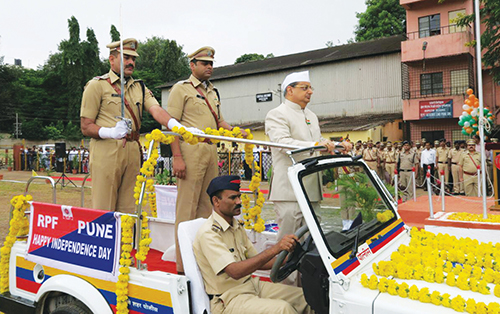
Bakhtiar Dadabhoy (top and above): inspecting the Railway Protection Force
contingent on Independence Day when he was divisional railway manager in Poona
Amongst a workforce of 1.2 million in the Indian Railways, Dadabhoy is reportedly the only Class I (or Group A) Parsi civil servant. He may well be the only Class I Parsi civil servant in the country today. Recruited through the prestigious Civil Services Examination conducted by the Union Public Service Commission, Class I civil servants get to directly join as junior officers. Of the nearly 10 lakh applicants who appear for the examination each year, around 0.1% manage to pass. "The Civil Services Examination remains the most difficult exam in the country and competition is now perhaps much more intense than it was when we joined,” conceded Dadabhoy who cleared the examination in the first attempt. To pass the Examination candidates have to appear for the preliminary and main examination followed by the interview. If unable to clear any of these three, candidates have to start from the preliminary exam stage all over again when many are known to fail.
"It is not easy to get a government job even at the lower levels. It is extremely competitive since many want the security, status and perks which go with government employment… It is a myth that the brightest opt for the private sector; there are a large number of IIT (Indian Institute of Technology) and IIM (Indian Institute of Management) graduates who sit for the exam every year… Now with the economic slowdown, government jobs are becoming even more attractive, not that they had ever lost their sheen,” he clarified.
Although he had the option of Indian Revenue Service and other central services based on his rank, Bakhtiar chose the Indian Railway Traffic Service, preferring to join the Railways where his paternal grandfather Dadabhoy and great-grandfather Meherwanji had served, rather than the police service where his late father Keki had risen to the rank of director general of police in Gujarat. Having started his career as assistant commercial manager in Churchgate in 1990, during his three decades with the Railways, Bakhtiar has been posted in Bombay, Secunderabad and Poona.
When Parsiana had last interviewed him (see "Drawn to dates,” November 2003) he had already completed his stint as senior divisional commercial manager and was serving as deputy chief vigilance officer of Western Railway. After that he moved to South Central Railway as chief commercial manager (passenger services and passenger marketing). On three occasions he was sponsored by the Railways to receive overseas training at INSEAD in Singapore, at the ICLIF (Leadership and Governance Centre) in Malaysia, and the Bocconi School of Management in Italy.
When the chairman of the Railway board chose Dadabhoy, "the poor, honest Parsi” to take on the cumbersome mantle of the Railway Recruitment Board as the erstwhile head had allegedly been trapped by the Central Bureau of Investigation for leaking question papers, Bakhtiar remembers "the setup was in shambles with staff morale understandably low and there was an atmosphere of fear and mistrust all around. There was a huge backlog with no recruitment for a long time.” Over time, he was able to restore normalcy and he feels gratified that the staff there "still remember me fondly” and refer to his tenure between 2011-2015 as "the golden period.” According to Bakhtiar, "I am something of a rarity in government service and the fair reputation of the Parsis has certainly helped. They are believed to be an honest, industrious and peaceful people, a reputation which I have tried to live up to.”
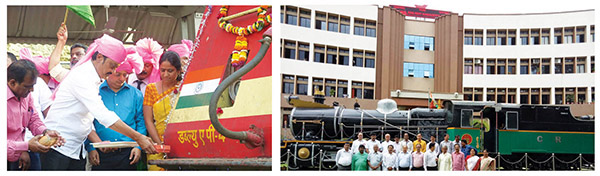
Above (l): Dadabhoy (2nd from r) with Member of Parliament Anil Shirole (2nd from l) at the inauguration of the first passenger
service with electric traction on the Poona-Daund section; (r): Divisional Railway Manager’s office in Poona embellished with an
old steam engine during Dadabhoy’s tenure
Clockwise from above (l): Dadabhoy with his tomes; Vasant Raiji, Dadabhoy presenting A Book of
Cricket Days to former British Prime Minister John Major; Dadabhoy with Zubin Mehta;
at the launch of Barons of Banking: Savak Tarapore, Dr Y. V. Reddy, Minoo Shroff, Yezdi Malegam and Dadabhoy
His stint as divisional railway manager in Poona he considered "the most challenging post.” As he further explained, it is the divisional regional manager who has "to meet targets… He actually runs the trains.” Besides having to interact with the minister of railways and assuage members of parliament, many conveniences were introduced for commuters. "From being the dirtiest ‘A’ class station in Indian Railways, the Pune station went to the top 10 cleanest stations,” he mentioned. To facilitate passenger movement, a ramp was introduced and the circulating area redesigned with new signage. On that posting, his "biggest contribution was planning and proposing a major yard remodeling” for Rs 37 crore as also a passenger terminus in Hadapsar to ease the bottleneck at the Poona railway station. Both these are works in progress.
The art aficionado took pride in reporting how he embellished the railway station and office building of the divisional railway manager in Poona with paintings and sculptures. The tennis enthusiast also facilitated a makeover for the Railway residential colony and club.
Bakhtiar’s next posting is expected to take him to the Railway Board in New Delhi as an additional member. The Railway Board that functions under a chairman has members from each of the important departments who are all ex officio secretaries to the Government of India. Below them are the additional members who are special secretaries to the Government and of the same grade as the zonal general managers. Under them are the executive directors, directors, deputy directors and a host of other functionaries, Bakhtiar elucidated on the hierarchy. Promotions are based on seniority and performance in a time bound manner — usually between two and four years — with "very few becoming special secretary and secretary level officers.” Currently in the Higher Administrative Grade of the Government of India, corresponding to an additional secretary, his next promotion would take him to the level of special secretary.
Educative exposure
Fifty-six-year-old Bakhtiar who is unmarried, and has three-and-a-half years of tenure with the Railways remaining, planned to spend his retirement years in Secunderabad where he has a parental home and has also invested in properties.
The wordsmith noted, "I started writing quite by accident. I had never seen myself in the role of an author but now after nearly 20 years, it has become a serious avocation. I write on weekends and late nights. One always finds the time for something one likes. Since I write non-fiction which requires an enormous amount of research it’s actually very hard work.”
After two brief compilations, Bakhtiar authored Jeh: A Life of J. R. D. Tata (see "He touched the sky,” Parsiana, March 2005) that continues to sell even after 15 years and has even been translated into Hindi. He describes his four recent works as "tomes” being over 1,50,000 words each, and the most recent one, The Magnificent Diwan on the life of Sir Salar Jung I being 2,40,000 words. The biography of Zubin Mehta, A Musical Journey (see "Booking the maestro,” Parsiana, May 21, 2016 and "Maintaining a chronology,” September 21, 2016), was written over seven years for it "took time to convince the maestro that his life was in safe hands!” Barons of Banking, released in 2015 (see "The banking pioneers,” Parsiana, February 21, 2015), though intended for the general reader, has ended up as recommended reading for candidates of banking examinations. It was recently translated into Marathi to help chartered accountancy students in Poona.
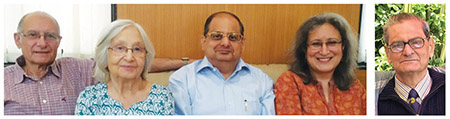
Dadabhoy’s family (from l): Phiroze Kotwal, Rati, Bakhtiar, Tushna Kotwal and Keki
Bakhtiar’s thirst for knowledge was sown in schools in Ahmedabad, Srinagar, Rourkela and New Delhi, depending on his father’s postings when the household that included mother Rati, elder sister Tushna and he were required to frequently shift abodes. "It was a privileged, albeit a peripatetic childhood, one of the disadvantages of being in a transferrable job. But it had its advantages: it resulted in an exposure to all parts of our country and a merging with the national mainstream, something which is sometimes missing in our community which tends to be limitedly metropolitan in its outlook,” he commented.
The unwillingness to move out of Bombay is one of the main reasons for the community’s low representation in government service, he felt. Parsi guards and drivers who once enjoyed a strong presence in the Railways "are now virtually non-existent,” he reported. Even at the clerical or inspectorial level, very few Parsis remain.
In the last century, several Parsis made a mark in the Railways. Among those who served on the highest echelons were Meherji Dhunjishah Sethna who, as conveyed by Dr Shernaz Cama, was a member of the Railway Board, and Jal S. Muncherjee who, according to his son Dinshaw, retired as general manager, Western Railway. Sir Jamsetjee Jejeebhoy was one of the directors when the Great Indian Peninsula Railway (precursor to Central Railway) was established in 1849. (The contributions of Parsis of yore to the Indian Railways will be featured in a forthcoming issue of Parsiana.)
"The Parsi youth need to be educated about government service in the country. There are things which go far beyond the compensation package. My guess is that those who are clever, and more importantly industrious enough to clear the Civil Services Examination, don’t want to sit for it; some who have the inclination sadly don’t have the ability.”
Assuming himself to be a liberal Zoroastrian, Bakhtiar clarified, "I do say my prayers every day but rituals are not an important part of my worship. I have freely visited Hindu temples and Muslim mosques whenever I have had the chance and subscribe to the theory of karma. We will all be well served if we follow the tenets of our religion encapsulated in good thoughts, words and deeds which in effect is earning good karma.”