Eminent scholars have contributed
to three volumes providing detailed
information about the religion
Prof Rasoul Sorkhabi
While there are a large number of books in English about Zoroastrian history, religion and scriptures, an up-to-date encyclopedia of Zoroastrianism has its own niche: It serves as a handy, reference volume and saves a great deal of time for the reader who desires to find concise information about a particular subject. I would like to introduce three encyclopedic volumes on Zoroastrianism: The Wiley Blackwell Companion to Zoroastrianism; Zoroastrianism: A Collection of Articles from the Encyclopaedia Iranica and Islam, Judaism, and Zoroastrianism (Encyclopedia of Indian Religions).
The Wiley Blackwell Companion to Zoroastrianism was first published in hardcover in 2015, but has been recently reprinted in paperback (Rs 3,901 on Amazon), with some updates and corrections. The volume is divided into six thematic parts: Zarathustra revisited; periods, regions and contexts; structures, discourses and dimension; practices and sites; intersections; and primary sources. Each part consists of several articles written by experts. Overall, there are 39 articles written by 34 authors from 10 countries.
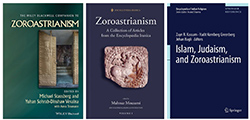
The book opens with an introduction by the editors on "Scholarship on Zoroastrianism.” The first part of the book contains eight articles on the life, times and homeland of Zoroaster and his Gathas. The second part contains eight articles dealing with Zoroastrian populations from pre-Islamic Iran until today’s Zoroastrian diaspora. The third part has six articles on Zoroastrian myths, doctrines and laws. The fourth part has six articles dealing with Zoroastrian ethics, rituals and practices. The fifth part contains nine articles on the intersections and interactions of Zoroastrianism with other religious traditions such as Mithraism, Manichaenism, Hinduism, Judaism, Christianity, Islam and Baha’ism. The last part of the book includes three articles on primary Zoroastrian sources in the Avestan, Pahlavi (Middle Persian), New Persian and Gujarati languages. The bibliography and indexes at the end of book amount to over 100 pages. The volume was edited by Michael Stausberg, professor of religion at the University of Bergen, Yuhan Sohrab-Dinshaw Vevaina, professor of Sasanian studies at the University of Oxford with Anna Tessmann, a post-doctoral fellow at Mainz University in Germany. This book is truly an international labor of love.
Zoroastrianism: A Collection of Articles from the Encyclopaedia Iranica, as is evident from its subtitle, is a collection of articles on various aspects of the Zoroastrian religion and history previously written for and published in the Encyclopedia Iranica that was founded by Prof Ehsan Yarshater (1920-2018) from 1973 (while he was in Iran) until 2017 (when he was a professor at Columbia University). While the Encyclopaedia Iranica articles are available online (https://iranicaonline.org), the 2,146-page collection of all Zoroastrian articles in these two beautiful hardcover volumes provide easy reading (away from computer screens) and handy volumes for personal and institutional libraries. (Not found on online booksellers. Price mentioned earlier was Rs 6,256 or USD 75.)
Edited by Mahnaz Moazami, a professor at the University of Columbia’s Middle East Institute who also served on the editorial board of the Encyclopaedia Iranica, the two volumes contain 287 articles categorized under 17 parts: religious concepts and philosophy; Zoroaster and Zoroastrianism; elements in Zoroastrianism; divine beings (Yazatas); demons, fiends and witches; Zoroastrian literature; sacrifices and offerings; ablutions and purification ceremonies; prayers, hymns and incantations; priestly titles and prominent Zoroastrian priests; legal aspects of Zoroastrianism; death and afterlife; festivals; place of worship; Zoroastrian heroes and adversaries; mythical and historical locations; and Parsi communities. Under each category, articles are arranged alphabetically as should be in an encyclopedia. There is a bibliography at the end of each article. The detailed index enables the reader to find exact pages related to a particular theme. Contributors come from various countries and include renowned experts such as academicians Mary Boyce, Philippe Gignoux, William Malandra, Mansour Shaki, Prods Oktor Skjaervө, Ahmad Tafazzoli and others.
Islam, Judaism, and Zoroastrianism forms part of Springer Encyclopedia of Indian Religions. Other volumes in this series include Buddhism and Jainism (2017), Sikhism (two volumes, 2017), and Hinduism and Tribal Religions (two volumes, 2022). The Islamic portion of Islam, Judaism and Zoroastrianism (with 751 entry articles in total) was edited by Zayn Kassam, professor of Religious Studies at Pomona College in Claremont, California. Yudit Kornberg Greenberg, chair of Religion and founding director of the Jewish Studies Program at Rollins College in Winter Park, Florida, edited the Jewish part. The Zoroastrian part was handled by Ervad (Dr) Jehan Bagli, an ordained Zoroastrian priest, founder editor of the FEZANA Journal and founder president of the Zoroastrian Association of Quebec, Canada.
Compared to the two encyclopedias on Zoroastrianism mentioned earlier, Islam, Judaism and Zoroastrianism with 825 pages is less detailed and its high price tag (Rs 45,475 or USD 545 on Amazon) will limit its purchase to university libraries. Nevertheless, the volume provides a useful body of literature focusing on Zoroastrianism in an Indian context. In the publisher’s description, it is stated: "In the case of Zoroastrianism, even its very beginnings are intertwined with India, as Zoroastrianism reformed a preexisting religion which had strong links to the Vedic heritage of India. This relationship took on a new dimension when a Zoroastrian community, fearing persecution in Persia after its Arab conquest, sought shelter in western India and ultimately went on to produce India’s pioneering nationalist in the figure of Dadabhai Naoroji (1825-1917), also known as the Grand Old Man of India.”

Prof Rasoul Sorkhabi, PhD, is a professor at the University of Utah’s Middle East Center. His article "Zoroaster: The First Philosopher and His Theosophical Revolution” appeared in Quest (Fall 2021) and his lecture on the same topic hosted by the American Theosophical Society is available on YouTube.