The K. R. Cama Oriental Institute completed 100 years of espousing scholarship on diverse topics
Farrokh Jijina
"We have manuscripts pertaining to the Zoroastrian religion and history not found anywhere else in the world,” states Muncherji Cama, president and trustee of The K. R. Cama Oriental Institute (KRCOI) that completed 100 years of existence in December 2016. "But we are not a Zoroastrian institute only,” he says, proud of the fact that their collection of rare books now totals 28,000 and manuscripts another 2,000. The subjects include philosophy, history, geography, language, literature, art and archeology. Diverse languages are represented in the collection: Avestan, Middle Persian, Pazand, Persian, Arabic, Turkish, Gujarati, Urdu, Hindustani, Punjabi and Tibetan. KRCOI consists of an amalgam of the private libraries of 19 donors, including educationist and scholar Kharshedji Rustomji Cama, after whom the Institute is named.
Kharshedji Rustomji Cama Photo: Jasmine D. Driver
The building housing the K. R. Cama Oriental Institute
When Parsiana visited the reading room and library, Sarita Gandhi, the librarian, carefully laid out a sample of books on a large oval wooden table. Cameras are not allowed, for security reasons and also because use of flash photography may damage the brittle pages of the tomes. "We have multiple copies of the Shahnameh (the epic by Persian poet Firdausi), the oldest being from the 16th century,” says Gandhi, reverentially displaying two, including an illustrated copy. A restored tome on mathematics in Arabic is shown. On display is also a treatise in Latin, the title of which translates to ‘A study of comparative religions with a focus on Zoroastrianism,’ which is over 200 years old. The Institute added 62 books to its library in 2015-16.
The library is in the midst of the 12th phase of its ongoing restoration project, supported through donations from the National Archives of India, the Erach and Roshan Sadri Foundation and the Navajbai Ratan Tata Trust. Earlier, as Dr Nawaz Mody, joint honorary secretary walks us through the screened off area in between the glass cupboards holding the collection and large portraits of well-wishers of KRCOI, the restorers provided by INTACH (Indian National Trust for Art and Cultural Heritage) stop their painstaking work to give us a glimpse of their efforts. They are covering each page of the selected manuscripts with special tissue and binding them again. The pleasant smell of gum permeates the air. This is an ongoing project since 2007, and is expected to cost the Institute Rs 50,00,000 this year.
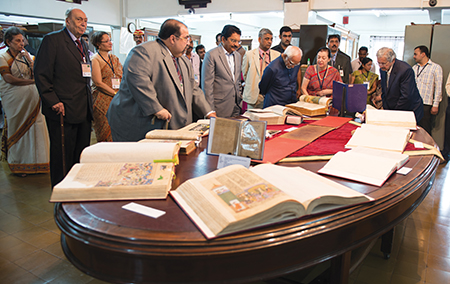
Trustee Homai Modi explains details of a text to Vice President
of India Mohammad Hamid Ansari at the library
Donations could be forthcoming, Cama says. "If we have a good project, we can always get funds for it,” he avers. "We also get a small sum from the Ministry of Culture,” he shares. Cama bemoans two impediments. "We are short of space to expand or hold more programs... We need air-conditioned space to house the restored manuscripts,” he mentions. Two of the floors of their building on Apollo Street, leased to a commercial enterprise are the subject of litigation and not available to the Institute. "Deep scholarship is lacking among the common public, even among academicians,” notes Cama. Safe custody of the books is another concern. Borrowers have absconded with some valuable books in the past. "We have stopped allowing members to borrow books that have been published before 1940,” says Mody. The institute has 316 members who pay Rs 1,000 as entrance fees and Rs 200 as annual membership fees. A listing of the books and manuscripts available with the Institute "is going to be available on the website by 2017,” reveals Mody.
Mody is proud of their collection of Parsee Prakash, the compilation of newspaper articles down the ages started by Bahmanji Patel and first published in 1878 that documents the social history of Bombay from a Parsi viewpoint. She refers to their collection of Stree Bodhe as the "first feminist publication in the city, started in 1857.” Parsi Mitr, among the first magazines for the community, also has pride of place in the Institute’s collection.
The board of trustees of the Institute includes, in addition to Cama, social worker Homai Modi who also serves as joint honorary secretary, Sir Dinshaw Petit, solicitor Homa Petit and solicitor Levi Rubens. Rohinton Padder serves as honorary treasurer. A governing council of over 12 members assists the board.
Acclaimed by academics
Registered under the Bombay Public Trusts Act since 1953, the Institute is recognized as a scientific and industrial research organization by the ministry of science and technology. KRCOI kicked off its centenary year with a lecture by Dr Nilanjan Sarkar of the London School of Economics titled "A sewer for a king: an insult to medieval Bijapur?” and the publication of the papers presented at their seminar on "The contribution made by the Parsis to the development of different aspects of education in the 19th and 20th centuries in Western India” held in January 2009.
Since the first ever international congress held in 1989 on Indo-Iranian historical and cultural studies, the high point of their academic calendar is the annual seminar, generally held in January. The 2017 seminar covered the theme of Mughal art and culture and included papers on painting, architecture, decorative arts and cultural relations with other Muslim cultures.
Government research fellowship lectures commenced in 1919, according to the Institute’s records. The annual report for 2015-16 notes that 14 lectures on topics ranging from colonialism, misdemeanors in medicine, art, furniture, the intercalation controversy among Zoroastrians, the Bombay plague and the concept of empire in Iranian history were delivered from April 2015 to March 2016.
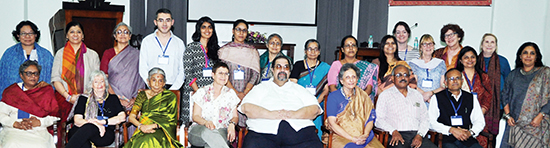
Speakers at the 2016 seminar on "Textiles, Collections, Communities, Culture and Trade"
with Muncherji Cama and Dr Nawaz Mody (seated 5th and 6th from left)
Examining a Thai textile at the 2016 seminar
At the inaugural of the platinum jubilee celebrations: L to R: Capt H. Desai,
Nani Palkhivala, Homai Modi, Jehangir Shroff
Six research projects commissioned by the KRCOI are in various stages of completion on subjects as diverse as architecture and social history. Seven research fellowships are currently ongoing, such as Indian art, Parsi physical culture clubs and the historical town of Maheshwar in Madhya Pradesh.
"The regular meetings which are held by eminent scholars on a variety of interesting and educative subjects are widely attended. However, not many are aware about the efforts made to motivate and encourage young students in religious and social subjects by holding several inter-school and inter-college essay writing competitions and debates,” states Dr Firdaus Gandavia, governing council member of KRCOI. Sabyasachi Mukherjee, another governing council member and director general of the Chhatrapati Shivaji Maharaj Vastu Sangrahalaya (formerly Prince of Wales Museum) calls their collection of manuscripts "rare and invaluable treasures.”
Burzine Waghmar, senior teaching fellow, department of The Languages and Cultures of South Asia, School of Oriental and African Studies, University of London, states it is his privilege to be associated as a governing body member of the KRCOI. "The library is second to none in the subcontinent,” says the scholar. This is where he initiated his foundation in Iranian studies, he avers. Calling the collection of rare books "comprehensive in range and rigor, for it covers Iranian and Persian studies wholly and substantially,” the academician states that the Institute has been the recipient of complimentary copies (of many books) authored by Iranists from eastern and western Europe, the Americas and Iran right through the previous century.
Phiroze Vasania, professor, Greek and Latin at University College London believes that "no place has done more for Zoroastrian studies” than the Institute. It is old fashioned, but in the best sense of the term, he says. He has encomiums for the library: the "books are well preserved because they are looked after by people who genuinely care for them.”
Prof Anna Krasnowolska of Jagiellonian University in Krakov, Poland believes that the Institute "is a place in which the best intellectual and historical traditions” of the Parsi community of Bombay have been preserved. "These are wonderful people, determined to keep alive their ancient cultural heritage in the briskly changing world,” she writes.
Sunil Sharma, professor of Persianate Literature at Boston University informs that not being from Bombay, "the Cama Institute is my home in that city, and I plan to be back there time and again in the future.”
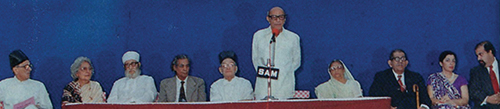
Speakers at the Firdausi festival organized during the Institute’s platinum jubilee
Cosmopolitan citizen
Writing in the platinum jubilee souvenir brought out a quarter century ago, Modi states that Kharshedji Cama first showed leanings towards erudition at age 22. As a partner in his uncle’s firm in Canton, he offered a prize of Rs 150 to the Board of Education in Bombay for the best essay on "The advantages of railways,” that were started in 1853. Conversant with 11 languages, including Avesta and Sanskrit, he was called "Le dastur laique” (a lay dastur) by noted orientalist James Darmesteter of France. Associated with the cause of women’s education, Kharshedji took an active role in the Sir Jamsetjee Jejeebhoy Parsi Benevolent Institution, and other schools in Navsari. A Fellow of the Bombay University, he was connected with the Royal Asiatic Society for 47 years in various capacities. Elected in 1863 to serve the Bombay Municipality, Kharshedji was also requested to serve on the committee to report on the needs of the madresa attached to the Anjuman-I-Islam.
The Encyclopaedia Iranica (EI) provides the details behind the setting up of the KRCOI. It explains that during the last few years of Kharshedji’s life, he had hoped to build a hall atop the Dadisett Agiary "to house a number of research societies and institutions of the Parsi community,” but efforts had been unsuccessful. After his death, a meeting of influential citizens was convened on December 8, 1909 "to determine a proper means of commemorating this respected scholar.” At the meeting chaired by the then governor of Bombay, Sir George Sydenham Clark, the consensus favored the "establishment of a research institute to advance oriental studies in general and Iranian studies in particular” to provide the kind of facilities that Kharshedji had been seeking.
From Modi’s writings in the souvenir we gather that a meeting of the general committee of the Memorial Fund was later held at the Town Hall. At this juncture, merchant-philanthropist Damodardas Sukhadwala offered Rs 100,000 if a free reading room, library and oriental institute was founded in the name of the late scholar. With this impetus, the Institute was inaugurated by the next governor, Lord Willingdon, in December 1916.
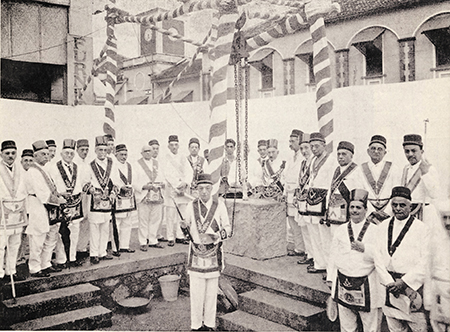
Laying the foundation stone of the building, 1936, according to Masonic rites by Dr Sir Tehmulji Nariman
The library and reading room opened in November 1915, even before the official inauguration of the Institute itself, on one floor of a building on Hornby Road, notes EI. In 1936, the growing need for space to house the Institute’s activities led the trustees to purchase a large plot of land for a new building on Apollo Street, where the Institute currently stands.
In November 1936, on the 106th birth anniversary of Kharshedji, the ceremony of laying the foundation of the present building was performed. Modi narrates that the ceremony was performed according to Masonic rites by the founder of the Parsi Lying-in Hospital Dr Sir Tehmulji Nariman, aided by other Freemasons "in their Masonic regalia.”
KRCOI continues "his (Kharshedji’s) silent charities ... mainly aimed at assisting young deserving scholars, assisting all worthy causes and promoting research,” as then president Jehangir Shroff wrote in the platinum jubilee souvenir.