Sketching and drawing were Hafeez Contractor’s interests, not school text books
Harshad Bhatia
The following extract from Becoming Hafeez Contractor: The Making of an Architect by Harshad Bhatia has been reprinted here with permission from HarperCollins Publishers.
His father Sorabe Contractor passed away at a young age, just a fortnight or so before he was born. His mother, Roshan, then 19, decided to complete her college education and take up teaching. Their only child, born in 1950, was named Hafeez, meaning custodian, protector or keeper.
Hafeez spent his toddler years in his maternal grandparents’ hometown of Navsari. He then schooled for two years at a Gujarati medium institution run by the Tatas.
It is in this setting of living near the Atash Behram at Navsari that the young mind grew to appreciate the idyllic low-rise (structure). This temple was a handsome and humble structure with a garden full of vegetation. At that age, of course, Hafeez did not know that this was an architectural insight. He felt good being there, and full of faith in good thoughts, good words and good deeds.
Joining a boarding school in Nasik (Boys’ Town) in 1957 or so, the child Hafeez entered a life of freedom with control. This place imbued in him a sense of discipline, but it was in his final year at school that Hafeez grasped the seriousness of learning. As time went by, the subjects being taught did not seem important, but living with others of his age gave him a sense of being among equals. His independent nature kept him from textbooks, which were what the world around him was reading. But his keen sense of observation stirred his ability to draw, and to create objects with his hands.
Hafeez considered himself a toughie, disinterested in studies, but good at games and sports. Failure in exams seemed commonplace with him, and he was often deemed to have passed in class if his scores were borderline. During his vacations, his aunt would make him study. She would hold a cane while she supervised him, but she never used the stick. Hafeez was the only male member amidst his mother and paternal aunts, and the devout family wanted the best for him. Here he learnt humility, righteousness and gratitude in prayer.
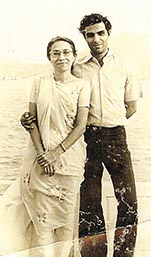
Roshan Contractor with son Hafeez
As might be expected from a boy, Hafeez drew designs of bikes, time bombs, dams, tanks, guns and forts with bastions and moats. He also made playthings from objects he found around him. His imagination converted historical battles into stories, depicted through drawings, models and character-based games, which he created with his close friend, Behram Divecha. One day Nergis Bharucha, his English teacher in the primary school section, who had observed Hafeez over the years, told him, "You are such a useless boy. You are not studying or doing anything; but remember that when you grow up, become an architect, don’t do anything else.” It seemed that she had noticed and sensed his true potential. Though Hafeez could not understand what she meant then, he made the connection later. His sketches were similar to plans for buildings.
There was a definite inborn skill. While the mind was not yet mature enough to understand where exactly it was heading, the hand was busy, drawing or fashioning something. He did this in times of distress. For example, out of necessity once, he made a button from a piece of chalk and stuck it to his shirt during the daily morning inspection of boarders before they left their dormitory for school.
As Hafeez entered class on the first day of his Senior School Certificate (SSC) year, the principal, Bejon Desai, called him and said, "See son, don’t think I don’t know what you are doing. All this time I was in control of your destiny, but from now on you have to take charge.” It was then that Hafeez realized he had been promoted on account of the principal’s discretion. The principal also told the teen Hafeez that everyone came with a destiny and that he would have to study with determination; success came to those who worked hard.
This caring advice left a positive mark on his morale, and during the entire final year of school Hafeez did not allow himself to be distracted.
Suddenly he was mature, responsible, serious about catching up with his subjects, all the way from his fifth standard lessons onwards. However, being averse to textbooks and not being an avid reader, he relied on his uncanny instinct to sense logic from observation and making connections to understand his school subjects. In 1968 he managed to clear his school examinations. His self-confidence, his focus and his dogged determination to get through the exams taught Hafeez that he could use his head in a practical way. This was the trait of a mind capable of objective analysis.
Hafeez remembered his primary school teacher’s advice that he become an architect. However, the necessary minimum percentage for admission was set at 80 per cent, and he had passed his SSC examination with just 48 per cent. Unsure if it would be possible for him to get admission to an architecture college, Hafeez, who had done well as a boy scout, prepared to join the defence forces as he was nearing the maximum age limit to be admitted for training as a cadet. On his own, he had applied to the National Defence Academy (NDA) at Khadakwasla, south-west of Poona. A letter received in reply was torn up by his aunt as she did not want the only child in the family to spend any more time away from home. Hafeez was unaware of all this. He now told his mother about his wish to join the police force.
That too was denied and he was informed about the torn letter. At his mother’s insistence to first get a degree and his aunt’s advice to graduate from a Bombay-based institution, Hafeez decided to join a local college. Hafeez finally gained admission to the Academy of Architecture, The Indian Institute of Architects, following a recommendation by noted architect Homi Dallas.
Sent away to boarding school at a very young age and having lived a lot of his life away from home, Hafeez now stayed in a small, one-room-kitchen tenement in a charitable block near August Kranti Maidan (Gowalia Tank) in south Bombay. It was only in his final year at school that he gathered that his widowed mother was managing the household on Rs 90 a month. His late father’s business partner Nariman Nallaseth kept sending her a monthly amount, which enabled her to take care of Hafeez’s expenses like any normal, aspiring child. As Hafeez was in boarding school, during his school holidays, mainly spent at Navsari, his mother showered the boy with whatever he wanted. However, his upbringing being modest, Hafeez’s demands were occasional; for an independent mind there is nothing called peer pressure.
The family seemed to be blessed that their only child, though sometimes demanding, had minimal wants. His wants never went beyond the needs for survival. For example, while his mother unquestioningly bought him whatever he wanted on his asking, such as a shirt for Rs 10 once, she declined to allow him to go on a tour to Delhi and Agra as she found it unaffordable. But Hafeez did go for the tour as his architect cousin Tehmasp Khareghat offered to pay for it.
The eventual getting of whatever he asked for was forming a pattern. There was a guide always appearing to grant his requests, much like a light that showed the path ahead. It was all fitting in, enabling him to reach a destination as yet unknown. During these formative years, whenever a stumbling block happened en route, there was always a kind soul who helped Hafeez.