The Parsis were the first to move into Connaught Place and Connaught
Circus when the circular complexes were newly constructed
Rusi Sorabji
When the city of New Delhi was inaugurated by Lord Irwin in February 1931 its iconic circular shopping mall and commercial center, Connaught Place and Connaught Circus were still under construction. No sooner was this India’s first shopping center ready for occupancy in 1935, a number of Parsis moved in from other areas of historic Old Delhi. In fact one of the first occupiers of a shop was a Parsi. While I am not able to recall this gentleman’s name as I write, this is what the famous author and columnist Khushwant Singh, son of one of the Sikh builders of New Delhi, says in Delhi: A Novel.
"Before Connaught Place opened, there was hardly any shopping center in the city. The first store in Connaught Place was run by a Parsi where now stands Wenger’s confectionery and sold liquor and cigars to the whites.” The shop formally opened in A block with a jashan on the Zoroastrian New Year’s day, Navroz, March 21, 1935. Later the tenant moved away from Delhi and Wenger’s moved into the vacated place.
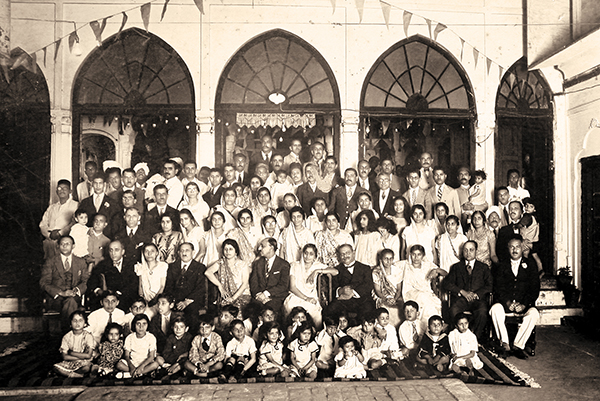
Delhi Parsi Anjuman (DPA) Jamshedi Navroz celebration, 1928. The photo was probably taken by
Daarush Modi who was the official photographer of the DPA. The picture was taken by igniting
magnesium flash powder which produced a big bang and a blinding flash.
That would explain some children covering their ears and the older folks turning their heads or hiding them.
The figure seated in the center appears to be famous eye specialist Dr S. P. Shroff who to protect
his eyes from the very bright flash had turned his face away.
Within the next five to seven years, we had a mini Parsi "colony” of sorts. Outside the Bombay Presidency of old which included Karachi, Connaught Place must have had the highest concentration of Parsis at one address.
Sometime later Sorabji Billimoria, father of my masa (maternal uncle) Navel, also opened a Chinese curio shop, called Chinese Arts Palace, and had a branch on the Mall, in Simla towards the post office.
The first floor of all the blocks in Connaught Place and the outer Circus were initially designed as spacious, high ceilinged, airy residential units with open verandahs facing the road and park with the bandstand in the middle.
The first Parsis to move into the newly constructed Connaught Place block B as residents was the family of Khurshedji Gandhi of Burmah Shell Oil Company. The couple and their four children resided above M/s Rai Sahib Bhola Ram and Sons, liquor and provisions store and Baluja Shoe Company, on the right corner of the B block.
The Gandhis were there from the early 1930s to about the late 40s. Their eldest son Homi was implicated in the boarding school murder of the son of their very close friend son, Noshir Edul, a banker in Mussorie. The father lost his life’s savings in shielding the son by employing the very best of legal brains then available, Sir Tej Bahadur Sapru.
The entrance to all the residential flats in Connaught Place was from the rear service road. To the right of the back entrance of the Gandhi residence, in later years lived Nariman Surty with his wife and daughter Homai.
Block C had two Parsi establishments, the first one being Minoo Kapadia’s suiting and tailoring shop, next to the popular Jaina Book Agency on the left hand corner corridor going towards Plaza Cinema.
At the other corner of the block towards the Odeon Cinema was the showroom of Singer Sewing Machine Company where Nariman Surty was the manager and Sabawalla his assistant. Senior sales representatives for Singers were Malloo, Bomansha Billimoria, and Daddy Muncherji.
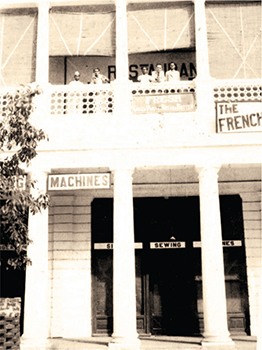
Singer Sewing showroom at Connaught Place, 1930s
Navel (left) and Sorabji Billimoria
Kumi and Mani Sorabji, Themina and Nergish Sethna with
others attend a free show on Khordad Saal at Plaza Cinema, 1947
Rusi Sorabji: relives Delhi of yore
Above Singers lived another Parsi. I can’t remember the name, though I have their picture looking down into the camera.
On the first floor in the middle of D block lived Ervad Burjor Sidhwa, our first resident priest, his wife Bapai, daughters Hilla and Katy. Sidhwa’s office M/s Muller & Phipps (present day Procter & Gamble) was in the same block too.
Somewhere on the ground floor, in the middle of block E was situated the Union Bank of India. A Parsi agent, Sopariwalla, and some auditors practiced there for some time.
F was the first block where construction started in the early 1930s and was known as the Hayat Block. It bordered on Queensway, now Janpath. There lived another Parsi family, right above Jankidas and Sons. We visited them often.
Crossing over the open unbuilt grassy plot sandwiched between Queensway and Parliament Street was the very popular India Coffee, partially open-air shop. In later years it was replaced by the underground Palika Bazar and parking lot.
Behind block A is block G, the longest block, curved and stretched out between Irwin Road and Panchkuian Road. Here on the corner facing the grassy plot opposite Regal Cinema was Zal Irani’s Spencer and Company, that had a Parsi manager, Meherwanji Virji.
Going around the corner was a billiard saloon with slot machines owned by the Polishwalla brothers, Hosangh and Ferdoon. During World War II, it was a meeting place for American soldiers (GIs) who were stationed in Delhi.
At the end of this block towards the Panchkuian Road, on the first floor was the popular Marina Hotel, with at least two Parsis amongst its senior staff.
Facing Marina Hotel was the Lady Hardinge Hospital whose eminent gynecologists included Drs Perviz Heera, Ichaporia, Kumi Pasricha and Sunoo Edulji.
The Plaza Cinema on H block was owned by the Modi Brothers, Keki and Sohrab. Plaza Cinema was where the Parsis of Delhi celebrated their New Years, Jamshedi Navroz and Shahenshahi Navroz with a free film show, drinks and light snacks by the Anjuman. Bomanshah Sethna, his wife Tehmina and children Nargish, Sarosh and Makki lived on the second floor. So did Dinshaw Joshi and at times fire chief Polly Umrigar. On the first floor lived Dhun Kharas of the Central Bank of India and his family. In the middle of the block, along the Service Road was the original office of M/s Jeena and Company, travel agents. Our friend Behram Dumasia was in-charge. He had a Parsi accounts manager and my younger brother Soli worked for him. Above Jeena, on the second floor lived a Desai family.
For some unknown reasons, the planners of New Delhi left out I and J when numbering these blocks and that brings us to block K. For a while, the Cavas Kheshwalla family of five had lived on the first floor facing the Odeon Cinema with the Minto Bridge on the left. A short time later they moved on to the Pusa Agricultural Research Institute.
In 1936 the navjote of my two friends Nargish and Heera took place here.
On the second floor lived Merehwanji Mehta with his wife Shirinbai and daughter Khorshed. Shirinbai managed a private guest house for Parsis only. Longtime resident guests included Minoo Mehta and his wife, Adi Daruwalla, Navel Billimoria, Sappy Dinshaw, Burjor Hiramaneck, Meher and Daulat Nanavatty, Zal Nusserwanji and his wife, Vera Dotiwalla and many others in later years.
Don’t know of any Parsis in blocks L, M and N but just behind N block on the other side of the road, was the office of The Statesman edited by Cusrow Irani. On the corner of Barakhamba Road lived the Sabawallas of Singer and Company, Chandni Chowk. Down Janpath was the Central Bank of India with Dr Dhun Faramji, Davar, Kharas, Noshir Vajifdar, Cavas Desai and auditor Firoze Nikoliwala. Then there was the Bank of India where there were one or two Parsis as well.
Further in the outer Circus going towards Regal Cinema, was New Delhi’s first top class restaurant, Davicos, with a bakery, confectionery and a wine shop on the ground floor next to the entrance to the cinema. Davico’s manager was Deboo. He and his family of four, resided in New Delhi from October to March. For the rest of the year they were in Simla running the Davicos on the Mall.
Between Regal and the Hardinge Hospital on the same road was an un-named block identical in design and style as the Connaught Circus, that housed the original India Coffee House, where Jerbai Mody and her husband had a huge first floor flat converted into a paying-guest facility. There lived Jimmy Pajnigara and his cousin from Karachi, Jerbai’s sister, then Homai Vyarawalla, the famous photographer and her husband. In later years, 1947/8, Burjor Italia of Deccan Airways, Hyderabad, also lived there before he married Khorshed Mehta of K block.
Four other families lived in railway bungalows on Chelmsford Road, leading from H block to the New Delhi railway station. Three of these who occupied bungalows on the left side of the road were North Western Railway’s Edul Bankwalla, superintendent station master with his wife, three girls and four boys, Eruch and Perin Muncherji Kapadia and their son, and Sorabji Battiwalla with his wife and two boys named Nari and Jangoo.
The fourth family on the right side of the road was from the railway engineering department (name forgotten).
So many Parsis in an area no more than half a square mile in the pre-Independence days. Today only one survives in K block: the grand-daughter of a 1935 tenant.