Ruttonshaw Sorabji’s life was intertwined with that of the Delhi Parsi community
Rusi Sorabji
My father, Ruttonshaw Sorabji, was born in 1898 and orphaned as a baby by the two plagues that afflicted Bombay at the turn of the 19th century. The first took his father before his birth; the second claimed his mother a few months later. Ruttonshaw was the youngest of brothers Dosabhoy, Ardeshir and a sister. They then lived on the top floor of the corner building known as Handloom House on Hornby Road adjoining the Bori Masjid. Raised by aunts and an uncle in Karachi, after his formal education Ruttonshaw joined the North Western Railway at the age of 17. He was soon promoted as a senior guard on mail trains out of Karachi, Quetta, Lahore, Sukkar and Rawalpindi. In those days mainly the British and Anglo-Indians held important positions in the railways.
In 1925 my father was posted to Delhi as Assistant Station Master, Delhi Main Station. Among his first contacts there was Dr Rustom Kapadia who had a dispensary on the Church Mission Road, a stone’s throw from the railway station, next to the entrance to Gadodia Market where Hormuzji "Cut-piece-walla” Sethna ran his cloth business. Kapadia was physician to most Parsis of Delhi. Ruttonshaw soon found himself involved with community matters and was a founding member of the Delhi Parsi Anjuman (DPA). In 1928 he became the first non-European station master of Delhi Main. He moved to a large bungalow west of the Dufferin Bridge, opposite the Peeli Kothi (the Railway Accounts Clearing Office). It was five stories high and the tallest building in the city at that time. Most of the Parsis then lived just a stone’s throw away on Burn Bastion Road, including the Jal Irani family, where he came to know their teenage daughter Kumi whom he later wed. The cover of Rukshana Shroff’s book At Home in the Capital carries a picture of my mother, then 17, seated on the right with her parents and siblings.
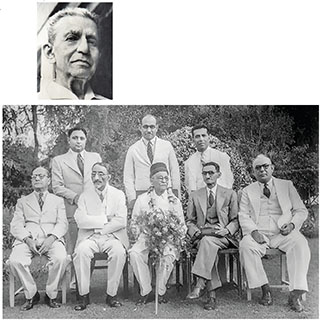
Ruttonshaw Sorabji (above) and (standing ext r) at the retirement of
Nowrosji Kapadia as Delhi Parsi Anjuman president in 1942
The city was expanding beyond the old walls of Shahjanabad: to the north between the Ridge and the Jamuna, an area called Civil Lines; and, on the south-west, to New Delhi and Connaught Place. Civil Lines was the temporary capital with the Secretariat Building, Cecil and Maidens Hotel on Alipore Road, the Viceregal Lodge and the Old Cantonment, now the Delhi University complex. Many Parsi businessmen, traders, engineers and others, as also candidates for job interviews were attracted to Delhi. Often, they had to overstay their visits. Some were stranded in Delhi with no place to stay but the railway retiring rooms (RRR). There were two RRRs at the Delhi Main Station, one for first class ticket holders and Europeans, the other for second/inter class. They could accommodate a limited number of ticket holding travelers, with priority given to Europeans. Parsi travelers who were unable to secure a place in the RRR were invited to stay at the station master’s residence where they were treated to hot Parsi meals and comfortable beds. A khansama (cook), a bearer and a host of other servants were present to attend to their needs.
Important mail trains had dining cars managed by European catering companies who employed Parsi managers. Stranded Parsis who did not have enough money to pay the fare were enabled to return to their hometowns via the dining car network, carrying gift baskets of fresh fruits, vegetables and several dozen eggs with compliments of the Parsi station master. (Incidentally, 100 eggs were available for one rupee and a heap of assorted seasonal vegetables cost less than half a rupee. Solan or Murree beer used to cost one rupee for six-and-a-half large bottles and the best Scotch whisky was available for eight rupees or Rs 10.) Ruttonshaw’s monthly salary then was Rs 600.
Ruttonshaw and Kumi’s wedding on January 26, 1929
The dining car breakfast was very popular with the Parsis of Delhi. It was not unusual to see local Parsis meeting early in the morning at the railway station to enjoy an English breakfast and exchange the latest news/gossip with the managers of the dining cars and receive/send personal letters or packages.
In January 1929 Ruttonshaw married Kumi, the 19-year-old daughter of Dinbai and Jal Irani. She was a pianist, sportswoman, champion equestrian and an excellent shot, having bagged several maneater tigers and panthers on shikars (hunts) where she accompanied her father. In those days shikar was a sport, especially in the princely states where Jal was chief engineer, and the big cats posed a real danger to humans.
Kumi and Ruttonshaw had three children. I was the eldest, followed by sister Mani Thakur and my late younger brother Soli. In 1934 Ruttonshaw resigned from the railways and went into business in partnership with Lala Bhagirathmal, importing woolens and electricals from Europe. The company was known as M/s Sorabji, Bhagirathmal and Sons.
In the same year he opened an eight-room guest house on Roshanara Road, near the Roshanara Gardens for Parsis where travelers were charged Rs 5 per day, including breakfast and dinner. It was probably the first Parsi guest house in Delhi and was managed by my mother. Among the earliest guests were Burjor Sidhwa and family. In fact, their second daughter Katty (sister of DPA trustee Hilla Sidhwa) was born at Sorabji’s Guest House. In later years, when the construction of Connaught Circus was completed, Shireenbai Mehta and Jerbai Mody also entered the guest house business. As New Delhi and the Connaught Place area developed and more government offices were set up, visitors began to opt for guest houses in New Delhi rather than in Old Delhi.
During his long term as secretary of the DPA under Nowrosji Kapadia and Dr S. P. Shroff, Ruttonshaw relentlessly campaigned for a dharamshala for the use of Parsi visitors. For years he was the main caterer for Anjuman functions, jashans, gahanbars and dinners, supplying Parsi food freshly cooked at the site, often surprising members by serving fresh OK wafers or papeta-ni-sali, or mouthwatering kolmi-no-patio, gharab-nu-achar, or fresh chutney-na-chhamna even when seafood was out of season in Delhi.
My father was a member of the Parsi delegation to the Sir Stafford Cripps’s Mission which was formed to determine the representation of the minority communities in the government and reservation of government jobs for them following the transfer of power from Britain.
Delhi Main Station in 2002, where Ruttonshaw became the first Indian station master in 1920
In 1947, when additional land near the Muthra Road cemetery was purchased and plans were approved for the dharamshala, his dream was partially realized. However, when construction was completed in 1951, he was in for disappointment; the Anjuman awarded him the contract to furnish the dharamshala but not to manage it, which he had been looking forward to.
Between 1925 and 1977 Ruttonshaw attended 49 annual general meetings of the DPA. When Shiavax Nargolwala visited him in 1978, Ruttonshaw expressed regret that he missed attending the meeting that year, which would have been his 50th and perhaps a record. Nargolwala was touched by his desire to serve the community despite his 80 years.
Ruttonshaw had a passion for gardening. He always said, "Digging, planting, watering and harvesting, when combined with quiet contemplation, can open the heart and mind to the higher mysteries of life.” During his long tenure as secretary of the DPA he planted fruit trees at the new cemetery, some of which still exist, providing the shade and serenity that make the Delhi aramgah the garden of eternal rest. He, along with Kumi, Soli and most of those dear friends and gentle people who lived in the city now rest in eternal peace under the shade of trees he had arranged to be planted a long, long time ago.
He remained a religious man to the very end. For when the angels came to take him to his heavenly abode, he was seated all alone in the garden in his favorite easy-chair, saying his evening prayers, at my sister’s home in Janakpuri. And that is how Wg Cdr Maneck Karbhary and his wife Kamal found him as they walked into the bungalow.