There was "Cantonization of the Parsis instead of westernization," contended novelist Amitav Ghosh before a gathering of scholars and lay people from around the world at the First Dastoor Meherjirana Library Conference in Navsari on January 14, 2013. In his talk titled, "The Parsi Presence in Canton in the 19th Century," Ghosh argued that the community’s trade with the orient exerted a greater influence on the Parsis than their exposure to the West.
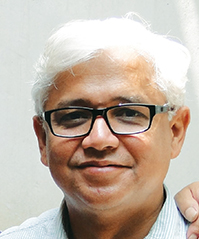
Author of River of Smoke, a novel that deals with the opium trade between India and China during the 18th century and whose protagonist is a Parsi, Bahram Modi, Ghosh referred to the various and lasting impressions made on the Parsi traders who resided in Canton during the heydays of the opium trade. These influences included the style of embroidery (garas), the structural setup of businesses along Chinese lines, words such as Chini (Chinoy), the growing influence of the Parsis in western India on account of the China link, the influence of Parsi theater on the Jakarta drama scene...
"Chinese (painting) techniques revolutionized our (Indian) landscape," commented the novelist. Reverse painting on glass was also a Chinese art. They influenced Indian calendar painting. The J. J. School of Art was probably based on what Sir Jamsetjee Jejeebhoy saw in China. "Did he borrow the model from Canton?" inquired Ghosh as Jejeebhoy had never visited the West.
"The Tatas and Wadias modeled their business in a similar manner to Chinese merchants…with tight family control," Ghosh remarked. And the Parsis are "the only community to still remember the China trade," he added.
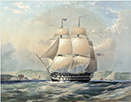
"The Parsis did not enter the opium trade straightaway," he observed. The Marwaris were the first. The Parsis were shipbuilders initially. "Ships and condiments go together. It was natural for them to enter the opium trade." The Treaty of Nanking between Britain and China that marked the end of the first Opium War (1839-1842) was signed in 1843 aboard the HMS Cornwallis, a vessel built from teak by master shipwright Jamsetjee Bomanjee (Wadia).
"Every important community dealt in opium," including the Marwaris, Gujaratis and Sindhis. But amongst these communities, few traveled with the opium consignments to China. The Parsis did. "This distinguished them from all the other communities. They took the pioneering role in the trade. From 1780 to 1850 the trade was almost exclusively a Parsi enterprise."
"A tsunami of opium"
Turkish and Arab traders first brought opium to China around 600 A.D. and its consumption was fuelled once smoking of tobacco gained popularity in China. Britain and the Europeans entered the trade around the beginning of the 18th century when China was exporting tea, silk and porcelain but importing very little. As the western nations’ coffers began to deplete, they searched for items to export to China. In 1729 around 200 cases of opium were exported to China. The trade "grew at a phenomenonal rate" with "an enormous infrastructure built around opium." In 1796 China banned the import and cultivation of the drug. Opium, however was smuggled into the country. By 1860 the number of cases sent increased to 60,000. The Chinese found "a tsunami of opium flooding towards them," noted Ghosh.
As the value of the imports exceeded the exports and addiction to opium increased, in 1796 the Chinese authorities banned the import and cultivation of opium. The product was then smuggled into China. After a large quantity of opium was requisitioned and destroyed, the British successfully fought two Opium Wars to force the Chinese to accept the import of the drug. The Opium Wars were "funded by Bombay merchants," said Ghosh.
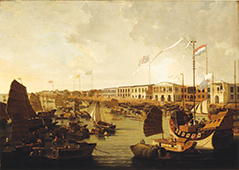
The writer described Canton as "a very, very old city (with) a floating population of one million people. It was the largest city in the world." The Parsi traders along with their office and domestic staff resided in the foreigners’ enclave in Canton, "an area of around 1,200 acres. Strict restrictions were in force. No women, children or weapons were allowed in Canton. Animals also were not permitted in the foreigners’ enclave. The Danish merchants, however, were permitted to keep cows as they professed they "needed milk. The Chinese were not keen on milk," Ghosh noted.
There were "few rich Parsi merchants." Six or seven of the expatriates would get together and share a residence. From their savings they would buy some opium and try to sell it. "The Parsis adapted…it was a social not a commercial thing…they were innovators in so many diverse aspects of life."
From the correspondence between Jejeebhoy and William Jardine, the most successful opium merchant, one could ascertain "they were respectful of each other… In 1803 Sir Jamsetjee Jejeebhoy made his last trip to China. (After that) he did not need to go."
During the question answer session in response to the addictive qualities of opium, Ghosh replied there was "an exaggerated notion of the dangers of opium." Initially opium was used "for recreational purposes. It follows the trail of tobacco. In India people eat (rather than) smoke opium, so the intensity is not the same. The British were aware of the dangers of opium. They tried to restrict" its consumption in their domains.
Would he pass any judgment on the opium traders? "I don’t think it is possible to make a moral judgment… Fortunately (Jejeebhoy) used the gains in a more productive way than the others."
Profiling a Parsi
Travel and journeys seem to be an integral part and an important theme in the novels of Amitav Ghosh. In The Circle of Reason, Alu travels from Lalpukur in East Bengal to Malabar, to Al Ghazira and finally to El Qued in Africa. The narrative in The Shadow Lines shuttles between Calcutta, Bangladesh and London. In In an Antique Land, Abraham Ben Yiju travels from the Middle East to Mangalore while his slave Bomma journeys from Mangalore to the Middle East; Ghosh himself travels to Egypt and scours libraries in England and the United States. And now more recently Sea of Poppies narrates the voyage of Indians to Mauritius to work in the sugar plantations and River of Smoke chronicles the fate of Bahram Modi who visits China in connection with the opium trade. One sees parallels in the personal life of Amitav Ghosh. As the son of a diplomat he had a peripatetic youth and grew up in East Pakistan, Sri Lanka, Iran and India. He studied in Delhi and Oxford, taught at Columbia University in New York and presently spends some of his time in Goa.
However, travel and journeys often result in a search for the self. In his most recent novel, River of Smoke, he examines a little known area of India’s involvement with the opium trade: poppies were grown and processed into opium, the Indian ships which transported opium to China were often constructed in Bombay and Indians fought for the British in the Opium Wars. Also, a fact which cannot be denied is the role of the Parsis in the opium trade: at one time, there were about 50 Parsis in Bombay who consigned their opium to Jardine Matheson. Though we are introduced to a relatively minor character, Ah Fatt, the half-Parsi son of Modi and Chi Mei, a Chinese boatwoman, in Sea of Poppies, the principal protagonist in River of Smoke is Modi himself, a superbly etched character with just the right touch of Parsi eccentricities (his fondness for good food).
Reading about his early life, one can’t help but notice the parallels between his career and that of Jamsetjee Jejeebhoy. Whereas for the average Englishman the opium trade is merely a matter of free trade versus protectionism, the dilemma which Modi faces is the more complex ethical problem which a thinking man confronts. Though he blithely mentions he is a small link in the supply chain, he is aware that his hands are tainted. He has an illicit relationship with Mei, but has serious compunctions about leaving his lawful family.
However, the point at which we really sympathize with Modi is when he has to vote on the course which the traders have to take and he is forced to choose between good and evil as exemplified in the teachings of Zoroastrianism. "Who will you choose Mr Modi?" he is asked. "Will you choose the light or the darkness, Ahura Mazda or Ahriman?" Our heart goes out to this man who is put in the awkward situation of having to choose between the welfare of his beloved family and his own "well-being in the hereafter" as he fumbles through his anhgarkha (long ethnic shirt) and seeks the reassurance of his kusti. Ghosh succeeds in portraying Modi as intelligent, capable, resilient, God fearing, loyal and above all a human character and his dilemma is one with which the reader can identify and sympathize. FIRDAUS GANDAVIA