The full day conference in Chicago by the Society
of Scholars of Zoroastrianism threw light on traditions
observed and discontinued by the community
Parinaz Gandhi
"Religious reform and revitalization often arise during conditions of community stress,” stated anthropologist Dr Janet Kestenberg Amighi, author of The Zoroastrians of Iran: a History of Transformation and Survival. As chair of the Society of Scholars of Zoroastrianism (SSZ) conference, she was among the distinguished speakers who presented a paper at the morning Zoom session on November 16, 2024 attended by nearly 100 and then spoke again at the community-oriented deliberations in the afternoon which saw participation from over 75 at the Zoroastrian Center of Chicago — Rustom Guiv Dar-e-Mehr.
"By creating a space for collaboration and advancing new discoveries,” the 18-year-old SSZ endeavors "to deepen our understanding of this ancient faith and inspire future generations of scholars,” remarked president Zal Taleyarkhan at the 2024 conference hosted by the Zoroastrian Association of Metropolitan Chicago (ZAMC).
Having spent several years in Iran and marrying a Zoroastrian from Iran, Amighi had many opportunities to collect stories and witness "traditionalists who backed by historical continuity tend to resist change; and forward looking reformists who favor change on perceived notions of modernity.”
Clockwise from top l: Dr Janet Kestenberg Amighi,
Dr Ted Good , Prof Jesse Palsetia,
Prof Miguel Angel Andres-Toledo
Zal Taleyarkhan (far l) and Noshir Contractor
Her morning talk was on "Frashokereti: Contemporary Reforms for Making the World Perfect Again,” and in the afternoon on a related subject, "Reform and Tradition amongst Zoroastrians in Modern Iran.” She explained that "struggle for a better future can be legitimate and righteous change can bring the world closer to perfection.” In the 19th century, Parsi influence encouraged reforms among hard-pressed Zoroastrians in Iran. In the 20th century secularization in Tehran resulted in parallel changes among Zoroastrians with reduced interest in religious ritual. Those who stayed back after the revolution in 1979 were again required to adapt. "In the face of strict Islamization of the nation and with religious education made compulsory in schools, kids now have to memorize the Gathas. While earlier 20% had their sedreh-pooshi, now 90% do.”
She mentioned how traditionalists have let some practices connected with purification and seclusion of women "die unmourned.” When there was an inability to find corpse bearers and body washers because of a more egalitarian attitude and better employment opportunities, commercial funeral services came to be used.

Other practices like celebrations of gahanbars were modified. In earlier times the priests would be praying separately in a corner or on the dais with the laity chatting away. Changes were introduced in the 21st century requiring the laity to rise when the clerics came and emulate their gestures during the ceremonies. Animal sacrifices that were prevalent in Achemenian and Sasanian times had continued through the ages and were mistakenly attributed to Islamic influence. With the current change in thinking, instead of killing goats and cows to feed Zoroastrians and Muslims as a gesture of gratitude, a family chicken dinner is recommended.
To anoint mobedyars, two traditions required to be broken: allowing laity to become priests and the taboo on menstruating women. In villages, there had long been the practice of lay male mobeds who tended fires and helped in ceremonies. Not formally educated, they did not pose any threat to the mobeds’ authority. Regarding acceptance of women mobedyars, although there is evidence from Sasanian times of wives of mobeds conducting the bareshnum for women in Yazd and women entering schools for mobeds, over the centuries the practice was discontinued. "In desperate need of mobeds in recent times, the Council of Mobeds prioritized the Gathic gender perspectives over the Vendidad based view on pollution,” stated Amighi. It was agreed that women who had passed the mobed examinations could practice as mobedyars but menstruating women would recuse themselves from rituals. Mobedyars though are not given votes in the Mobed Council and have set up their own associations in Yazd and Tehran.
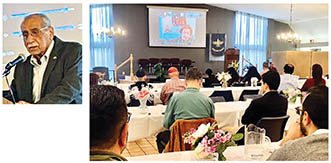
Above l: Rohinton Rivetna; r: participants at the SSZ conference in Chicago
Writings by priests and historians
"Denkard — III with 420 chapters is the single biggest book in Middle Persian,” explained Dr Ted Good from the School of Oriental and African Studies, London, the University of Chicago and the University of Toronto. In his exposition on "History in Denkard — III” Good explained how the book written by different Zoroastrian priests after the downfall of the Sasanians and during the rise of Islam, bears "weird” descriptions. Good behavior is indicated as "back from vice, forth to virtue” while bad behavior is "back from virtue, forth to vice.” Forth is not to be equated with good, nor back with bad. A prudent person collects good and bad experiences, uses them wisely and virtuously at the right time. Forth is characterized by humility, contentment and honesty. The back pulling vices are arrogance, greed, indignation, laziness, resentment.
When most people in an era perform good deeds it leads to good rule, good religion and knowledge. Even if one person is good amidst the general trend of bad behavior it is a pull to goodness for the rest. Conversely even the presence of a single bad person in a generally good society may result in fear in the general public. Good or bad is relative depending on what response is shown at which time. Members of the good religion or Zoroastrians are referred to as Huden while those who are irreligious are termed Agden.
A question included in the interactive quiz
"While the fire holds a special theological, ritual status for Zoroastrians, the sacred fire does not hinder its use for practical purposes,” said Prof Miguel Angel Andres-Toledo, FEZANA (Federation of Zoroastrian Associations of North America) Professor of Zoroastrian Languages and Literature at the Department of Near and Middle Eastern Civilizations of the University of Toronto. In his brief talk on "The Fire Beyond: Non-Ritual Avestan Fires,” he alluded to the Vendidad that deals with contamination of different fires, from those considered the most contaminating to the least. The fire of cremation is the most polluting and the list includes fire used in the dyeing process; on which cream has been boiled/curdled; from a potter’s kiln; from a glass kiln; from an oven to roast grain; smelting gold, silver, bronze, iron, steel; bonfire stones; charcoal burner; with nearest brazier being the least contaminating.
"Parsi Historical Writing — Pages from the Parsee Prakash to Parsiana, Tropes and Truths” was the subject of a talk by Prof Jesse Palsetia, professor in the Department of History at the University of Guelph in Canada. He quoted Dosabhai Karaka’s statement in 1884: "The Parsis…are well launched on the path of progress. They have risen from poverty and oppression to security and wealth.” According to Palsetia, Karaka has set the standard for modern history writing on the Parsis with the trope or theme of Parsis being accomplished and boasting unique triumphs. This pattern followed by generations of historians often obscured other realities or truths. He cited two principal works – The Sixteen Sanskrit Slokas and Qissa-i- Sanjan written around the 16th century, that establish Parsis as a distinct group with their own religion and customs, a peaceful group, complimentary to the social milieu of India suggesting "an ability to shape their circumstances and identity under all circumstances.”
"History though is also shaped by external factors and circumstances beyond one’s control,” mentioned Palsetia. With pressures to assimilate being very great, some converted to Hinduism and other religions. "The quantitative loss is unknown to us.” Following the arrival of the British, "from an obscure community they became a colonial elite, from obscure traders to merchant princes or sethias.” The voluminous set of Parsee Prakash, compiled by Bomanjee Byramjee Patel and later R. B. Paymaster gleaned facts from newspapers from 1888 to 1910. This reflected the social history of the times throwing up unusual facts like how many Parsi women end up at the bottom of wells rather than have their husbands divorce them.
The grand figures of history were always shown as "benevolent, philanthropic, enterprising, insightful but the history of Parsis in the opium trade was obscured for a very long time” although opium trading was legal then with prices being regularly quoted in the papers. "Philanthropy was a way for Indian elites to make themselves known, to court favor, to engage in humanitarian acts which the British would find laudable. Rarely does the 19th century history speak of a level of dependency or poverty among the Parsis. Pioneers of Indian nationalism were shown as peaceful and constitutional. The majority who were ambivalent to Indian nationalism which they did not consider in their interest were obscured.”
One of the most interesting writings to emerge in the post-colonial period was Parsiana in 1964, said Palsetia. "It combined the accomplishments of Parsis while keeping an eye on the prevailing quarrels and controversies in the community. This upset many Parsis for they had not been exposed to reality. They had been spoon fed and other fed on the great accomplishments!”
Parsi historical writing in current times still bears "a strong sense of nostalgia and commemoration of community’s accomplishments but for a different reason now for they are seen as a dying community. The decline of numbers is now an old-fashioned lament. The real lament is that there is nobody to take over community housing and the great trusts. There are books trying to document Parsi history with a whole new generation of non Parsis entering the field. In 200 years whether there will be any Parsis to write about is uncertain.”
SSZ director Noshir Contractor coordinated the morning proceedings. Ervad (Dr) Kersey Antia summarized the morning symposium after which Mobedyar Boman Damkevala and the group recited Tandarosti prayers for the well-being of the Zoroastrian community.
Above: Chicago youth at the conference
Sharpening their knowledge
The afternoon session, chaired by ZAMC president Jamshed Rivetna and assistant treasurer Afshan Barshan, started with a benediction by Damkevala and a monajat by Mani Rao, according to a report of the event written by Roshan Rivetna. An interactive quiz session "Sharpen Your Knowledge of Zoroastrian History and Scriptures” included teasers like "Which Achemenid emperor is known for the world’s first postal service…?” (answer: Cyrus the Great) It was the combined efforts of Meheryar Rivetna, Rohinton Rivetna, Kamal Saher and Vispi Karkaria as also some ZAMC youth who were encouraged to undertake individual research under their religion education teacher Dr Persis Driver to give meaningful explanations to the questions. The quiz prizes (Roshan’s badam ni boi) were won by Damkevala, Jimmy Antia and Eric Elavia.
Cyrus Rivetna who had visited Tajikistan in August shared slides of Zoroastrian art, architecture and archeological sites indicating that Zoroastrian culture continues to thrive there. Ancient fire temples and fire altars in Panjakent bear remnants of Zoroastrian rituals once conducted there. Ervad Kobad Zarolia recommended the need to promote Zoroastrianism in Tajikistan, particularly through tourism and donations. In "Uzbekistan and Zoroastrianism” Jivahn Moradian shared his experiences of visits to heritage sites in Uzbekistan, Tajikistan and Georgia. Uzbekistan has one of the highest concentrations of ancient Zoroastrian sites in the world: the Chilpik Kala is a dakhma from the first century; the Mizdakhan Necropolis is a Muslim cemetery built over a Zoroastrian ossuary; the Magok mosque in Bukhara is built over a fire temple. The Avesta Museum in Urgench showcases Uzbekistan’s Zoroastrian and pre-Islamic heritage.
At the end of an intellectually stimulating day, in her talk "Making History Ours: Collective Stories as a Source of Identity and Belonging,” Driver wove together the day’s presentations through the tradition and art of storytelling.
The Conference was co-sponsored by the World Zoroastrian Organisation (WZO)-US Region and FEZANA Information Research and Education System (FIRES). Kayomarsh Mehta, president of WZO-US region, thanked SSZ for organizing these very valuable educational conferences every year and urged everyone to also support the causes that WZO-US region supports: medical emergencies, educational loans, religious institutions, and of course the SSZ. On behalf of FIRES, co-chair Aban Rustomji commended SSZ for its "dynamic contributions and assembling such a distinguished gathering, fostering community, and championing our heritage with enthusiasm and dedication.” Besides housing a centralized collection dedicated to books, manuscripts and scholarly research, FIRES, located at the Zoroastrian Association of Houston (ZAH) library, also does lecture series, historical preservation, rare book collections and oral history archives.
"SSZ has come a long way” since its founding in 2006, said founder director and currently treasurer Rohinton giving credit to all who have been helping realize the mission of SSZ "to revive the tradition of scholarship within our community.” As remarked Binaisha Mistry, the master of ceremonies for the evening that ended with a patra-nu-bhonu dinner, "We are truly blessed to be part of the very vibrant ZAMC community – we pray together… we learn together… we celebrate together… we stand by each other in their hour of need.”