The items carried in this Sports column were readied before the pandemic brought all sporting activities to a halt. Parsiana is featuring the accomplishments of these sportspersons although the events they participated in are dated.
Equestrian endurance
"It took me nearly five hours to complete the race. My mount Flash is an eight-year-old, grey colored Marwari mare that we have trained since the last five years,” stated Khushru Patel who emerged winner in the 60 km category at the All India Open Endurance Championship 2019. "The race is run in three loops of 20 km each, and we have our strategies for each loop being ridden differently,” added Patel. Describing Flash as "very clever,” he noted, "she has some tricks up her sleeve and we use it together to our advantage.”
There were more than 45 entries for the graded championship of the Equestrian Federation of India held from December 20 to 22, 2019 in the Palanpur region of western India. Usually four to five endurance events are held during the four-month season from November to mid-March each year. "As it is long riding hours, winter is the best season,” noted Patel. Competitors can participate in the 20 km, 40 km or 60 km distance. The eligibility criterion for a horse is six years and above, and for a rider, 14 years and above.
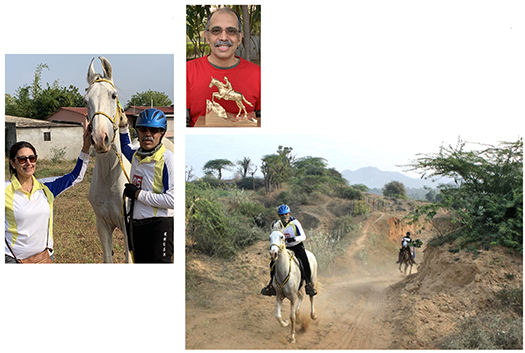
Clockwise from above: Meheru and Khushru Patel with mount Flash;
Khushru with the trophy and in the lead at the 60 km endurance event
Endurance is considered a strategic test of horsemanship. After gauging the difficulty of the course/terrain/weather, riders are expected to set the pace based on the ability and fitness of their horse. Although it is an individual event, family members can ride alongside. Patel is happy that his wife Meheru "accompanies me everywhere. She is the backbone for me and my mare.”
Patel ensures that "Flash has a regular routine of exercise and daily training from two to six hours. Her feed is very well planned and procured from around India.”
Realizing the importance of fitness for himself, proper riding technique and correct gear, 57-year-old Khushru undertakes "yoga three times a week and horse riding three times a week along with conscious healthy eating habits.” Besides overseeing the printing press as partner of JAK Printers in Bombay, he runs a competitive yard in Lonavala for training horses and riders for endurance. "We have international coaches come over from France to train us every year.” These facilities are available to those who know basic riding and are keen horsemen. A full year’s training with competitions and horse maintenance costs upwards of five lakh rupees.
Khushru is happy to mention that his nephew Bakhtyar Irani is also a champion endurance rider. There are others like Yashaaan Khambatta who had stood 11th in Asian Championship in show jumping.
Interested in horse riding since childhood, Khushru has been involved in endurance championship races for the last six years. Endurance riding, as related to Parsiana by horse owner Berjis Desai, was first developed in the early 1900s as a military test for cavalry mounts when horses were required to go on a five-day, 300 miles (483 km) ride. Once the distance and time were curtailed, the cavalry test became a civilian sport in the early 1950s. In 1978 the Federation Equestre Internationale, the international governing body for world and Olympic equestrian events, recognized endurance riding as an international sport.