Social entrepreneur Mira Mehta is endeavoring
to turn the fortunes of poor tomato farmers in Nigeria
Parinaz Gandhi
Farmers in Northern Nigeria had lined the roads with tomatoes hoping to dry them because prices were abysmally low in 2008. Mira Mehta who was then working with the Clinton Health Access Initiative in Nigeria, coordinating with the US government’s Federal Ministry of Health HIV/AIDS Division, could not understand why this region that produces 65% of the tomatoes grown in West Africa was also the largest importer of tomato paste in the world. When analyzing this problem in depth, she conceived Tomato Jos (TJ) as a lucrative food processing business opportunity for herself and simultaneously sought to make tomato farming profitable and sustainable for local smallholder farmers.
TJ was started "to alleviate poverty,” stated Mehta when she was conferred the Outstanding Zarathushti Social Entrepreneur of the Year award by the World Zarathushti Chamber of Commerce on January 4, 2020 (see "Talent, technology and trust,” pg 34). As compared to 81 million (or about 5% of the population) who fall below the poverty line in India, there are 87 million constituting 43 % of the Nigerian population living in extreme poverty according to the comparative figures she shared. "Our company mission is to create a middle class in rural Nigeria,” said Mehta who co-founded the venture with Shane Kiernan. They propose to do this by being responsible employers and simultaneously creating growth opportunities for the small farmers.
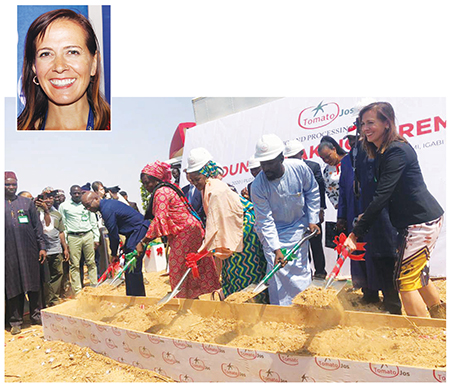
Mira Mehta (inset and far r) at the ground-breaking
ceremony for the Tomato Jos factory
Mira Mehta (above and l): creating awareness of best farming practices
"I wanted to do something fulfilling,” said Mehta during an interview with Parsiana prior to the awards function justifying her decision to move to the non-profit sector even though it required her to settle for a 50% pay cut. "I’ve always had an empathetic nature,” she added, revealing that she initially wanted to be a veterinarian or doctor. Her training and experience in finance, though, she considers an asset, having learnt how to be methodical and professional in her dealings.
"An average Nigerian farm yields five tons (of tomatoes) per hectare while the global average is 35 tons per hectare,” Mehta briefed us in the course of an interview. As per her business plan, she bought 500 hectares of land in Kaduna, 10% of which is under cultivation. Of this 10%, half the land is commercially cultivated by her team and on the remaining half she invites local farmers to cultivate for two years by offering them knowhow and superior inputs and assuring them that their produce will be purchased at the best price.
Knowing that the economically challenged local farmers are "extremely unproductive,” Mehta’s team advances some of them a loan to induce them to farm on the TJ land. To better their productivity the farmers are taught how to prepare the land, which seedlings to use, the way to irrigate, the type of fertilizers to use… At the end of two years, these trained farmers repay the loan, move out from Mehta’s holding and cultivate their independent tomato patches, thereby ensuring Mehta is able to reach out to a new set of agriculturists. While in the transition phase TJ had 130 farmers on their model farm, their goal is to cover 3,000 to 4,000. Their first batch of local farmers "graduated” in 2019 and from their profits they were able to pay back their loans, finance the education of their children, get healthcare and invest in other ventures.
The maximum learning for Mehta’s team was in the first few years when they were helpless bystanders as cows trampled their fields, had to battle tomato viruses, face acute water shortage, and even a virtual shutdown of operations during the 2015 election period, she recalls.
There are three seasons in Nigeria: During the rainy season from May to September they cultivate maize. The harmattan season from October to February when dry and dusty trade winds blow in from the Sahara desert are actually conducive for the cultivation of tomato plants. Harvesting is done from January to March. April is the ‘show’ month when they see the yield of their efforts.
"Jos is a city in Nigeria known for its vegetable produce and Tomato Jos is an expression used by the locals to describe a girlfriend who is sweet, juicy and ripe,” Mehta explained the different nuances of the nomenclature for their enterprise. Beginning next year they will launch their processing plant that will manufacture tomato paste to compete in the $ 500 million market in Nigeria that is currently largely dominated by Italians. The ground-breaking ceremony for the new factory was performed on January 27 when the dignitaries in attendance included Godwin Emefiele, governor of the Central Bank of Nigeria, and Mal. Nasir Er-Rufai, Kaduna state governor.
The initial investment required for this project came from family and friends, acknowledges Mehta. She was able to raise three million dollars (Rs 21.4 crores) through her Harvard Business School network, having completed her Masters in Business Administration from there in 2014. On an average there are 180 graduates each year and if added to this count are those who opt for other short duration courses, the total network for each batch works out to around 450. "We are in the process of raising five million dollars (Rs 35.6 crores) for our expansion and factory,” notes the entrepreneur. Undeterred by the environment in Nigeria the gutsy lady believes in conducting her business in an ethical way. "The skill sets I have developed are valuable,” she is confident.
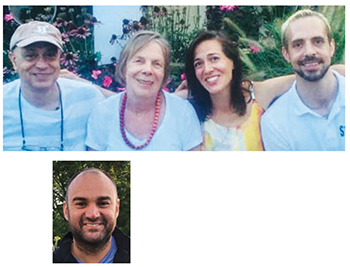
From l top: Cyrus, Satu, Mira and Arun Mehta; above: Art Cardoso
Mehta had studied at Brown University in Rhode Island from where she graduated with an honors degree in community health. Later she gained experience at the investment firm BlackRock as lead asset manager, working as an analyst on a marketing and business development team. Two years thereafter she joined the Clinton Health Access Initiative coordinating with the Federal Ministry of Health HIV/AIDS Division, the US government and various United Nations organizations, to import HIV medication into Nigeria, obtain necessary drug approvals and facilitate pediatric testing and treatment operations. When she returned to the US to pursue an MBA from Harvard Business School, she became actively involved in the Africa Business Club and started pursuing her plans to launch TJ.
Born to Cyrus and Satu Mistry, the daughter proudly mentions that her father Cyrus who studied at the Indian Institute of Technology in Bombay, was a J. N. Tata Scholar, studied business operations at the Massachusetts Institute of Technology, earned his MBA and PhD and was the founder of Cytel Inc, a biostatistical consulting and software company in the US. Starting with four employees, the number had grown to 600 when he sold it a couple of years ago. While he is no longer the chief executive officer there, he continues to serve as its president and teaches at the Harvard School of Public Health. Her Finnish mother Satu has had a career in education, teaching teachers, having completed an education in early childhood teaching. Elder brother Arun who lives in Tokyo is chief technological officer creating learning applications for a Chinese corporation specializing in artificial intelligence and virtual reality. Mira’s partner Art Cardoso who is also her business partner looks after the farming side of the TJ business.
Initiated into the Zoroastrian faith when she was seven and Arun was 12, Mira wears the sudreh-kusti only on special occasions when there is a celebration in the father’s side of the family. Both Cyrus, a Zoroastrian, and Satu, a Lutheran Christian, are drawn to the teachings of the Vedanta Society of Boston that they visit every Sunday. Mira is not able to reconcile to the fact that born of a Parsi father, she is accepted as a Zoroastrian but her elder cousin from whom she draws inspiration, is denied the same privilege as she is born of a Parsi mother and non-Parsi father. The Parsi flavor at her home, says Mira, is invariably experienced during Thanksgiving when "Mom makes dhansak and dad makes shrimp patia.”
Always seeking to support the cause of marginalized women, Mira is keen to involve women in her Nigerian farming project because she is convinced that "if women had more money, they would make the choices they want to make.”