The Parsi contribution to Indian literature is analyzed at a seminar
Firdaus Gandavia
"There is a lot of Parsiness in your writing. I don’t think you have to worry about where it is. The mantras of social justice, class divide, moral righteousness and wrongness are very Parsi attributes,” commented session chairperson Dr Nilufer Bharucha on the apprehension novelist Murzban Shroff had about "never seeing myself as a Parsi writer (and) about the bane of being a bawa.” The exchange between the former head of the Bombay University (BU) English department and the writer took place at the inaugural session of a one-day seminar titled "The Parsi contribution to Indian literature” at Sir Pherozeshah Mehta Bhavan on the Kalina campus of BU on September 20, 2016.
"The emphasis on social justice goes back a very, very long time to writers such as social reformer Behram Malabari and to part of the writings of Cornelia Sorabjee,” noted the academician. The Parsi attributes include "a high sense of moral probity...a sense of place... social justice...displacement,” she added.
Alluding to Shroff’s remark that he saw himself as a chronicler of Bombay, Bharucha remarked, "A sense of place is dear to Parsis. (Novelist) Rohinton Mistry can’t stop writing about Bombay. There is a deep relationship between the city and the Parsi writer.”
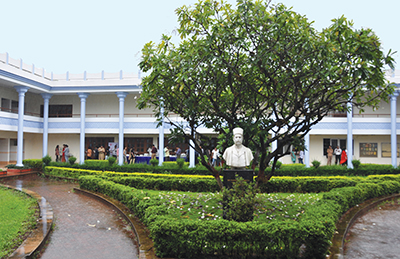
Bust of Sir Pherozeshaw Mehta at Centre named after him at
the Bombay University campus in Kalina
A former advertising executive, Shroff "started writing in 2001,” opting for the short story format. Being a "South Bombay person for too long,” he decided "to step out and see what India was all about.” He stayed with tribals in Gujarat and "came back with a different perspective.” He observed the dhobis (washer people) in Bombay and the problems that beset them. He classified the citizenry as "the haves, the have nots and the know nots.” His role as a writer was "to inform the know nots — the people like me.”
"Until the age of 25 I thought of myself as a cricketer,” confessed poet and novelist Keki Daruwalla in a discussion with poet Arundhati Subramaniam. As a writer he "never thought in terms of identity... Parsi identity came to me very late. I lived in North India.” The former secretary and chairman of the joint intelligence committee of the Union Cabinet and one time policeman lamented the bane of being tagged a "policeman poet,” noting he served in the police for only 11 years, or one-seventh of his life. He served "in the wilds” of North India and came to Delhi only in 1974. He began to visit Bombay later, adding, "I hope I never write about (Bombay). I don’t know it.”
Initially he was "a little self-conscious and shy of mingling with the literary crowd.” He had sent his poems to the late renowned poet Nissim Ezekiel and the two corresponded through inland letters till Ezekiel moved to postcards. (When Parsiana had carried a cover story on the four "Parsi poets” — Kersi Katrak, Adil Jussawalla, Gieve Patel and Daruwalla — in May 1974 Ezekiel mentioned he saw a copy in a book shop but refrained from buying one, commenting to the editor, "Do I want to spend Rs 3 to read about them?”) Daruwalla sees himself "more and more as a fiction writer.” He explained he was "more comfortable writing about Parsis” than, say Punjabis. He was more familiar with the Parsi ethos.
The convenor of the symposium, Dr Coomi Vevaina, former head of the English department at BU could not attend the meet as she was hospitalized that morning due to a viral infection. Her introductory remarks were read out by the current head of the department, Prof Shobha Ghosh. "On May 6 this year when I first attended the advisory board meeting of the Sahitya Akademi, the president, Prof Malashri Lal proposed a symposium on the contribution of Parsis to Indian literature and asked me if I would like to host it in the University of Bombay. I naturally agreed feeling very glad that the Akademi had thought of devoting an entire symposium on the contribution of Parsi writers.
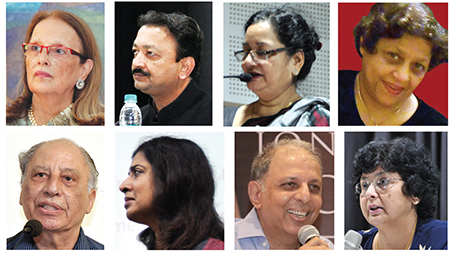
From left (1st row): Dr Pheroza Godrej; Dr Sanjay Deshmukh; Gitanjali Chatterjee,
deputy secretary of the Sahitya Akademi; Dr Coomi Vevaina;
(2nd row) Keki Daruwalla; Arundhati Subramaniam; Murzban Shroff; Dr Nilufer Bharucha
L to R (1st row): Dr Shernaz Cama; Dr Pearl Pastakia; Cyrus Broacha; Dr Kurush Dalal;
Dr Novy Kapadia; (2nd row) Dr Mala Pandurang; session chairs Dr Shobha Ghosh and
Prof Shivaji Sargar; compere Dr Neena Nair of Valia College
"Though a dwindling minority in India, the Parsi contribution to Indian literature and culture has been significant enough to attract attention from all over the world.
"The Parsi attraction to English law and education was largely because it protected human rights (at least in theory) and Zoroastrianism is a ‘Religion of Right Action.’ Straddling both traditional culture and English education, the Parsis acted as bi-lingual bridge builders and played important roles in the creation of the modern Indian state. In the post-Independence years however, a great ethnic anxiety overtook the community, leading many to the diaspora. This crisis of identity takes the form of diverse positions adopted by writers such as Bapsi Sidhwa, Daruwalla, Jussawalla, Patel, Dina Mehta, Shroff, Cyrus Mistry, Rohinton Mistry, Saros Cowasjee, Boman Desai, Firdaus Kanga, Farrukh Dhondy, Anosh Irani and media icons like Adi Marzban, Cyrus Broacha, Shiamak Daver, Boman Irani, Sooni Taraporevala and several others.”
The guest of honor, art historian Dr Pheroza Godrej, commenting on Vevaina’s absence noted, "Many things have gone wrong in our cities that are causing the common people to suffer...viruses don’t make a selection,” they affect all. The outbreak of epidemics indicated a failure of the administration to provide a safe environment for citizens. She said in her family they stressed on "education, health care and livelihood...these cover everything we want for our children.”
Godrej recalled her early days as a student on the Fort campus of BU. "Kalina was a just a glimpse” at the time. Her first professor was the late Dr Mehroo Bengalee, principal of the St Xavier Institute of Education at Churchgate. She was a jovial and well-loved figure who went on to become vice chancellor (VC) of BU. Godrej was glad the government of Maharashtra recognized Bengalee’s services by appointing her to this prestigious office. Stating that education was an ongoing activity for herself, Godrej recalled her mother supplementing her pocket money (Pheroza was "always over budget”) by buying books for her.
The current VC of BU Dr Sanjay Deshmukh recalled his father advising him to read 40 pages every day on subjects outside his field of study. He recalled his indebtedness to the Godrej family, especially Sohrab Godrej, who encouraged him to study the mangrove swamps at Vikhroli. According to Wikipedia, of the 3,500 acre estate of Godrej in Bombay’s eastern suburbs, 1,750 comprise mangroves that the family has preserved all these years. Sohrab had even offered him a job but when Deshmukh informed him that renowned geneticist Dr M. S. Swaminathan, the father of the green revolution in India, had asked for his services, "Sohrabji said I should be with” the scientist. Deshmukh recalled it was at the initiative of the Godrej family that potted plants were placed on the Kemp’s Corner (now renamed Ardeshir Godrej Chowk) flyover.
The VC lauded the English department, noting that they "have contributed greatly to the growth of this University” and to society at large. He spoke of leading Parsis such as social reformer Malabari and Sorabjee, the first Indian woman to graduate in law in Britain, and other prominent and literary figures.
"Marginal man”
"When one thinks of the Parsi contribution to Indian literature, one generally thinks of the present day novelists and poets,” stated Dr Shernaz Cama, whose paper traces the concept of the Parsi being a "marginal man,” from the time Parsis first appeared in Zoroastrian literature. When one travels back in time one is familiar with Malabari and possibly the Qisse-i-Sanjan as early as 1599. She asserted that there was Zoroastrian literature even prior to this date. "Zarathushtra is important in the history of literature because he is the first individual Indo-European voice heard speaking distinctly out of the mists of time.” His Gathas or Songs of Wisdom, composed as early as the 2nd millennium BC are poems which reflect the joy and the despair of human lives, a theme which continues to haunt Parsi writers even today.
The subject of Bharucha’s paper was "Making the Subaltern Speak” and she focused on Rohinton Mistry’s A Fine Balance. The protagonist of the novel is ostensibly Dina Dalal, a Parsi widow, who takes to stitching to support herself. However, Bharucha drew attention to the fact that Mistry widens the scope of his novel by including several characters who are not Parsis: Om and Ishwar, who are untouchable tailors, as well as ragpickers and beggars who constitute the "underbelly of Bombay.” The background of the novel is the Emergency of 1975 with all the horrors of slum razing, compulsory vasectomies and the victimization of the subaltern (person holding a subordinate position). Bharucha raised a pertinent question: Do novelist Mistry’s subalterns really speak?
The seriousness and the gravity of the previous papers were totally annihilated and the pendulum swung in the opposite direction with Broacha’s presentation on "Unconventional Professions.” When asked to mention "father’s profession” on admission forms for his children, he is faced with a dilemma. Though he comes from a long line of lawyers, his career has taken him in different and unique directions. However, his speech did have a serious undercurrent when he spoke about his time as a radio jockey, receiving calls from listeners. From these, he felt that there was a lack of communication and cohesive connection in contemporary Indian society, a situation he compared to Edward Albee’s one act play, Zoo Story. He ended on a positive note encouraging students to choose their calling. If they do not really enjoy their profession, then there is no point in doing it at all.
Lunches at seminars could be quite boring affairs with lukewarm and tasteless food. But, in keeping with the theme, the lunch served resonated with the content of the seminar and Dr Kurush Dalal laid out a marvelous spread of Parsi fare — sali chicken, pulav dal and kulfi.
After lunch Dr Pearl Pastakia, head of the English department at St Xavier’s College, spoke on K. D. Sethna, also known as Amal Kiran (1904-2011) and his association with the Pondicherry ashram, first as a disciple of Aurobindo and subsequently the Mother. Sethna, a brilliant student of St Xavier’s College, was an agnostic and a disbeliever, seeking enlightenment. Pastakia enlivened the serious nature of her subject with amusing personal anecdotes from Sethna’s life. Sethna read about Aurobindo in a newspaper in which a box of shoes he had purchased had been wrapped. He was brought up by his grandfather who was concerned that he would marry outside the community if he acceded to the grandson’s request to study abroad. When Sethna got interested in spirituality, his grandfather regretted that he did not send him to the United Kingdom!
In his paper on "Love and Politics in Dina Mehta’s And Some Take a Lover,” Dr Novy Kapadia, Associate Professor, Shri Guru Tegh Bahadur Khalsa College, wondered what made Parsi writers take an interest in politics, whether it is Mehta or Sidhwa’s Ice Candy Man. In both the novels, the Parsi characters realize that they cannot distance themselves from the political condition during 1947 and the Partition. "The protagonist, Roshni, feels betrayed when her lover, Sudhir, prefers to follow in the footsteps of Mahatma Gandhi rather than American poet Walt Whitman.” Kapadia drew the audience’s attention to parallels the author draws between the turmoil in the country and Roshni’s emotions. He also highlighted the complexity with which Mehta portrays her characters. Is Roshni’s involvement with the social and political situation merely a way to impress Sudhir and ingratiate herself into his affections? Does Sudhir follow Gandhi because he is afraid of an emotional relationship?
As Vevaina was unable to present her paper personally, it was read by one of her students. Her paper dealt with Dastur (Dr) Maneckji Dhalla and his autobiography The Saga of the Soul. Dhalla obtained his PhD from Columbia University in 1909. He was an unpretentious scholar, endowed with deep wisdom, a gentle demeanor and charisma. Vevaina spoke of the 12 stages of The Hero’s Journey developed by Joseph Campbell and drew parallels with Dhalla’s life, starting with his marriage at the age of eight to a girl of five, through his "call for adventure” (meeting Dadabhai Naoroji), "meeting his mentor” (Prof William Jackson of Columbia) to the final stage of "returning with the elixir” (stripping religion to its essence).
Dr Mala Pandurang, professor and head of department of English at Dr B. M. N. College, Bombay (affiliated to S. N. D. T. Women’s University), in her paper "Jambo Paulo, Jambo Mykol,” dealt with a very little known area about the life of the Parsis in Kenya. Pandurang focused on the life of Kersi Rustomji, a school teacher in Tanzania. "At one time, the strength of the Parsi community in Zanzibar was the largest in the world after India,” (probably before Partition — editors) she noted. Now, their number is in single digits. She included several family photographs in her presentation which show a synthesis of cultures where, in one of them, Rustomji is seen with his servant even though his family was reluctant to allow him to play with the "blacks.” Rustomji spoke three languages — English, Gujarati and Swahili. Pandurang presents an enjoyable account of the utopian life in Tanzania (still not embroiled in the National Movement) till Rustomji finally migrated to Australia in 1975. His "Ode to the Indian Dukanwalas” narrates the history of the very difficult and dangerous journey these men made across the ocean. They were basically middlemen who imported products from Europe (Sloans Liniment) and India (Amrutanjan). They played a very prominent and important part in the economic and the political growth of the country. Paul and Michael were the names of his sons. His autobiographical work, Jambo Paulo, Jambo Mykol, Hello Paul, Hello Michael, Kem Che Paul, Kem Che Maikl, How Are You Paul, How Are You Michael, is fascinating reading. This work tells in vivid details the true story of an Indian boy growing up in Tanzania.
To round up the very interesting day Dalal, assistant professor, archaeology, BU, made an effective and engrossing presentation on the Sanjan excavations and how important literary sources can be to validate historical data which in this case is the arrival of Parsis in India. He made a cogent presentation of various sources which evidence the antiquity of Sanjan. There were garbled and confused accounts passed down through oral tradition such as the listing in Pahlavi script of Parsi visitors at Kanheri caves, as early as 1009. However, the most important seems to be the Qisse-i-Sanjan. Subsequently, minor research was carried out in 1917 and 1949. However, in 2002, 2003 and 2004, under the leadership of Dalal and the late S. P. Gupta, excavations were undertaken which revealed an enormous number of ceramic pots and other items establishing the fact that there was trade in this area which resulted in prosperity, as can be seen by the brick houses, ring wells and sanitation. That the inhabitants were Zoroastrians and that the site had been functional as early as the 8th century AD in Sanjan corroborates the data in the Qisse-i- Sanjan. Dalal noted however that while archaeology can identify and date objects, it cannot say who they belonged to.