Part of the World Zarathushti Chamber of Commerce’s annual meet in Bombay was a panel discussion on doing business with/in India
Arnavaz S. Mama
"India is the youngest nation in the world: 70 percent are below 34 years of age. It is adding seven million — the population of an entire New Zealand — to the workforce each year. Disposable income is rising. Their propensity to spend – in the past even the wealthy hesitated to spend the way the youth is spending today – is driving the Indian economy.”
Farokh Balsara, partner in Ernest and Young, the global economic assessor, advisor and provider of support services to commerce and industry, set out facts and figures for the World Zarathushti Chamber of Commerce (WZCC) panel discussion: "Doing business with/in India” on January 7, 2007 at Bombay’s West End Hotel. The other panelists included Tata Power managing director Adi Engineer, realtor Rusi Gandhi of New York and Zarine Karani Araoz of Boston whose firm Managing Cultures specializes in aiding international business with advice on what it takes to vibe with different cultures.
Moderating the discussion was noted lawyer and religious scholar Nadir Modi. In his opening remarks Modi noted that unlike some other religions which referred to the world as maya or illusion, the oft repeated injunction in the Gathas is to make this a "beneficial, thriving world.” If the happy compliment to the community from Mahatma Gandhi, "‘In numbers beneath contempt, in contribution beyond compare,’ is to continue, organizations like this have a vital role to play; Zoroastrians on both sides of the waters need to interact…in the process of making this world more beneficial,” said Modi. His word of advice: "Incorporate a provision in the by-laws that disputes of any sort will always go under arbitration. You will save money otherwise spent in useless litigation in court.”
"What is driving the India story?” asked Balsara and noted that apart from the congestion, slums, pot holes and traffic jams the Indian world also included 220 political parties, more than 30 lakh elected representatives — "no nation on earth has known this,” more than 25 states "each waking up to the need to change…even communist West Bengal.” There have been five governments in 10 years, each a coalition, but "India has mastered the art of the politics of consensus. Now the trend is to build on what’s been achieved, not undo it. Politicians are becoming more accountable because of the active media – 58,000 different publications, more than 300 TV stations, over 500 radio stations. The media forced the judiciary to review some decisions... It is a very positive trend.” Admitting that a large portion of the population is still illiterate, Balsara stated that as literacy inches upward, it will make politicians and governments more accountable.
Time was when India’s foreign exchange resources were almost nil. Now they stand at $ 150 billion. Other high points of the Indian economy that Balsara noted were the outsourcing and information technology industries, the outsourcing of clinical research to India ("400 of Fortune 500 companies are outsourcing in India”), the increasing manufacture of bulk drugs and auto components, increasing air traffic and decreasing governmental interference in economic affairs. According to Balsara, (urban) unemployment had reduced from 35 percent in 1997 to nine percent today.
Balsara spoke of two "enablers” – the financial institutions like banks and capital markets and physical infrastructure like ports, airports, roads, railways — admitting that a "huge catch up is required in terms of investment” in the latter without which the sector "can possibly derail the economy.” On the other hand the banking network is strong and so are the capital markets — "the BSE (Bombay Stock Exchange) and NSE (National Stock Exchange) are among the largest stock exchanges in the world. People believe and trust them. (We have) a robust financial infrastructure.”
As for corporate India, now seeing a separation of ownership and management, it "wants to see the world as its market — not only India,” said Balsara alluding, in passing, to the major Indian acquisitions of companies in the West. "The confidence of Indian businessmen is on the rise. They are embracing corporate governance norms from the West without making mistakes like Enron.”
Engineer, who described himself as a player who has done a lot of work within the country as well as interacted with players from outside, spoke of India’s strong legal system. Foreign investors "say they feel comfortable working here.” He also spoke of the strong political will to support business and industry reflected as much in the move towards indirect taxation as in the "West Bengal chief minister putting his neck on the line to get new companies to invest there.” With more of India’s rural population getting urbanized, Engineer forecasted the doubling of 5,000 plus towns to 10,000 plus with a corresponding growth in infrastructural needs — "a rosy but bumpy road ahead.” He underlined the need for private enterprise to help the government whose "ago-old bureaucracy — IAS (Indian Administrative Service) could stand for the I Am Safe syndrome — takes an exasperating long time to get done what needs to be done. The regulators have a mindset of 65 years. One needs patience for this change.” Low productivity, lack of discipline and a "systems approach,” the chalta hai (anything will pass) approach to quality were some of the demerits listed by Engineer.
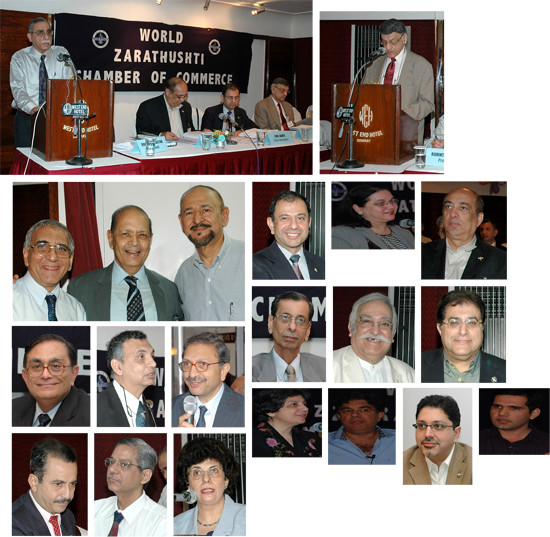
Top L to R (1st row): Rohinton Rivetna (speaking), Kobad Zarolia, Edul Daver and Bomy Boyce; Boyce (speaking) (2nd row) Russi Ghadiali, Nadir Modi and Ness Lakdawala; Edul Daver; Meher Bhesania, Kobad Zarolia ; (3rd row) Rusi Gandhi, Behram Pastakia, Farrokh Rustamji, Adi Engineer, Dadi Mistry and Rustom Engineer. (4th row) Kersi Commissariat, Yazdi Tantra, Zarine Commissariat, Zarine Araoz, Tehmasp Printer, Farokh Balsara and Cyrus Driver
"Energy will be a crunch…Unless energy is placed on top (of the priorities list), information technology will go to seed,” said Engineer. Noting that "53 percent of power consumption in Delhi was not paid for when we went in in 2004,” Engineer emphasized the need to rouse the "laid back” Indian public to rein in corruption. "Our community’s hallmark has been integrity and honesty…We must stand apart on fundamental values,” said the power baron allowing that a little hospitality, a little give and take within limits, helps grease the wheels of commerce.
If Balsara and Engineer presented a chiaroscuro on the Indian economy, Araoz provided glimpses of the cultural nuances that strengthen or derail international collaborations. She addressed such FAQs (frequently asked questions) as: How do you know if ‘yes’ really means ‘yes?’ When is a commitment a commitment? Can you really trust schedules? Araoz referred to these factors as critical in the making or breaking of a partnership.
The lady, whose forte is human factors in global interactions, has counseled such companies as Cummins, among others who wanted to know how to select, retain, motivate people in India. AT&T Lucent "had a policy that they’d not send NRI Indians back to India because they were not sure of how NRIs are viewed by resident Indians.” Araoz said one of the first questions Multi National Companies look at is the issue of trust. When she started out she had said with much more confidence than she can today, "Look for a Zarathushti for you can rely on them.” She told the gathering that the collaborating party must feel assured that what you say is what you mean, adhere to our age-old values.
One assignment she had, was to be sent to a plant in India by the US collaborator to educate the Indian counterparts that "bad news conveyed early enough is considered good news in the US.” She explained that if something was not going to be ready for delivery by the agreed date, it is important that the foreign collaborator is informed as soon as this becomes evident to the local management so that solutions can be worked out together and mistakes corrected. As a Zarathushti, ensure that we’ll live up to our word, she impressed on the audience. As for corruption, there are corporations like Dupont and Cummins who have succeeded in India without going down the bribery route. The other crucial factor she identified for business success with foreign collaborators is result orientation — results, not excuses even after taking the monsoons, power failure, traffic congestion and other baddies into the reckoning. Also, immediate responsiveness: "check your e-mails at least twice daily if not oftener,” Araoz emphasized. "I didn’t check my mail yesterday is horrifying for anyone focused on global business!”
An interesting issue she honed in on was the need for brevity and clarity when dealing with US collaborators. Also, Indians like to talk so that when to interrupt becomes a cultural issue for the listener. On the other hand, they don’t always speak up on conference calls, being diffident despite their technical brilliance. What the westerners do value about Indians is that once their commitment is won, they’ll stay through the night to get things done — something not true of the wider Zoroastrian community today. She also referred to the American businessman’s need for direct feedback.
Are we making use of resources available outside the Zarathushti community? asked Araoz and proceeded to educate the present and future entrepreneurs in the audience. She referred to TiE (The Indus Entrepreneur) Atlantic, an active, dynamic entrepreneurial support organization run by Indians. They teach how to write a good business project, where to go for venture capital, provide a peep at cutting-edge technology, she noted. The US India Business Council sends a daily bulletin on every major investment in India from all over the world. The Open Business Club with its website globalindiaforum.com aims at the small entrepreneur on the other side.
"Let us capitalize on our English education — our accent is far easier to understand than that of some other Indians — on our integrity, our reliability, and by immediate and pleasant responsiveness to global partners,” she advised.
An MBA who entered the real estate business after reaching the ceiling in the healthcare field, Gandhi noted that 50 percent of realtors and builders were wiped out when interest rates in the US rose critically in 1981. Underscoring the importance of innovation, Gandhi noted that the move to amortize property over the long term of 30 years, with articles of agreement, saved him and others. The industry in America also subsequently developed the Global Pointing System (GPS) for property. India is still a virgin market for real estate, with demand outstripping supply, he noted.
In the discussion that followed, Alayar Dabestani, cinema owner from North America, wanted to know the procedure for establishing a foundation or trust for Zarathushtis in India, the terms of ownership and retransfer of money. Modi noted that because of illegal use of foreign funds in the past, government permissions are required, and they take their own time coming.
Radiologist Dr Behram Pastakia of Washington DC spoke of the opportunity for the IT qualified to step into the emerging field of digitized medicine. Engineer and businessman Bomy Boyce of Toronto referred to nuclear power as a widening area of activity.
From the audience Sanober Kotwal wished to know what is a good career option for her son. The gathered experts were almost unanimous: "Let him do whatever he wants to do. Only then will he do it well. Leave him alone and give him a good example,” said Modi. "Build on the natural strengths of the child…Give him a nudge, but he will listen better to outsiders,” averred Engineer. "Give him information and let him decide,” suggested Gandhi.
Entrepreneurs present
"Diamond merchants won’t trust anybody. They want to sit next to the diamonds. They trusted me because of my Parsi heritage.”
Tehmasp Printer, managing director of the International Gemological Institute, India – an affiliate of the Antwerp based international agency — offered the gathering an insight into a sunrise industry in India: the certification of gold and diamond jewelry. With the Indian diamond industry exporting 57 percent of its manufactures, integrity and dedication are essential in the certification process.
The government has realized that there is a lot of fraud in the gold jewelry industry as the consumer is generally shortchanged. Hence from 2008 hallmarking will become mandatory, Printer noted, suggesting that an industry growing at 40 percent a year offers huge opportunity to the community because of the confidence others have in Parsis.
"Gold can be sold as bullion or as alloy. If it’s the latter, we need to hallmark it with integrity…set up authenticity centers, provide services, have independent assaying units…”
Describing his venture Calorie Care as a "work-in-process story” providing 250 meals a day to upper income executives, Cyrus Driver noted that he had deliberately aimed at providing a top of the line, expensive catering service. The unique selling point of Calorie Care is that the meals, each individually packed, are catered to personal health and taste requirements. A master in business administration who opted out of a secure job with J. P. Morgan, Driver said he had set up his first Gym Café at Kandivli and was preparing for the launch of the second (launched thereafter in Juhu). While he was broad basing his service to reduce costs, it was still a struggling venture, he noted.
AGM
The panel discussion had been preceded by the annual general meeting (AGM) of the WZCC, the fifth to date. Described by its founder president Rohinton Rivetna as the engine for the economic prosperity of the community world wide, the WZCC’s mission has been to energize the Zarathushti entrepreneurial spirit through networking.
This AGM marked the retirement of the founding directors — vice presidents Homi Davier and Dadi Mistry, treasurer Sarosh Collector, corporate secretary Edul Daver and directors at large Ness Lakdawala, Kobad Zarolia and Dorab Mistry — all of whom had completed two terms on the board. As per a new article introduced into its constitution, Rivetna continues on the board as immediate outgoing president.
The new team is headed by Bomy Boyce, now in his second term on the board, as president. India director Kersi Limathwala is vice president, US’s Framroze Patel, treasurer, Zarine Commissariat, corporate secretary and Yazdi Tantra of India, who won much acclaim for the way he has designed the WZCC website, technical director.
The regional directors are Khodayar Attaie (Iran), Meher Bhesania (Middle East). Nowsherwan Irani (Pakistan) and Filli Madon (Australia). Hoshang Karani, Zareen Karani Araoz, Rustom Engineer, Firdosh Mehta, Shernaaz Engineer and Rusi Gandhi are directors at large.