.jpg)
To commence with a disclaimer sounds ominous! Despite repeated requests to exclude the undersigned from his Acknowledgements, the compiler has gone ahead regardless. There is nothing in Kersee Kabraji’s (pictured) foray into Zoroastrianism to suggest that he has followed any solicited advice and guidance on the proper appraisal of the coherent philosophy underpinning Gathic precepts. So, assuming this task here as stupefied reviewer will doubtlessly shock Parsiana’s readers.
Proceeding with this farrago, one applauds the generosity of two high-profiled signatories to the Forewords: the Dalai Lama has offered a cosily benign page; Lord Karan Bilimoria has submitted a polite, political piece.
Kabraji’s Preface, introducing himself and his professed allegiance to Dastur Maneckji Dhalla, indicates one thing only – that he has scarcely understood the great Parsi prelate. Using a particularly telling paragraph from the Dastur’s Autobiography to launch his own fantasy by randomly picking through the most diverse and differing "translations” (they are convenience paraphrases!) of selected Gatha stanzas – shows unsurprisingly confused results.
Will aspiring authors ever understand that the Gathas are the unifying product of a profound inner relevation expounded by a genius outside his time, and are not to be trifled with in attempts to impose vague, garbled notions without concentrated study and careful evaluation?
When Kabraji boldly states "...there is a need to change/correct the focus,” one may be assured that this chaotic booklet does not offer any suggestions to achieve it. Elsewhere he seems to personally address the well-loved Karachi high priest who died in 1956!

Zarathushtra in the court of King Vishtasp Illustration from the book
Dhalla is deservedly respected for the unity and coherence of his scholarly writings. When, however, Kabraji declares he was "the pioneer of the revival movement,” he attributes wrongly, for the real instigator was the steadfast Kharshedji Rustamji Cama (1831-1909), the determined Parsi educationist in various Zoroastrian fields who mentored the 19th and early 20th century galaxy of brilliant students among whom was Dhalla.
Kabraji could have taken the hint from Bilimoria’s Foreword, for Dadabhai Naoroji had come to England with Cama for establishing a Cama enterprise at which both were notably unsuccessful. Naoroji frequently consulted Cama on Zoroastrian matters although his heart was in politics; Cama’s inclination was towards the serious study of areas in Zoroastrianism which he pursued, not in England in the wake of the Wilson attacks on it, but chiefly with Friedrich von Spiegel (1820-1905) at Erlangen, Germany.
It was at Cama’s urging that the Tata and other families funded young Dhalla’s further studies at Columbia University with the great Iranologist Williams Jackson. Had Kabraji taken note of that fact, he might just have broadened his list of famous Parsis to include the Mazdayasnian priests’ solid contributions to sadly neglected religiocultural studies. Present day Parsis likewise restrict themselves to naming top professionals and captains of industry with their millions disbursed in noteworthy charitable causes. Illuminati like Dhalla, Jivanji Modi, Sheriarji Bharucha, Kavasji Kanga, Edulji Antia, Jal Pavri, Tahmuras Anklesaria and others are all but forgotten. The revival promoted by Kabraji has done nothing to evoke their glorious achievements for the intellectual advancement of interested Parsis.
Far more serious is Kabraji’s indiscriminate selection of Gatha "translators,” some of whom have wilfully distorted the sage’s teachings to feed their particular fancies. Especially alarming are by those who chose to forget that Zarathushtra lived amongst tribal confederacies of pastoralists and agriculturists. This has resulted in ludicrous formulations as "soul of creation/soul of the world” instead of the apt "soul of the kine” best suited to his cattle-breeding audiences. Such outlandish notions were to commence, in wholly different later contexts, with Plato which spread centuries after among gnostics and neo-Platonists.
Similar is the trite "Happiness to him who happiness gives” which thrusts aside Zarathushtra’s profound benediction that opens Yasna 43.1. What, one wonders, is Kabraji’s notion of "happiness?” He projects the strangest "messages” concocted from the sage’s subtly inspiring guiding precepts and provides some naive ravings couched in Parglish (Parsi-English), reducing the sage’s poems to infantile catechisms. For whom then was this booklet compiled?
Zarathushtra was a realist, an existentialist; his practical philosophy was directly addressed to the ruling class. He had time neither for kavis (poet-seers)and karpans/karaps (mumbler priests), nor for bagas (gods) and yazatas (worshipful beings), but solely for his deity, the monad Ahura Mazda ("Lordly Wisdom”).
The author has come unstuck with his quirky ideas on "rationalism” which congeal as good thoughts, good words and good deeds, and bewilderingly on the "declaration.” He even believes that the Gathas are "totally silent” on prehistoric or primitive cults. Were that so, what exactly and against whom are the strong condemnations of Yss.32 and 44.19, 20 aimed? Religions do not arise from nothing or without reason: Zarathushtra’s was a vehement protest against the daevas or false gods whose cults from the remote past persisted down to his own times with the connivance of the karaps abetted by the kavis. Vishtaspa was from the kavian line and follower of the older cultic worship, together with the Hvogva brothers Frashaoshtra and Jamaspa, until the advent and proselytizing activities of the sage. They became the first Mazdaeans.
It becomes clear that it is Kabraji and not Zarathushtra who sets the parameters of acceptance – a restructuring of the navjote ceremony that demands three signatures to his declaration farrago! Were the undersigned a non-Zoroastrian seeking a higher religion, Kabraji’s preposterous "declaration” clauses would quickly make him quest elsewhere.
Kabraji tries to make sense of hamkar (co-worker) by informing readers that the word is absent from the Gathas – not surprising, since it is a Pahlavi term! He did not realize that frya-, "friend,” applies far more significantly to the ever-closer relationship between Mazda and Zarathushtra (and indeed with all mazdayasn-zarathushtrish). The sage looks to Mazda, "wisdom,” to solicit His friendly support. No theocratic religion has envisaged such collaboration.
The treatment of two of our three standing prayers is wayward and contributes nothing to Zarathushtra’s unifying philosophy. Examples are noted in the ahu- and ratu- from our Yatha ahu vairyo. They specifically refer to spiritual and earthly guides – Mazda and Zarathushtra with all future truth-abiding disciples.
Chapter 6, "The Declaration of Cyrus the Great,” is a thoroughly dishonest feature in this compilation. Kabraji had been warned off tampering with the Cylinder’s contents, but evidently unsuccessfully. Here he has gone overboard with his utterly incredible gibberish.
For the readers’ benefit: the Cylinder was scripted in Akkadian – a non-Iranian language; it was drafted by Babylonian partisan priests of Marduk, not by old, Persian speaking Mazdaean magi; much of it deals with the Babylonian background to Cyrus’ conquest; Cyrus’ Persian ancestry unfolds in Mesopotamian form. Kabraji horrendously substitutes Ahura Mazda everywhere for the chief Babylonian god Marduk; his shambolic take on the contents is disgraceful – one cannot fathom his thinking on Cyrus’ ethical religion, nor on the nature of his military exploits!
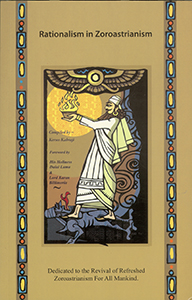
The saving grace of this booklet is the wonderful set of color illustrations provided by Farzana Cooper – they are absolute delights, and have even subconsciously incorporated some amusing sideshows. It is for these plates alone that the reader is recommended to part with Rs 400.