A pictorial presentation of 19th century Parsis dressed in their distinctive garb
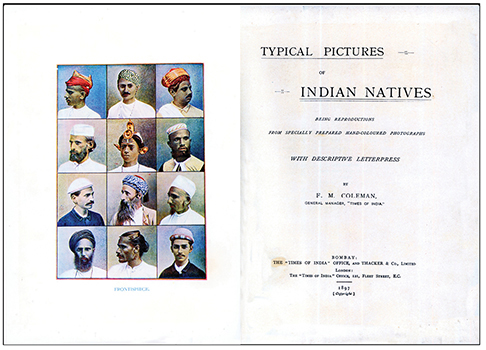
These extracts appeared in Typical Pictures of Indian Natives, being representations from specially prepared hand-colored photographs with descriptive letterpress by F. M. Coleman, printed in 1897. Coleman, general manager, Times of India, explains in his introduction: "The ‘Gorgeous East,’ if robbed of the vivid coloring which is its greatest charm, would cease to please… (This book is prepared) to enable travelers to present to their friends at home a true rendering of the varied and picturesque costumes worn by natives of India.” There are photographs and descriptions of all the "native” communities. Three pertaining to the Parsis are reprinted here.
Top, from l: Parsee lady and a school girl
Parsee lady
There are no such gaily attired women in the world as the Parsees. Their costumes, though similar in form to those of the Hindoos, usually comprise less vivid colors — pale pink, sea green and lemon being favorite shades. The younger members of the community wear stockings, and shoes of English shape.
A strange old custom in Parsee society is for the head of both males and females to be always covered, although there does not appear to be any other reason for this than long usage. The men, when not wearing their outdoor headcovering, put on a round cap, flat at the top, but as this is apparently in many instances only worn to comply with the letter rather than the spirit of the injunction, it is not infrequently worn so small as to forcibly remind us of the appearance of the humble companion of the organ grinder, minus the chin strap. The article worn by the women over their hair is known as a mathabana, and resembles a white pocket-handkerchief. Its use does not improve their personal appearance. In the walking costume, however, the sari, or outside garment, is passed round the shoulders and over the top of the head, so that the mathabana is unobserved, and the tout ensemble (total effect) is then very graceful.
The most earnest desire and the highest ambition of a Parsee damsel is to secure an eligible husband, but she stands no chance whatever of becoming a bride unless her father pays, and pays handsomely, for the honor. A dowry is necessary, and the older the maiden, the larger the qualifying accompaniment has to become. It is by no means uncommon for a man earning a monthly salary of Rs 30, to spend six months’ earnings upon the marriage of his daughter. This is not done from a wanton disregard of due economy, but because it is dastoor — custom — and custom and caste are the two most far reaching words in the vocabulary of the continent of Hindustan, to whatever class of natives the words may be applied.
Parsees usually take three meals a day, the constituents of which very nearly resemble those of Europeans. It was formerly the custom for the men to eat first, and then allow the women to finish what was left, after the fashion still adopted by the Hindoos. But of late this, and many other old habits, have fallen into disuse, and the meals are now taken together, the family being seated at a table, instead of squatting upon the floor.
The Parsee
The advantages derived by the natives of India from the British conquest of the country have in no instance been so marked as among the Parsees. Before that event had been consummated, they were literally the hewers of wood and drawers of water for their rulers, whereas at the present time they have been enabled to become one of the most enlightened and wealthy races in the west of India. The hat worn by the Parsees is not their own original form of topi, although frequently regarded as such, but is similar to that worn by a section of the inhabitants of Gujerat.
They are of Persian origin, having fled from their country about the year 716 (AC), in order to escape from the tyrannies of their Mohamedan conquerors, and are supposed to have first settled in the island of Diew, near the coast of Kathiawar; shortly afterwards, however, they changed their quarters for Gujerat. Here they were only permitted to remain on condition that they adopted the language of the country and dressed their women in Indian garb. At the present day their community numbers about 70,000 persons, inclusive of those who have settled in China and elsewhere. Very few Parsees engage in agricultural pursuits, nor do we find a single soldier among them. Many learn trades, and the commercial world in general finds numerous recruits from their ranks.
The indoor male costume consists of a muslin shirt, a pair of loose white cotton trousers, a cotton waistcoat with sleeves, a skull cap and slippers. For outdoor wear, a long loose coat of cotton or cloth is added and, in addition to the cap, a hat or turban is worn. There is also a special costume, worn only on the occasion of a funeral and a wedding, which consists of a long double-breasted white cotton coat, gathered in at the waist by a broad white sash, and reaching to the ankles.
A peculiarity of the Parsees is their manner of disposing of the dead. In Bombay, and certain other large towns in Western India, they have erected what are called "Towers of Silence.” These consist of circular structures, built of stone from 20 to 30 ft high, the diameter of the largest being 90 ft. Inside the tower is a circular pavement, shelving towards the center, which terminates in what may be called a well, forming the center of the tower. On this pavement are three circular rows of wide grooves, about an inch in depth, in which the bodies are deposited. In the course of about an hour vultures have completely stripped the flesh from the bones, which are afterwards thrown into the pit in the middle of the tower, where they eventually crumble into dust.
The Parsees are followers of the Zoroastrian faith which admits of the belief in a Supreme Being but the very prevalent supposition that they are worshippers of the sun, or of fire, has no foundation in fact. In offering prayers, their faces are turned towards the sun, as being one of the most powerful symbols of the Almighty, and from this has probably arisen the mistaken notion.
Parsee school girl
Among the many strange costumes which attract the eye of a newcomer, few appear so grotesque as that of the Parsee young lady, when at that stage of her existence which is prior to the assumption of her outer garment. One gets used to many things in India, but to see a little damsel of 10 or 11 years of age skipping about, without the semblance of either a frock or a petticoat, is at first sight a comical picture.
Her jacket may be of cloth, or of cotton, or silk, according to the season, but it is always cut in the same style, falling just below the waist. Sometimes little colored silk or satin trousers are worn, reaching to the ankle, and then of course the absence of either a frock or a sari is not so noticeable. Most young Parsee girls have their hair done up in a knob at the back of the head, as shown in the picture, but this is merely a matter of taste, it being occasionally allowed to hang loose upon the shoulders. A cap, similar in shape to the undress cap worn by the male members of the community, is always their form of headgear, unless a European costume is adopted, and then it is not infrequently difficult to distinguish the little wearer from an English child, except from her surroundings, as the complexion of many Parsees is very fair. A few are really brown, it is true, but the majority are little darker than the inhabitants of southern Europe.
Considering how fluently the men usually speak English, it is surprising to note that the Parsee women folk, as a body, know relatively little of our language. Occasionally, however, we have exceptions to the rule, and there are now living in Bombay several young Parsee ladies who, having qualified themselves by passing the necessary examinations, are earning their living as medical practitioners.