The sanctity and heritage of Bombay is further threatened by government
The Street Vendors Act, 2014 has as its objectives the "Protection of livelihood and regulation of street vending” but its proposed implementation appears to be achieving neither goal and upsetting everyone.
On Sunday morning, April 19, 2015, many areas of the city witnessed an outpouring of residents on the streets expressing their opposition to the Bombay Municipal Corporation’s (BMC) proposal to create hawking zones in residential areas. Placards reading, "We say no to hawkers in our city,” "Develop municipal markets,” "Shift hawkers to markets,” "F North Ward wants a Say in how we Stay!! Save our city,” "Footpaths are for walking, not for hawking” and many more expressing similar sentiments were on display.
Morcha at Parsi colony in Dadar
Bust of colony founder Mancherji Joshi
Even the usually apolitical Parsis took out a procession from the landmark Five Gardens locale situated between the Parsi Colony in Dadar and the Hindu Colony in Matunga along the sylvan Mancherji Joshi Road named after the Parsi Colony’s founder. Addressing a gathering of around 1,000 before Joshi’s marble bust, Udvada High Priest Dastur Khurshed Dastoor stated, "We want the BMC to know this peaceful, harmonious…community has not asked for anything (but) we will not allow hawkers… This is the time we all (Parsis and others) have to come together” to voice our dissent.
Terming the gathering "enormous,” Bombay Parsi Punchayet (BPP) chairman Dinshaw Mehta lamented that if the late Dadar Parsi Colony resident Rustom Tirandaz "were alive today this (proposed encroachment) would never have happened.” He would have scuttled the proposal in the initial stages. Tirandaz was once leader of the opposition in the Corporation.
Mehta said the BMC’s perception of the community was that of "bailaas (sissies)” and said that his lawyer friend Berjis Desai, managing partner of the reputed law firm J. Sagar Associates, community activist and Parsiana columnist, had told him that he and other lawyers would fight the case pro bono should the matter go to court.
Mehta noted the BMC F North ward officer had sent a letter to the deputy municipal commissioner stating hawkers should not be permitted in the area. A news item in The Times of India (April 18, 2015) stated the ward office "has suggested cancelling hawking pitches” on certain roads in the Hindu and Parsi colonies. A fire temple and schools were among the areas marked for hawking, a violation of the guidelines.
Joshi’s granddaughter Zareen Engineer noted her grandfather had been a corporator for 17 years and had ensured the Colony was allotted green, open spaces as well as a covenant that only Parsis could reside there. Mithoo Jesia, who compere Mahiyar Dastoor termed "the Lady of the Colony,” said the colonites were "not against hawkers. Hawkers have as much a right as you or I.” She noted that Katrak Street was marked as a commercial area 95 years ago "and we have no problem with that.” The opposition was to hawking in areas marked for residential purposes. Pointing out that Zoroastrianism did not prescribe "turning the other cheek,” she asked the gathering to pledge they would "do everything in (their) power to protest and protect.”
The residents alleged that the present Congress corporator, Nayna Seth Doshi, did nothing to prevent the hawker zones being demarcated in the Parsi and Hindu colonies. When Parsiana attempted to speak to Doshi to ascertain her point of view, several agitated protesters plucked the papers handed by her to Parsiana and shoved them back in her hands. "We don’t want politicians participating in the protest,” was their chant. A purported request by her to address the gathering was also denied.
Community activist, Dadar resident and Congress member Mehernosh Fitter later sent scanned copies of the letters to Parsiana and stated she had written to the BMC commissioner on March 27, 2015 "objecting to the public footpaths or roads (being) occupied (by) hawkers… She has suggested instead to develop the BMC Matunga and Wadala market for…hawkers’ stalls.”
Even the hawkers are unenthused over being located in non-commercial areas. A news item in The Indian Express (IE) of April 22, 2015 quotes the general secretary of the Azad Hawkers Union, Salma Sheikh as stating a shift "to residential areas …is illogical for it will merely lead to loss of livelihood and nothing else.” The founder of the Union, Dayashankar Singh alleges the shift is a deliberate ploy to thwart the Act’s requirement that 2.5 percent of a city’s population have to be vendors: "The money collection by officials will end if hawkers are granted pitches legally. That is why the BMC has deliberately marked hawking zones in residential areas so that the proposal is axed because of protests.”
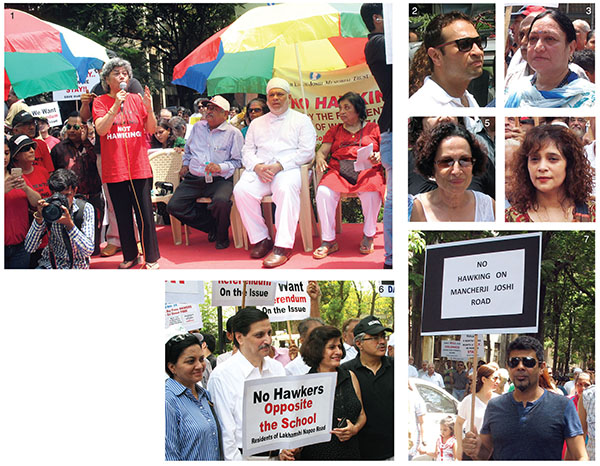
1) Zareen Engineer addressing the gathering with Dinshaw Mehta, Dastur Khurshed Dastoor and Mithoo Jesia on stage;
2) BPP trustee Jimmy Mistry; 3) Nayna Seth Doshi; 4) ghazal singer Penaaz Masani; 5) writer Bachi Karkaria;
6) community activist Anahita Desai, BPP trustees Yazdi Desai and Arnavaz Mistry, and Mahiyar Dastoor;
7) sculptor Arzan Khambatta Photos: Dolly Divecha
In an article titled "How we define the street,” which appeared in the March 10, 2014 issue of IE, assistant professor of anthropology at Brandeis University in Massachusetts, USA, Jonathan Shapiro Anjaria noted, "The question of street vendors’ rights ultimately comes down to our understanding of the city, the public spaces that constitute it and the people who animate it. It lies in the resolution of a tension between the regulatory impulse to segregate and concretize, on one hand, and the flexibility and fluidity essential to vibrant public spaces on the other. It also lies in the fundamental questions all cities face: How do we define streets — as places to pass through, or spaces of sociality?”
"Glaring omissions”
Aside from the contentious issue of hawkers, the BMC is also facing flak for its Development Plan (DP) which was finally sent back to the drawing board by the chief minister. Many heritage structures have been omitted from the plan including over 20 fire temples.
The financial daily Mint (April 20, 2015) carries an interview with Cyrus Guzder, founder member of Citizens for Justice and Peace, who also has served on the city’s Heritage Committee wherein he states, "If you look at all these glaring omissions, they are either the result of absolute ineptitude or perhaps the intent to support vested interests… Either way, it is very objectionable. On heritage, Bombay was the pioneer in city heritage legislation. In 1995, the city enacted a heritage list which has stayed and endured right up to today. Initially, it had some 680 buildings on it, graded as one, two and three… now the total number of buildings on the list which have the force of law is about 1,480. What has happened in this DP is 1,000 buildings have just disappeared from the plan. So, they have obliterated roughly three quarters of the heritage of Bombay. The implication of this is that either all of the buildings that they have their eye on are slated for redevelopment or it means that they simply don’t believe that heritage is worth conserving anymore. The sad thing about this is that in the long run, it is the preservation of urban form and heritage that gives the city its sense of history and its sense of belonging. If you want to obliterate this, then you will convert the whole of the city into large tracts of what we see today as suburbia without any sense of character or urban form.”
Noted architect Sam Rao in a letter on behalf of one of his clients to the BMC commissioner stated, "When the first heritage list was prepared and made public in 1995, (I) felt that the Corporation was moving in the right direction towards the preservation of the heritage properties in (this) city... (They) are now making a mockery of the heritage... The original owner of Dhun Lodge had appointed us (Poonager Bilimoria and Company) as his architect… the building had been repaired and was well maintained. However it was a shock to me when one fine day, just a couple of months back, I saw that beautiful heritage building being brought down before my very eyes and now a monstrosity of a high rise building will be coming up ... that will have no character or resemblance whatsoever to the old Dhun Lodge which was a delight to see.”
Who is a hawker?
The Street Vendors Act, 2014 Act defines a street vendor as "a person engaged in vending of articles, goods, wares, food items or merchandise of everyday use or offering services to the general public, in a street, lane, sidewalk, footpath, pavement, public park or any other public place or private area, from a temporary built up structure or by moving from place to place and includes hawker, peddler, squatter and all other synonymous terms which may be local or region specific.”