Tata – Living by Values: A Travelogue by Donn Doongaji. Published in 2022 by The Write Place, Crossword Bookstores Limited, 1st Floor, Sohrab Hall, Opposite Jehangir Hospital, Behind Pune Railway Station, Poona 411001; website: www.The Write Place.in Pp: xxiv + 358. Price: Rs 695.
James O’Toole, in his introduction to Donn Doongaji’s book Tata — Living by Values, emphasizes how the ingrained values of integrity, reliance and social responsibility of the founder Jamsetji Tata have survived over a century.
Doongaji has worked in various departments of the organization and addressed the social requirements of the community as a whole while giving priority to environmental improvement and preservation of vegetation in planning.
The origins of the Tata ethos no doubt lie in the concepts of good thoughts, good words and good deeds. A major part of the profits of the Tata Group are channeled to the shareholding trusts.
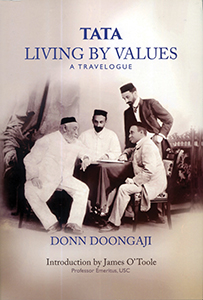
Throughout his book, Doongaji portrays the importance of honesty and character during selection of employees so that the Tata name should not be tarnished as happened in the Tata Finance Company in 2001.
Emotional happiness not only for its employees but for the nation was the late J. R. D. Tata’s goal, and the Tata companies strove towards it by encouraging work fulfillment.
The personal story of Doongaji’s family and his upbringing, mainly by his grandparents, makes for fascinating reading and highlight the feasibility of inter-religious harmony, if pursued with tolerance and understanding. The inherent instinct for charity, instilled by observing his grandfather, engendered in Doongaji the joy of seeing happiness in others. Also, his constant changing environment during youth made him adapt easily to varying circumstances.
While describing his tenure in Jamshedpur he dwells on the spirit of camaraderie prevalent among the Tata employees, irrespective of rank. The love and respect of the workers is demonstrated when they wrote to the then Janata Government opposing nationalization of Tata Iron and Steel Company (TISCO).
Doongaji’s experience in working in various sections and departments of Tatas also tells us of the spirit of bonhomie which pervades the organization, making it not only efficient but also a pleasant workplace. He stresses how "J. R. D. empowered everyone” and was proud of his or her success. "True leadership is omnipresent and felt, not necessarily seen.”
An entire chapter on sports reveals the role of Sir Dorabji Tata, a great sportsman, in supporting the participation of Indian athletes in world events like the Olympics and Commonwealth Games. Sport was not a profession in those days and it was only due to the support of private organizations like the Tatas that our athletes and sportsmen could forge ahead. Recreation for employees was part of the Tata ethos and bridge tournaments were popular.
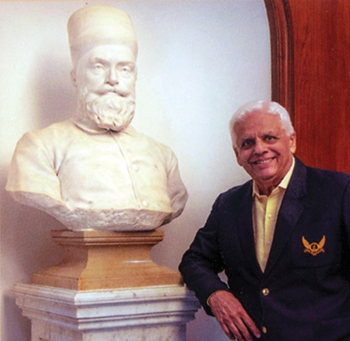
Donn Doongaji with bust of Jamsetji Tata
Young officers were given an opportunity to interact with eminent seniors in the group like J. R. D. Tata, Sumant Moolgaokar, Nani Palkhivala, Russi Mody and others, to enable them to understand the true purpose of business, to balance and hold the interest of all stakeholders and not be afraid to modify and maximize profit.
The latter half of the book stresses the importance of the workers and their supervisors in contributing towards products of high quality. The Tata ethos has always been to solve the problems of workers, urging them to to clear any misunderstanding that may occur.
Doongaji, having worked at the administrative and grassroots level, has been able to bring out the ethos of the Tata Group. The publication is certainly worth a read as it not only reinforces one’s faith in humanity but gives us pride in the integrity and values of the Group.
Dr PILLOO P. HAKIM
Dr Hakim is professor emeritus, Grant Medical College and Sir J. J. Group of Hospitals, Department of Ear, Nose and Throat (ENT) and Head and Neck Oncology, and honorary consulting ENT surgeon at Saifee and The B. D. Petit Parsee General hospitals.