Died: Homai Nadir Modi, 82, trustee and joint honorary secretary of The K. R. Cama Oriental Institute (KRCOI), erstwhile general secretary of the Indian Red Cross Society (IRCS) Maharashtra state branch, honorary secretary of the Fourth and Fifth World Zoroastrian Congress (WZC) held in Bombay in 1985 and 1990; on March 25, 2022 in Bombay following abdominal sepsis.
With her organizational skills, methodical ways, eye for detail, charming disposition, ability to give and command respect, Modi could win over heads of state as also of the community. Whether organizing the WZCs, the seminars at KRCOI or the exhibitions that showcased the community, Modi’s touch ensured the smooth progress of events. At the time of the 10th WZC in Bombay in 2013, when administrative matters were in disarray, Modi had to be roped in at the penultimate hour to salvage the event that was inaugurated by the President of India Pranab Mukherjee.
Although she worked closely with different Bombay Parsi Punchayet (BPP) trust boards, Modi chose to distance herself from politics. In 1985 when the BPP set up a marriage bureau, she and dramatist Adi Marzban along with others planned activities that could help singles find life partners. Seeing the attitude of parents, some of whom did not want their offspring to get married, or insisted on a gher jamai (son-in-law who would reside with the wife’s parents), or a daughter-in-law whose earning capacity was higher than their son’s she was not surprised that the bureau’s efforts resulted in an insignificant number of community marriages. Likewise when the Jiyo Parsi scheme was launched in 2013 Modi was sanguine that it would have limited impact for mere financial aid from the government to assist those who need fertility treatment would not help increase the community numbers. "Change is a must,” she believed, for besides low fertility, there were other attitudinal factors that contribute to the community decline like preference for higher education and career fulfilment leading to late marriages, interfaith marriages, economic constraints, fewer joint families to look after the children, more divorces… (see "Jiyo and jaago Parsis,” Parsiana, November 7, 2013).
When BPP trustees constituted the Doongerwadi Advisory Committee in 2011, she was among the two social workers selected to work alongside the trustees and the members of the Council of High Priests. A firm votary of treading the middle path, she understood, "Bigotry can have no place in matters religious… When prayers for the departed are denied, especially when our dakhmenashini system does no longer work properly, we fracture our community.”
Having repeatedly officiated at BPP trusteeship elections, Modi felt that the community was not ready for adult franchise. She believed like Nani Palkhivala that we need to "educate our people first to make them worthy of discharging their duties as citizens of a great democracy.” When Parsiana had sought views of community activists on what are the qualities one should seek in trusteeship candidates she had opined, "Look for persons with a good background, wide experience, who are upright and honest… People who are committed and selfless, with a proven track record in community service… Select someone who has put money into the BPP without motives of self-benefit… follows the religion to the best of his/her belief… has the ability to conduct meetings with discipline and decorum… has time to devote to BPP… is reasonably accessible to the public… (see "Believing in miracles,” Parsiana, August 21, 2007).
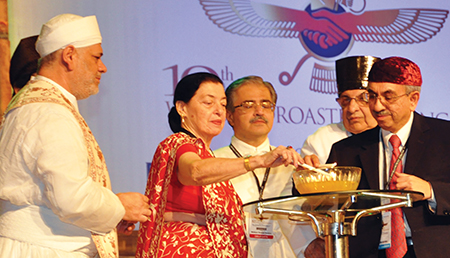
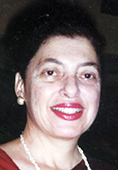
Top: Homai Modi; above: at the 10th World Zoroastrian Congress (with from l)
Dastur Khurshed Dastoor, Mahiyar Dastoor, Dr Cyrus Poonawalla, Nadir Godrej
Modi was involved with the KRCOI since 1982. Having succeeded Dr Homi Eduljee as joint honorary secretary at the KRCOI when she was "a total novice,” she had acknowledged the guidance she received from her precursor and Dastur (Dr) Kaikhusroo JamaspAsa, both of whom were regulars at the Institute. Since her responsibilities required her to edit the KRCOI Journal, she would consult these scholars for their sage advice.
As trustee-secretary she was further instrumental in organizing the Parsika exhibition at the Prince of Wales Museum on the occasion of KRCOI’s 75th anniversary in 1990. With the exhibition having "touched the hearts of Zoroastrians” who took pride in their culture, it was repeatedly suggested that the religious, historical, cultural and artistic exhibits should be exhibited for posterity.
This task was taken up by the Foundation for the Development of Udvada where Modi was a trustee. She thus played a key role in the creation of the Zoroastrian Information Centre in Udvada in 2008. Her skills had also been put to use in the creation of Sir Jamsetjee Jejeebhoy Memorial Museum in Navsari.
A managing committee member of the Red Cross in Delhi, until five years ago she continued to serve as general secretary of the IRCS in Maharashtra. The home page of their website carried a parting message "Fondly remembered by the Red Cross fraternity.” The accompanying photo of a cheerful Homai in short white hair looked different from her earlier distinctive style where dressed in a sari, her black tresses would be neatly tied up in a French bun at the nape of her neck. She had enduring ties with the Bel-Air TB and HIV Sanatorium and Hospital in Panchgani managed by the IRCS as also the Ayurveda and Naturopathy Centre in Panchgani. Bel-Air had won The Times of India Healthcare Achievers Award 2014 in the category "Innovation in managing long-term conditions.”
The hands-on social worker had earlier related her personal experiences at Gadchiroli, the Naxal affected area of Maharashtra where the Red Cross ran a mobile health unit covering nearly 30 villages. The Red Cross principles of respect for all life and strict neutrality between warring factions had guided her conduct too in all fields.
Modi had served as the chancellor’s nominee on the senate of the University of Bombay from 1998 to 2005. At the inauguration of Sir Pherozeshah Mehta Bhavan and Research Centre on the University campus in Kalina in 2007, then governor of Maharashtra and chancellor of the Bombay University S. M. Krishna acknowledged that Modi along with Dr Nawaz Mody had contributed immensely towards the creation of this structure. "Were it not for their perseverance — despite several setbacks and disappointments, commitment to the cause, involvement in raising funds and planning the entire project so meticulously — the Bhavan would not have been completed…” Modi’s contacts had helped secure donations from Faridoon and Mehraban Zartoshty towards creating the Zartoshty Brothers’ Library as also the Jamshed and Shirin Guzder Auditorium in the edifice comprising 40 rooms built at a cost of six crore rupees.
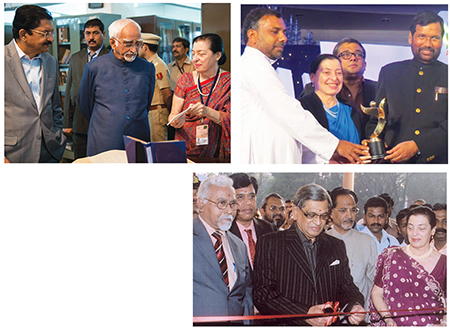
(Clockwise from above l) At the K. R. Cama Oriental Institute in 2015: Ch Vidyasagar Rao,
Mohammed Hamid Ansari, Modi Photo: Devki Dhuldhoya;receiving award for Bel-Air in 2014: Fr Tomy Kariyilakulam,
Modi, Joy Chakraborty, Ram Vilas Paswan; at the inauguration of Sir Pherozeshah Mehta Bhavan and
Research Centre in 2007: Modi, S. M. Krishna (cutting ribbon), Vijay Khole
The eldest born of Khorshed and Minoo Minocher-Homji, Homai’s early education was in Karachi. When the family relocated to Bombay in undivided India, Homai continued her studies at The Cathedral and John Connon School. As a young girl, she learnt ballet and acrobatics, recalls her younger sister Firoza Bhabha who was 15 years her junior. Homai earned her BA and MA in English from Jai Hind College and got married to noted advocate Ervad Nadir Modi at the young age of 21 years. After separating from her husband she had more time for community and social work. Stamp and coin collecting were her avenues for relaxation.
"I continue to believe in my community. I also believe in miracles,” Homai had remarked. "Despite being individually intelligent, when we break our tradition of being collectively foolish, that will be the day!”
The indefatigable social worker is survived by her brother Behman Minocher-Homji, sister Firoza Bhabha, sons Pesi and Noshirwan, and daughter Nawaz Modi Singhania.