When Sterling Cineplex (pictured) turned 50 in October 2019, Kaizad Mistry, a director in the partnership firm that owns the three-screen venue, wrote that the theater was "the first in Bombay, and perhaps India’s first to present THX Certified Cinema, (which is) designed to recreate the acoustics and ambiance of the movie studio.” The certification establishes that the venue has superior audio reproduction, in accordance with international standards. The theater was also the first to introduce Dolby Sound and Xenon Projection Systems, technologies that enhanced the movie-viewing experience, noted Mistry. Its three dimensional (3D) 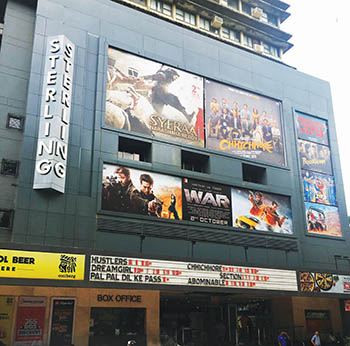 equipment provides "unmatched image brightness and unparalleled 3D experience” for audiences, noted a press release from the Cineplex. Built as a single screen theater, Sterling was converted into a three-screen Cineplex about a decade ago.
The Cineplex stands in the erstwhile compound of the ornate white-facaded Tata House (Palace). Rajendra Narla of the Tata Central Archives wrote in response to Parsiana’s inquiries that Sir Ratan Tata (son of the Tata Group founder Jamsetji) planned the construction of a "palatial house,” which on completion would be named Tata House, on Waudby Road (today’s Hazarimal Somani Marg) in 1912. The industrialist engaged a Parisian architect, one M. Maurice, to prepare the designs. "The building in some respects was inspired by the famous Petit Trianon at Versailles,” Narla informed us. The work was completed first under the supervision of the architect Charles Stevens and later under another architect Dara Mirza. Sir Ratan took a keen interest in the work of construction and "attended to all details personally.”
During the four years that it took to construct the building, work on many occasions was interrupted because of World War I. "Most of the materials used for the palatial residence were imported from France. However, the entire outside railing and the ornate gates were made at the Tata Iron and Steel Works (now Tata Steel) at Jamshedpur and Sir Ratan took great pride in displaying them,” elaborated Narla. The House was completed in 1915 at a cost of Rs 10 lakhs, he explained. Sir Ratan "was only able to stay in this house for a few month as he sailed for England for medical treatment and passed away over there.” Ratan’s wife Lady Navajbai resided in this house, as did Naval, Simone and present Tata Sons chairman emeritus Ratan Tata. "The building subsequently went on to be utilized as a residential-cum-office space for the Tatas.”Around 1991 Tata House was purchased by the Deutsche Bank who currently operate out of this heritage building, he stated.
"As of now Sterling has no Tata connection,” Narla wrote.