There were two Zoroastrians among the
artistes from India and abroad who were shortlisted
for The Beyond Killa Art Festival in Pardi
in The Beyond Killa Art Festival in Pardi
Mehroo Kotval
A man was trying to paste a bill on the mural,” said Pritishbhai Bharucha, narrating an incident where rickshawalas prevented an advertiser from sticking a poster on the mural in the railway bridge underpass in Pardi, a town in the Valsad district of Gujarat. Bharucha, a professional voice dubbing artist, was referring to the wall of mural portraits of the karamcharis (municipal workers) of the Pardi Municipality. "Jagruti aavi gai chhè (people are awakened),” he stated, pleased that the rickshawalas had stopped the publicist from defacing "their” mural. The beautification movement, which began with this wall has spread to the town culminating in The Beyond Killa Art Festival (BKAF) in Pardi. Bharucha, along with several other residents of Pardi helped put together the BKAF inside the premises of the historic fort (killa) on a promontory near the river Pardi.
Painting the humble karamcharis was the idea of Somu Desai, project director, visual artist and organizer who spearheaded the BKAF. Desai’s intention was to place Pardi on the cultural map. Before the Festival, only a few had known where Pardi was and some had never even heard of it. Desai scoured his network to bring together international and Indian artists to create installations which were scheduled to remain on display till June 6. Unfortunately, due to the countrywide lockdown this did not happen and with the monsoon season looming they had to be removed. Though disappointed, Desai seems to have taken these developments in his stride, as there was no option during the pandemic.
He was staunchly supported by Falguni Bhatt, teacher and mayor of Pardi Nagarpalika. Earlier, during preparations for the Festival, Bhatt had the electricity supply extended up to the hillock where the fort stands in record time, created a paved path for pedestrians and motorists, and obtained sundry permissions, no mean achievements.
Participating in the Festival were eight Indian artists from Pardi, Baroda, Bhuj, Bombay, Jaipur, New Delhi and neighboring Udvada. Foreign artists travelled from France, Ghana, Hungary, Japan, South Korea and the UK. The Iranian artists were denied permission to travel and they were as disappointed as the organizers. All the artists remained in residence at Pardi for about two weeks from January 15-30, 2020.
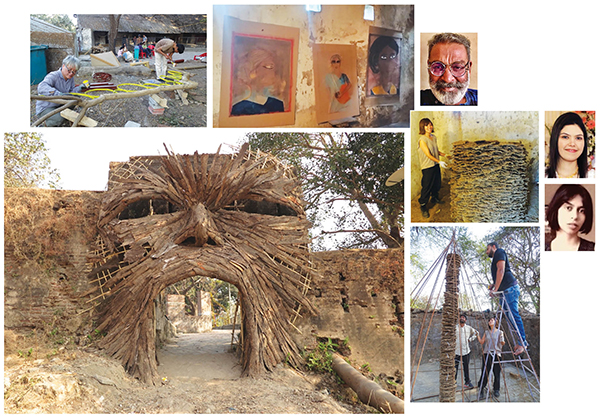
Installations at The Beyond Killa Art Festival in Pardi with organizer Somu Desai (wearing spectacles),
Kainaaz Pardiwala-Hathiram (top right) and Freny Pavri (above right)
Both the artistes from Udvada are Zoroastrians — Freny Pavri, 37, based in the UK with a home in Udvada and Kainaaz Pardiwala-Hathiram 29, who shuttles between the fire temple town, where her husband Ervad Marzban Hathiram lives, and Pardi where her parental home and dance class are located.
They were initially reluctant to participate, stating that they were not installation artists. Pardiwala-Hathiram is an exponent of the Indian classical dance form Bharat Natyam while Pavri is a performing artiste in theater and plays the rudra veena, an Indian classical string instrument. She also does portraits and photography. Desai asked Pavri to depict killa scenes as well as still life as her forte is portraying people and their culture. Her art was displayed in two or three rooms of the killa which had at one time been used as jail khanas (cells) by the British. She explains that the windows were "very small with narrow frames and the rooms are dark. Each cell is completely different from the other; even the windows differ. Only one cell has a huge window and adjacent to that is a cell with a skylight. For a brief time a strong beam of light enters, creating a special effect.” Though low wattage bulbs were installed, the artists had to adjust to the dimness or install their creations outdoors in the rustic setting.
Inspired by observing the laborers and gardeners at the killa, Pavri depicted a sweeper woman. Her portraits, she says, are "an amalgamation of me and what I feel about what I see. Women are strong and fight to protect their children. What they have to endure entails bravery, vigilance and vulnerability. They are seemingly from a different world but live with and among us. I’m putting them in a jail which could subject them to possible interrogation. Through this murky light, one interprets the metaphor (as one wishes). Spaces offer a lot of stories. I’m working on a two-dimensional format.”
Pavri was influenced by Mahendra Kedia, her art teacher in her mother Nina’s school in Ahmedabad — The Firdaus Amrut School — from which she and her brothers Peshotan and Firdaus passed out. She describes Kedia "as a most inspiring human being. He taught through example, with a passion for his work rather than in a traditional manner. He made me feel as if I was a fellow artist even when I was a child; as if we were on this journey together.” With Kedia’s sustained encouragement Pavri thrived as a spirited, independent person. She adds, "Your work was your responsibility. He never judged but encouraged by giving suggestions; and there was no right or wrong. He would just draw a line on your artwork and change the entire perspective.” His favorite adage, she recalls, was repeated regularly — "mechanical nai bani javaanu (never become mechanical).”
She worked in theater and her job involved art development, looking at funding, production, financing for festivals, researching where to tap for funds, etc. She decided that instead of doing all this for others, as she had done for 10 years, she might as well do it for herself. Living in the UK, she missed India until "the sitar happened to me” which she took up learning seriously. She eventually found her métier in the rudra veena. Unable to find a suitable guru in the UK she returned to India to study under Ustad Bahauddin Dagar for two years, commuting between his classes in Bombay and her residence in Udvada. "Your exam is your performance. It is a slow, long process,” she says. The sudreh-kusti wearing Zoroastrian wends her way to the Iranshah every day when based in Udvada.
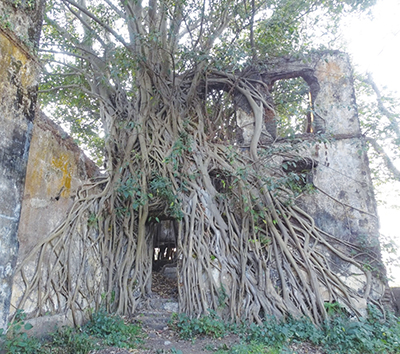
Peepal tree at the killa: the highlight of the Festival
Since the Festival did not run its full course, Pardiwala-Hathiram could not showcase her talent. A devout Zoroastrian, the dancer found the sudreh inconvenient during performances, but under the tutelage of her priest husband she now wears it while performing, as she has her stylish cholis tailored much longer. Passionate about dance, she has had exposure not only to Bharat Natyam but modern ballet as well. The creative girl had blanked out during her physics examination in 12th grade and ultimately failed, leading to depression. Her father Dara Pardiwala, who founded the Bhaskar Dyuti Vidyalay in Pardi, recommended she visit her married sister Pearl in Madras. Pearl’s husband, Ervad Burzin Unwala prevailed on her to enroll in Deiv’s Dance Academy there — a small hip-hop dance group. The owner, Prasanna Kumar, had to go out of Madras for a few months and left his class in the beginner’s care. Pardiwala-Hathiram’s confidence surged. The students were very happy with her tutelage and put up a much appreciated commercial performance. The new dance teacher then learnt salsa and mastered it within two-and-a-half months. This boost entitled her to go on a tour after a month’s probation.
Two auditions later, Prasanna wanted Pardiwala-Hathiram to join other seasoned artistes on a national tour but insisted on first talking to her father as she had just turned 18 then. Dara gave immediate approval but said he wanted Prasanna’s help to ensure that his daughter became a graduate at least. "Having regained my confidence and seeing doors opening, I realized my potential. I could see a future,” said Pardiwala-Hathiram. "I appeared for my 12th again and passed,” she stated, gazing heavenwards. She was back on track. She completed a bachelor’s degree course in dance at the Maharaja Sayajirao University of Baroda followed by a Master’s degree in Performing Arts with dance as her major. A new world opened up to her. She became a serious exponent of classical dance, "understanding its richness and value. I even did a diploma in Hindustani voice training via evening classes. I have classical vocabulary. The traditional art form is bound by rules whilst contemporary dance is open to imagination and creativity.”
Prasanna encouraged her to train at the Broadway Dance Center in Manhattan, New York. The first three months of the six-month course seemed a washout for her as the foundation was ballet, a dance form that was alien to her. Ryan Daniel Beck, her contemporary dance teacher, took her under his wing. "He was a fabulous teacher and inspired me a lot. I have incorporated his style of teaching in my own (encouraging, pushing and being compassionate at the same time).” The six-month stint was extended by another three months which "changed my approach to life.” She admits she is a quiet person and did not really enjoy the hustle and bustle of the Big Apple. "I like the calm of a small town. NYC (New York City) did not suit my personality.”
Brought up with a traditional perspective, Pardiwala-Hathiram’s mother Bepsi (née Choksey) had instilled the values of family first in her three daughters. Bepsi stopped working after marriage, with the arrival of the first child Jasmine, and remained by her husband’s side through thick and thin.
Pardiwala-Hathiram strives to impart her love for classical art forms to the people in her home town of Pardi. She started a dance class in the compound of her parental home and named it Abubhuti (Experience) Dance Studio. She aspires for her students to respect their culture. Having travelled all over the country for her performances, she yearns to give Pardiwalas the same exposure. "I want them to attend performances, look at my poster and desire to pursue traditional art forms.” She laments that her classes for Bollywood and other hip-hop genres are packed but the classical art form hardly attracts a few. "Today, an arangetram (début on stage) is the ultimate in classical art form. But, most often, the story ends there.”