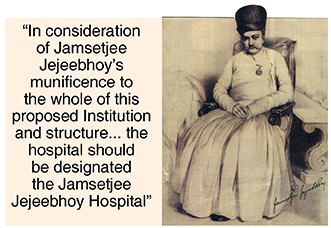
It was decided that in consideration of Sir Jamsetjee Jejeebhoy’s
munificence to the proposed institution and structure, the hospital
should be named after him
Dr Sunil K. Pandya
In the second part of his series detailing the founding of the Sir J. J. Hospital and the Grant Medical College in Bombay, the late medical researcher Dr Sunil K. Pandya wrote about the events leading to the opening of the now 180-year Hospital. Spread over 44 acres the institution is currently undergoing a partial makeover.
On August 20, 1845, Sir Jamsetjee Jejeebhoy wrote to the Earl of Clare in London: "My dear Lord. There is nothing that would give me greater pleasure than to see my friend Dr Mackie appointed to a share of the duties in the Jamsetjee Jejeebhoy (J. J.) Hospital, and if I thought I could have any influence with the government here or with the court of directors in furthering an object I know he has much at heart, I should most willingly make use of it in his favor but I have already seen enough to convince me that no representations from me would have the least effect. The government and the court are so prejudiced in favor of their own servants that a person in Dr Mackie’s position from the mere fact of his not being in their service and without any consideration of his claims to the employment he seeks is at once unscrupulously set aside and it would require more influence than I could command to effect any change in their views.” (Even Jejeebhoy could not prevail on the government to employ Mackie in the hospital named after him.)
On November 16, 1840, Jejeebhoy wrote to the government: "In order to facilitate a measure which must prove so very beneficial to the whole community, I have purchased (on February 1, 1840 from Dadabhoy Pestonjee and Muncherjee Pestonjee) for the sum of Rs 28,125 (USD 336) the ground adjacent to the Sudder Adawlat and which was originally fixed upon by the late committee as the most central spot for the proposed hospital that could be found on the whole island.”
In addition to the Rs 100,000 (USD 1,193) pledged earlier, he now offered to defray half the cost of the land and offer it to the government. In the document transferring it to the government, the land is referred to as "that piece or parcel of land or ground situated without the Fort walls of Bombay at the side of the Parell Road, bounded as follows, that is to say on or towards the east by a road leading to the house now occupied by Major Lester, on or towards the west by the Parell Road, on or towards the north by a piece of land belonging to Dadabhoy Pestonjee and Muncherjee Pestonjee and on or towards the south by the road leading to Baboola’s Tank and a part of which said piece of land or ground is No. 2227 and the remainder whereof is No. 455 on the books of the Collector of Land Revenue.”
Grant Medical College and Sir J. J. Hospital complex
Dadabhoy was an Indian pioneer in banking in Bombay. Douglas (1900) described him as "a man of unbounded means, of great credit, of great possessions in land, property... It was said that half of the land around Parel at one time belonged to him... He was amongst the 13 of the native population declared by Lord Clare in 1834 to be entitled to affix to their name the word Esquire...”
On November 25, the Governor accepted, with great satisfaction, this benevolent gesture.
On January 20, 1841, Jejeebhoy purchased at the cost of Rs 16,403 (USD 196) "houses which run along the high road in front of the space” on the site where it was proposed to construct the Grant Medical College and the Hospital. These houses were to be demolished.
Work on the actual construction now commenced. Rs 3,000 (USD 36) was spent in leveling the uneven ground by "removing thither clearings out of the Baboola Tank in its immediate neighborhood” and obtaining cartloads of dust and rubbish from the Fort. The stone needed for the construction was quarried from the site itself.
In his minute dated September 30, 1841, the Governor proposed: "In consideration of Jamsetjee Jejeebhoy’s munificence to the whole of this proposed institution and structure... the hospital should be designated the Jamsetjee Jejeebhoy Hospital.”
The final cost of construction of the Jamsetjee Jejeebhoy Hospital was Rs 1,35,706 (USD 1,619) of which Jejeebhoy paid Rs 1,00,000 (USD 1,160)and the government the rest. In addition to these expenses must be reckoned the cost of the ground and some other expenses during construction: Rs 61,134 (USD 729) paid by the government and Rs 8,531 (USD 102) paid by Jejeebhoy for the erection of a clock tower.
The Grant Medical College, on the other hand, cost Rs 89,906-4-2 (USD 1,073) of which Rs 44,800 (USD 535) was paid by the friends of Sir Robert Grant and the rest by the government.
The Hospital was built by kamathis, Telugu-speaking contractors and artisans from the Telangana region of what is now Andhra Pradesh. (They also constructed Victoria Terminus, the High Court, the University of Bombay and the Municipal Corporation buildings.) The first wave of these immigrants arrived in Bombay in 1757. Some were helpers in the British Army. They built their homes in the low-lying unwanted area near the present Grant Road railway station. As they extended their residential area, it was named after them — Kamathipura — later to gain notoriety as the red-light district of Bombay.
While the Hospital was being constructed, the Governor communicated to Jejeebhoy the text of the inscription to be placed at the entrance of the building, which he approved on October 3, 1841requesting that in addition to the English version, the text be translated into Marathi, Gujarati and Persian as well and engraved on the same site.
Orders to commence construction were issued on July 21, 1842.
Laying the foundation stone of the Sir Jamsetjee Jejeebhoy Hospital was the first major occasion of Masonic display in Bombay. The north-east cornerstone of the Hospital was laid by Dr James Burns, Grand Master of the Grand Lodge of All Scottish Freemasonry in India, on January 3, 1843. He was assisted by G. W. Anderson, Member of Council; Chief Magistrate L. R. Reid and J. P. Willoughby, Secretary to Government. Governor Sir George Arthur and Sir Thomas MacMahon, Commander-in-Chief (C-in-C) of the army in Bombay were in attendance.
Arthur paid the Parsi knight a very handsome and becoming compliment of coming to the Fort from Parel to accompany him to the ceremony. They reached the ground shortly after 4 p.m. The Registrar of the Lodge and the Treasurer presented the inscribed plate and coins to Arthur and Jejeebhoy. The inscription on the plate was read aloud to the audience.
The Lodge officials then descended into the trench. The coins and inscribed plate were deposited in their respective places. Cement was spread over them with a trowel and the foundation stone lowered on them.
On April 1, 1843, Jejeebhoy wrote to Capt W. Goodfellow, architect of the Hospital, as the latter prepared to return to England:
"My dear Goodfellow,
"Accompanying I have the pleasure to send you a silver trowel together with a note from the Private Secretary of H.E. (His Excellency) the Governor by which you will perceive that I am permitted to present the same to you in consideration of the trouble you have taken in laying the foundation stone of the Hospital on the 3rd January and I can assure you that I feel deeply indebted to you for the interest you have taken in carrying out my wishes about the Hospital.
"Wishing you and your family a safe and pleasant passage...”
General ground plan of the Grant Medical College and Sir J. J. Hospital
A sequel regarding the coins buried under the foundation stone occurred 115 years later when "on or about March 31, 1958 three mazdoors (laborers) — Dayanoo Laxman, Tukaram Gangoo and Antoo Ganoo — were detailed to dig the foundations of old Ward 11 of the (Jamsetjee Jejeebhoy) Hospital. Whilst they were digging, they found a casket and a silver plated copper sheet underneath the foundation stone. The casket was opened and found to contain gold and silver coins which they distributed among themselves. The empty casket and the plate were kept in the temporary shed erected for storing scrap.
"On May 2, 1958, about 12.30 p.m., Tukaram Naroo Kadam noted the empty casket and plate. The partner of the company, Abdul Karim Mussa, was immediately informed. He elicited the account of how the casket, coins and plate were unearthed from two of three mazdoors. The third had left for his village.
"Two gold and eight silver coins were recovered from one mazdoor. Some of the other coins had already been melted to prepare a putli har (literally translated as garland for a doll). Four gold and 14 silver coins were recovered from the other individual.
"The three mazdoors were convicted and sentenced to imprisonment for a year.
"Six gold and 22 silver coins were handed over to the Government.”
Dr Shantilal J. Mehta, Medical Superintendent of the Sir Jamsetjee Jejeebhoy Hospital proposed that these coins be placed in a showcase in the central hall of the new building of the hospital shortly to be constructed.
This was not permitted since the coins were "of pretty olden days” and deemed worthy of being displayed in a museum. The total value of the metal making up the coins and the engraved plate was deemed to be Rs 400 (USD 5) on January 8, 1965.
Top: Sir J. J. Hospital; above: Parsi Ward
Opening
The opening ceremony of the Jamsetjee Jejeebhoy Hospital was reported in The Bombay Times and Journal of Commerce, May 21, 1845:
On May 15, 1845 (Thursday), in the evening, the respectable members of the European and Native communities gathered at the Jamsetjee Jejeebhoy Hospital to do honor to its founder.
Jejeebhoy received the visitors as they entered the large hall, which formed the middle part of the building. The reporter commented:
"...The hall presents a tasteful appearance, with two rows of Gothic pillars supporting the interior of the roof. Fixed in the sidewalls of the hall are two marble slabs, each bearing two inscriptions, to the right in English and Hindoostanee, and to the left in Mahrathee and Guzerathee...”
He then quoted the English inscription: "This edifice was erected by Sir Jamsetjee Jeejeebhoy, Knight. The first native of Indiahonored with British Knighthood, who thus hoped to perform a pleasing duty towards his government, his country, and his people; And in solemn remembrance of blessings bestowed, to present this, his offering of religious gratitude to Almighty God, the Father of heaven — of the Christian — the Hindoo — Mahommedan — and the Parsee, With humble earnest prayer, for his continued care and blessing upon his children, his family, his tribe and his country.”
He continued his report:
"... About half past five o’clock, H.E. the C-in-C entered the Hall and soon afterwards the Governor’s band, which was in attendance during the evening... The hall was full and presented a most interesting appearance, for the black dress of the Civilian, the red of the Military, the blue of the Sailor were blended with the spotless white of the Native Gentlemen with their various distinguishing turbans...
"The building is of great length and extends itself like two Ts. A corridor or verandah runs on all sides, and the interior is divided into compartments
The wards were to be arranged according to the divisions of the poor; thus there will be two large wards for the Hindoos in which they will be placed according to their castes, two for the Mahomedans, two for the native Christians, two or more for the Parsees, which last are to be left at the disposal of the founder. When the old J. J. Hospital was demolished to give way to the new multi-storeyed building, the Parsee wards and the Jewish wards were shifted to their present location near the old Obstetric Institute.

Dr Sunil Pandya who wrote the two-part article on the history of the Sir J. J. Hospital and Grant Medical College passed away on December 17, 2024, before his well-researched piece appeared in print. His frequent collaborator in historical medical research was his wife, Dr Shubhada Pandya, a neurophysiologist and historian of leprosy in India. Several of his articles on Parsis in the medical field have been published in Parsiana.
The former Professor and Head, Department of Neurosurgery at Seth G. S. Medical College and KEM Hospital in Bombay, Dr Sunil later worked as a neurosurgeon at the Jaslok Hospital and Research Centre. His contributions to neurosurgery and medical ethics have left a legacy of excellence, integrity and compassion. On his passing, his body was donated for research.