I have read many stories about Parsis serving in the railways, including the one about "The engine driver’s curse” (Parsiana, February 21-March 6, 2021). My father Behramji, born in Bilimora in 1893 but having spent his early years in Navsari, used to narrate many tales about his uncles who were employed in the railways.
The first story is about one Edalji. He was a mail driver on the Bombay to Baroda line of the Bombay Baroda and Central India Railway (now Western Railway). As he had a dark complexion, and working for decades on coal engines did not help, he was stuck with the name Edalji Karia (black), though his surname was not Karia. As fate would have it, his wife was, in contrast, an extremely fair complexioned Parsi lady. Now Edalji, like most Parsis, was extremely fond of tarela boomla (fried Bombay ducks). When his train arrived at Bilimora station, his wife would be waiting on the platform with more than a dozen fried boomlas on a khumcha (a flat metal plate). Without leaving his seat in the locomotive, Edalji would gobble them down, picking up the Bombay ducks by their tails and dropping them into his mouth, eating them whole, soft bones and all. He never left his driver’s seat in the engine at Bilimora or at any other station. He remained in total control.
The second story is about another of my father’s uncles, whose name I have forgotten. He was from Navsari and worked as an engine driver for the South-Central Railway with headquarters at Guntakal (now in Andhra Pradesh). He was a bachelor and lived all alone in the railway quarters assigned to him. Not too fond of cooking, he would often open up a can or two for his lunch or dinner. One day, the tin’s contents were contaminated. He got food poisoning and died despite efforts (in the 1930s) to save him. Since his nearest relatives were in faraway Navsari and could not arrive in time, and as the body began to decompose, he was buried in a grave close to the Guntakal station’s outer signal cabin.
My late brother Rustom, who lived in Bangalore, would often travel to Bombay by train via Guntakal. My father would tell him to look out for his uncle’s grave near the outer signal cabin when the train slowed down.
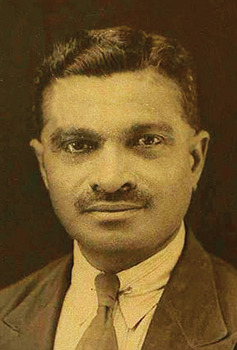
The third story is about my own uncle (father’s older brother) Dorabji Mancherji Damania (pictured). While employed in a Parsi owned general store in Lahore he made friends with a British customer who was a superintendent in the Northern Railways. The Englishman, impressed by Dorabji, gave him his card saying, "If ever you are in need of help contact me.” This Dorabji did some months later, after a spat with his boss. He went to Delhi and met the Englishman who asked him to report to the station master with his note. The very next day Dorabji was employed as a ticket collector even before a uniform could be stitched for him. He later became a guard of goods trains and was subsequently promoted to guard of passenger trains. I still have his whistle, made in England. Even today, after almost 100 years, it is loud enough to be heard at least half a kilometer away.