Died: Dr Jamshed Jiji Irani, 86, former managing director of Tata Iron and Steel Company Limited (TISCO, since renamed Tata Steel) and erstwhile director of Tata Sons plus other Tata Group companies, as also president of the Jamshedpur Parsee Association (JPA); on October 31, 2022 at Jamshedpur’s Tata Main Hospital following pneumonia with respiratory failure, post Covid.
Well-known figures from the corporate, political and social fields came to pay their last respects as a flower bedecked hearse carried the mortal remains of Irani for cremation at the Parvati Ghat in Bistupur, noted a report in Jamshedpur’s leading English newspaper, The Avenue Mail of November 1.
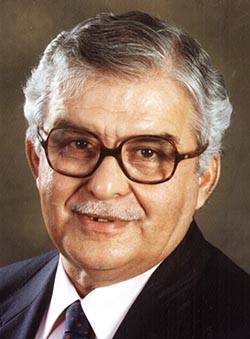
"Dr J. J. Irani was a quintessential Tata man. He was a towering corporate personality whose contribution to the steel industry was immense,” Tata Sons chairman N. Chandrasekaran was quoted in The Economic Times of November 2.
"Dr Irani transformed Tata Steel in the 1990s and made us one of the lowest cost steel producers in the world. He helped build a strong foundation on which we grew in the subsequent decades,” expressed T. V. Narendran, chief executive officer and managing director of Tata Steel when speaking to The Avenue Mail. "He was one of the pioneers of the Total Quality Management movement in the country. He led with courage and conviction and was a role model and mentor for many in Tata Steel then and now. The employees of Tata Steel, past and present, are indebted to his leadership during turbulent times,” added Narendran.
Avoid seeking political solutions to problems and stand by ethical principles in business, advocated Irani as he steered TISCO from 1992 to 2001 to make an impressive turnaround. A decade prior he had cautioned J. R. D. Tata (then chairman of the group whom he greatly admired) that if TISCO was not modernized, "we’ll soon be standing at the factory gates selling entry tickets to a museum.” Irani was convinced, "Indian brains can compare with the best in the world. Where we lag behind is in research, imagination and innovation.”
Irani’s successor B. Muthuraman, who was later appointed non executive vice chairman, wrote in his column in the Business Standard of November 2, "Irani had a tough exterior that hid his soft heart. He expected promises to be kept and helped people raise the bar and achieve goals.” Despite renowned consultants labeling the company "uncompetitive and unsustainable” and advising it to exit the steel business, Irani’s expertise was able to restore investor confidence in the blue chip company. As part of the massive restructuring exercise, the loss-making cement units were sold, the plant was modernized, a brand new cold rolling mill was set up, a range of value-added, branded steel products were introduced, and the unwieldy 78,000 workforce was pruned without industrial unrest. In fact in 2001 when Irani retired, TISCO was declared "Company of the Year” by Economic Times for its outstanding performance. "We also make steel,” announced the company’s creative advertisement campaign!
Associated with the Tata Group for over four decades Irani imbibed and inculcated the values of "fairness and firmness, integrity and excellence,” which to him symbolized "Tataness.” "Credibility takes a lifetime to establish but an instant to lose,” he would remind his juniors.
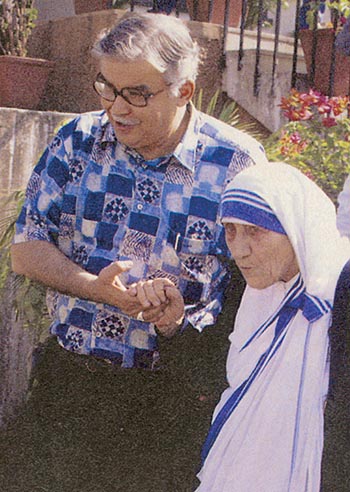
Dr Jamshed Irani (top and above)with Mother Teresa at the
inauguration of the leprosy hospital Nirmal Hriday
Irani had been conferred the honorary knighthood (Knight commander of the British Empire) at the hands of Queen Elizabeth II for his contributions to Indo-British trade and cooperation (see "Knight in shining armor,” Parsiana, December 1997) and the Padma Bhushan, India’s third highest civilian award, a decade later for his distinguished services to trade and industry (see "Man of mettle,” Parsiana, June 7, 2007). On both occasions the industrialist was featured on the cover of the magazine.
His academic honors included appointment as International Fellow of the Royal Academy of Engineering in 1996. The erstwhile president of the Confederation of Indian Industry (1992-93) had been appointed chairman of the Expert Committee for formation of the new Companies Act of India by the Government in 2004. His services to metallurgy were recognized with the Lifetime Achievement Award by the Government of India in 2008.
Irani was a member of the Scientific Advisory Committee to the Cabinet, Government of India, and on the Central Advisory Board of Education, among numerous other appointments. "In any discussion or meeting, be it with government, labor unions or board of directors, Dr Irani can say ‘no’ without fear or favor. Despite this he has the ability to change the mood of people across the table, from extreme animosity to extreme amiability,” Sanjay Singh who headed corporate relations at TISCO had commented earlier.
With the backing of the well-known Tata code of conduct and without mincing words, Irani is known to have candidly informed Lalu Prasad Yadav, then chief minister of Bihar, that TISCO was in no position to offer any more employment although the company could support schools and hospitals in Bihar.
Many local entrepreneurs vouch for the encouragement and support they received from Irani. Ashok Bhalotia, former president of Singhbhum Chamber of Commerce and Industry and chairman of Bhalotia Group of Companies whose units focus mainly on auto and spare parts was quoted by The Indian Express as stating that Irani "favored giving work orders locally rather than sourcing it from outside the state. This had a lot of impact on companies such as mine.” Irani has also been given credit for the development of Adityapur Industrial Area in Jamshedpur, home to medium and small manufacturing enterprises.
Taking pride in the planned industrial township of Jamshedpur that functions as an island of orderliness amidst the confusion that often prevails in the rest of the state (formerly Bihar, now Jharkhand), Irani commented, "We (Tatas) are totally committed to protecting the environment. We believe strongly in corporate social responsibility. Jamshedpur is probably the only city (in India) where you can drink water from the tap,” he had told Parsiana. When he was director of Tata Sons, occupying an office at Bombay House, feathered friends would dart in and out of the plants that adorned the terrace. "No one in the building has as verdant an ambience in the office as I have,” noted an elated Irani. He was also on the board of Tata Industries Ltd, The Tata Engineering and Locomotive Co Ltd, Tata Teleservices and Tata Exports.
"The present global environment is such that you have to take risks. Nothing is going to fall into your lap. You have to go in where others already are, be superior or die,” Irani had remarked when Tata Steel acquired the Anglo-Dutch steelmaker Corus (erstwhile British Steel, and a company several times its size) in 2007 for $ 12.9 billion (Rs 55,000 crore), the largest ever acquisition at that time by an Indian company.
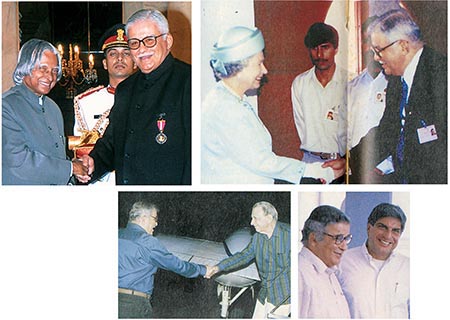
Top: Irani receiving the Padma Bhushan from Dr A. P. J. Abdul Kalam (l)
and honorary knighthood from Queen Elizabeth II;
above: Irani with J. R. D. Tata (l) and Ratan Tata
Irani (4th from l): the mainstay of the Jiji Irani pentagular cricket matches
On his retirement from TISCO, Irani was instrumental in starting the Tata Education Excellence Program in 2003. "Unfortunately, education has become an industry (in India),” he lamented. "While we have some of the best educational institutions in the world, the quality is so terrible in others that their products are quite unemployable!”
Born to Jiji and Khorshed Irani, Jamshed grew up in Nagpur. Jiji who worked for Empress Mills "gave me the best education he could afford. He was a great influence in my life,” Jamshed had told Parsiana. With a first class first in MSc (Geology) from Nagpur University, Jamshed proceeded in 1958 as a J. N. Tata scholar to what was at that time the mecca of steel — Sheffield in the UK. Winning a gold medal for his PhD in metallurgy in 1963, Irani began his career in the research arm of British Steel. On his return to India he was offered a job in TISCO as assistant to the director in charge of research and development. "My first year at TISCO in Jamshedpur however was not a good experience and I did think of going back. When JRD came to know of this, he shifted me to another job where I was happier and I forgot all about going back!” Jamshed had reminisced.
There were 700-800 Parsis in Jamshedpur when Jamshed first went there in 1968. "I have personally tried very hard to bring Parsis to the steel city. It’s a good life. We have fine clubs. There is horse riding, para gliding, river rafting through our Adventure Club, chess, archery and football academies...” But even to find a priest was a challenge for his wife Daisy who is a trustee of the local agiary.
"We are fortunate to have had him as the JPA president for many years, guiding and supporting all community causes. His enthusiasm, genuine concern, wisdom, strong leadership and loyalty inspired us all to rise above mediocrity and set higher goals for ourselves,” remarked Katy Narielwala and Nargis Madon, president and honorary assistant secretary of Jamshedpur’s Parsee Stree Mandal.
A strict disciplinarian known to be candid and straightforward, Jamshed had commented at an executive council meeting of the Federation of the Parsi Zoroastrian Anjumans of India in July 2000, "Knowing Parsis, there will never be any agreement… We believe in disagreement.”
Forthright in his view that "the community will die out unless you take in the children of both males and females married out,” Jamshed however was not in favor of conversion per se. Community members must shed their "superior-because-we-are- Parsis” attitude and allow non Parsis for the last rites of the dead and other such ceremonies, he believed. To a community that thrives on controversy he preferred to ask, "Why is it always ‘are you against this or that?’ ‘What are you for?’ we should ask.”
An ardent cricket enthusiast, Jamshed sponsored the pentangular Jiji Irani cricket trophy in memory of his father, played by teams from Nagpur, Jamshedpur, Calcutta, Secunderabad and Surat by rotation in different cities when around 100-120 Zoroastrians (players and supporters) come together each year. "It’s more than just cricket — it’s a good way of mixing and building friendships,” he observed.
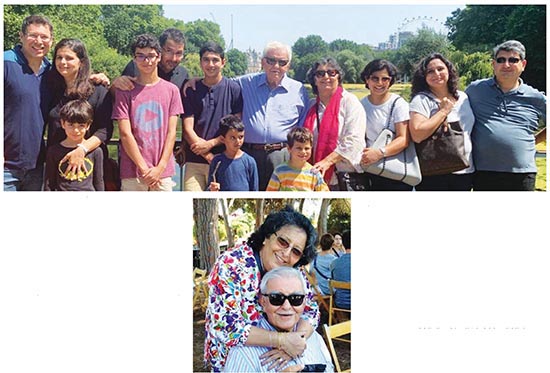
Above and top: Jamshed and Daisy Irani (center) with family (from l): Cyrus, Tanaaz and
Riaan Rastomjee, Aayush, Zubin and Rehaan Irani, Zal Nagporewalla, Shaun Rastomjee,
Priya Irani, Niloufer and Yezdi Nagporewalla
"When my father, Navzar Dotivala passed away in September 2020 I thought that the JPA could not have been dealt with a bigger blow. Little did I know what the JPA was going to face just over two years later. Such was Dr Irani’s contribution to the JPA that I really do not know how we are going to recover from the setback. In fact not only the JPA but also our Jiji Irani Memorial Sports Trust and Jiji Irani pentangular cricket tournaments are going to face their toughest challenges without his support and guidance,” stated JPA assistant secretary Yim Dotivala.
Known to enjoy good food, good friends and a good game of cards on a Sunday, Daisy had remarked, "Jamshed is meticulous to a T…does not suffer fools, will not tolerate incompetence and cannot make small talk.”
His guiding principle in all walks of life has been "Do what you say and say what you think.” Always endeavoring to progress, Jamshed believed, "The moment you stop learning, you stop growing.”
The sporting steelman is survived by his wife Daisy, son Zubin, daughters Niloufer Yezdi Nagporewalla and Tanaaz Cyrus Rastomjee and sister Diana Hormusji.