The Art Gallery On Princess Street by Jerry Pinto. Published in 2019 by Pratham Books, #621, 2nd Floor, 5th Main, OMBR Layout, Banaswadi, Bangalore 560043; website: www.prathambooks.org; email: info@prathambooks.org. Pp: 28. Price: Rs 65.
If someone were to ask me how I would describe Jerry Pinto (pictured), the author of this book, on the beginnings of the
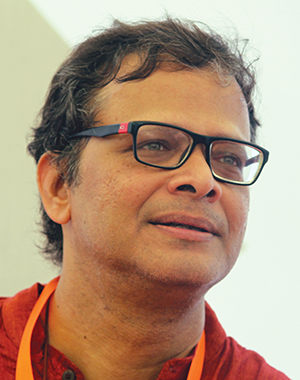
contemporary art world in Bombay, I would call him a millipede. In fact, a millipede with its thousand feet under a shiny red double-decker Bombay city bus running from one end of the Fort across to the Bandra seaface and all the areas in between, stopping for a dékho (look) every now and then.
The Pratham books are meant for children. When they come with a blue back-cover we are also told that these are meant for children with superior reading skills. They can equally be enjoyed by adults with minimum reading skills, as they are accompanied in this case by the very lively watercolor illustrations of Kripa, the artist who seems particularly adept at rendering Pinto’s ideas in all their fluid anecdotal style.
In the afterword to his book, he himself ends with a riff on how (he) "whistles and hums and thrums and jumps and walks in Mumbai-Bombay-Momoi-Mhamai-Bambai),” while going about his daily life that has its own compulsions. That is to say, he will not be pinned down.
This also applies to the book. Pinto seems to walk very fast with his tremendous enthusiasm in various directions, stops abruptly and takes a whole new route. Never mind that you don’t really know where he’s going. You realize that getting to the different stops is what matters. You don’t ask: Do people actually "thrum?” Is this book the sound of Pinto thrumming through the by-lanes and back alleys of the Fort in Bombay recording the lives of artists from the past?
Is it by chance that so many of the characters that he meets are from the glorious past of Parsi art lovers, patrons and practitioners? And yet, let it be said he hasn’t got anywhere to meeting them all, the early collectors, the curators and the commercial business houses that first put a brand new generation of artists on their walls and in the city’s public spaces.
Then again, the title tells you that it’s about a very specific art gallery on Princess Street. It’s also a very affectionate tribute to both Khorshed and Kekoo Gandhy and the Chemould Gallery that continues to nurture artists.
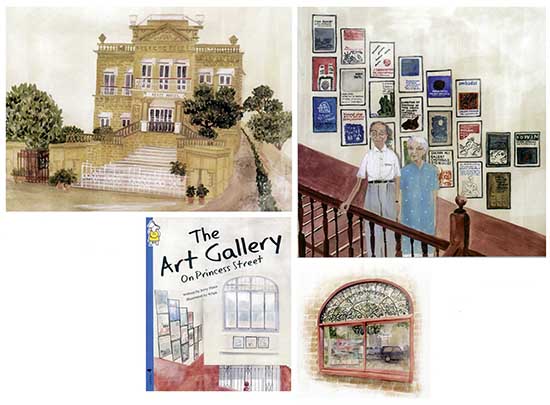
Illustrations from the book, clockwise from top l:
Kekee Manzil; Kekoo and Khorshed Gandhy;
the Princess Street space; book cover
The chronicles of Bapsy
The first stop that Pinto makes is on Malabar Hill at Aiwan-e Rafiyat, the melodiously named mansion of Cowasji Jehangir, a doyen of the Parsi community in his time. The episode he relates is about Bapsy Sabavala, the youngest daughter of Cowasji and his wife Dhanbai. The chronicles of Bapsy could be straight out of the P. G. Wodehouse novels, set around the same period of time in England about Lord Emsworth, the owner of Blandings Castle. Suffice to say that both Bapsy and Lord Emsworth had a fondness for their prize pet pig. There are many stories that have been spun around Bapsy, and Pinto tells all of them in style.
He also introduces Bapsy’s artist son Jehangir Sabavala, his wife Shirin, as a prelude to describing the romantic adventures that lead to Khorshed Adenwalla as she was known, meeting the young Kekoo Gandhy. He then leaves Jehangir to his fate in his family bedroom with Shirin on their first night, apparently forgetting to mention that Sabavala was to become one of the city’s greatly admired artists in his time.
Long before that Kekoo himself has a chance encounter when his car, that we are told he was driving with his cousin Dara, bumps into Roger van Damme, a refugee from Belgium fleeing from World War II in Europe. The drawings on this page are particularly charming. We are also given the names of the seven goddesses protecting the islands on which the city has evolved. After a brief montage of images involving scenes from the War that leads to other well-known European art lovers and critics washing up on the shores of Bombay as it was then known, the millipede moves on.
Equally interesting is how the Gandhys, married by then, came across Italian prisoners of war, sent to India, some of whom had been commissioned by Lord Louis Mountbatten, the Last Viceroy, to paint the walls of barracks and mess rooms. Since presumably Lord Mountbatten was busy with other matters such as over-seeing the final parting of the ways with the Raj, we are then fast-forwarded to an overview of how modern art grew out of all these disparate elements and made an appearance in the window of Kekoo’s shop on Princess Street where as we have been told he had set up his framing enterprise.
Here again, there is a lovely color wash of Maqbool Fida Husain in his old age sitting barefoot with a tranche of his earlier works. This is a cue to fast forward the story to the opening of Gallery Chemould in 1952 on a narrow space on the first floor of the Jehangir Art Gallery.
There’s an entirely arbitrary reference to the Shahbanu of Iran being shown paintings at the Governor’s house by Kekoo during the visit of the Shah of Iran to Bombay. She was an architecture student who had studied in Paris and presumably because of that, a patroness of the arts.
There were many more interesting visitors to both the Jehangir Art Gallery and Chemould that Pinto seems to have left out in favor of the Shahbanu. He could have included a paragraph from a page about the Jehangir Art Gallery and the legendary Cafe Samovar by the most zestful of artists who have captured the city’s cultural mores, Paul Fernandes, in his book, Coast Line — An Amuseum of Mumbai Musing, published by R and J Resource Communications Private Limited in 2019.
Next to a line drawing of the facade of the Jehangir Art Gallery and the winsome specter of Husain standing on the pavement alongside a crowded water color portrait of Samovar, Fernandes, or his amanuensis Chiku Jayadeva, writes: "The list of celebrities who frequented the Samovar is the stuff of legend: M. F. Husain, Jehangir Sabavala, Balraj Sahni, Mario Miranda, Amitabh and Jaya Bachchan, Shyam Benegal, Satyadev Dubey, Dolly Thakore... They shared tables with lawyers from nearby courts, college students, museum goers, tourists and everyday people from all parts of Bombay.” (Page 44 from Coast Line by Paul Fernandes.)
The final moments of Khorshed and Kekoo Gandhy standing together in their old age on the staircase to their beloved Gallery is full of charm. Rendered with great affection by both the artist Kripa and Pinto, it signals the final bell on the double-decker bus and its ride through the city of eternal surprises.
GEETA DOCTOR
Doctor, a longtime contributor to Parsiana, is a writer and critic.