Parsis were among the early collectors of picture postcards
Farrokh Jijina
Meher Taleyarkhan of Readymoney House, Napean Sea Road was "among Bombay’s earliest persons who collected postcards as a hobby,” noted collectors of Indian memorabilia Sangeeta and Ratnesh Mathur at a public talk titled "Bombay outside Mumbai” organized on June 5, 2021 by the Khaki Heritage Foundation (KHF), a not-for-profit entity created by the reputed Khaki Tours. She was reportedly a copious writer of picture postcards to correspondents overseas between 1905 and 1915 and the Mathurs noted that they have eight postcards from Taleyarkhan in their collection. "We have seen a couple more online at different times, which we couldn’t acquire.”
In communication with Parsiana after the talk, Sangeeta shared that "the postcards sent by Taleyarkhan to two pen pals, one in Prague and another in New York in our collection, comprise the longest and earliest known string of hobby enthusiast correspondence from India, known to us.” Sangeeta rued that they "haven’t yet found a reply to Taleyarkhan… The frank style of writing and the curiosity and enthusiasm of this early hobbyist is what speaks to me most… We all correspond with our known family and friends, but this is different and far ahead of its time.” The Mathurs have been collecting picture postcards of India since 2003, and have a good set of over 6,500, dated between 1896 to 1950, some postally used and several unused. The Mathurs are the authors of Picturesque India: A Journey in Early Picture Postcards 1896-1947.
Writing in the Mumbai Mirror (MM) of June 20, 2019, Sangeeta noted that the government allowed the use of picture postcards from 1896 onwards, just a few years after they were introduced in Austria. "British India’s postcards far exceeded postcards of any other country in the empire…Bombay, considered the ‘eye of India,’ had possibly the largest number of postcards, and the most varied… Picture postcards, a relatively expensive product, were used exclusively by Europeans or wealthy Parsis, and a handful of merchants.”
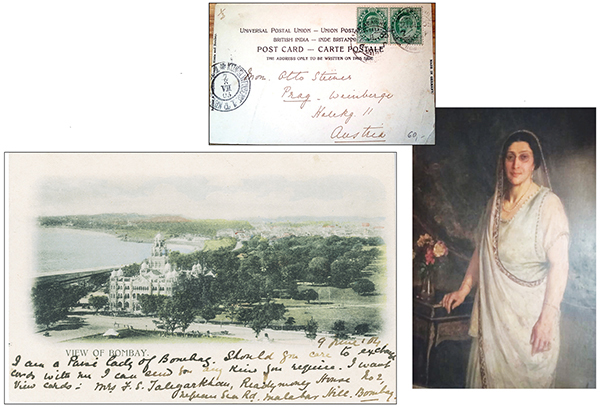
Copious correspondent Meher Taleyarkhan (above r) and her missives
Taleyarkhan’s postcards from Bombay, the "eye of India;"
Partial view of Readymoney House
The Mathurs shared with Parsiana a few images of Taleyarkhan’s missives. In June 1904, Taleyarkhan sent a lightly colored photographic "View of Bombay” which showed the Bombay Baroda and Central India (now Western) Railway headquarters to one A. E. Small of New York. "With undivided backs (no line down the rear side), the entire reverse side of the picture postcards issued before 1907 was exclusively for the address of the receiver… the sender could scribble a personal message on the front in whatever space was available,” wrote Sangeeta in the MM piece. "I want view cards,” Taleyarkhan wrote to Small. Another postcard to Small, depicting "Views from Watson’s Hotel,” without any message on it, was signed in the front. "I require colored and black views and actresses,” she cryptically implored correspondent Otto Steiner of Prague in July 1905 on an image of a "Native Bazaar.”
Readymoney House from where the postcards were written was the family seat of the Cowasji Jehangir baronets, scion Adi Jehangir told Parsiana on June 9. "The Taleyarkhans stayed there in the 8,000 sq ft ‘outhouse’ till 1910 when my grandfather (the second baronet) married Hirabai and the Taleyarkhans had to vacate…The house was demolished almost overnight just before the start of World War II as the family did not want it to be requisitioned for the war effort.” Jehangir stated that the Taleyarkhans were parents of cricket commentator Ardeshir (A. F. S. T. or Bobby), Shireen (Lulu), corporate executive Rustom (Russi) and journalist Frene (Babs).
Ratnesh shared with Parsiana a copy of the London Gazette of January 1, 1943 which listed Meher as a recipient of the Kaisar-E-Hind gold medal in that year "for public services.” Meher’s grandson Darab told Parsiana on June 11 that he was only four when she passed away so he did not have any memories of her, but confirmed that Meher was a founder member of Bombay’s Princess Victoria Mary Gymkhana.
Her obituary in The Evening News of India of August 11, 1949 throws up other facets of the prolific postcard writer. "She showed the leisured few how to divert their energies to the advantage of society in social welfare work.” A founder member of the Bombay Presidency Women’s Council and its secretary and vice president for many years, she also presided over the Stri Zarthoshti Mandal and the Sir Ratan Tata Industrial Home for Women. The news report noted that she was involved in multiple charitable organizations, "so numerous as to constitute almost a complete catalog of charitable and public institutions in the city.” While in World War 1 she assisted Lady Willingdon, wife of the Bombay presidency governor in the war effort, "World War II saw her zeal undiminished.” Reportedly, she started a hostel for Parsi girls in Colaba in 1936 "which she conducted with the help of friends.”
Jurist Fredun Devitre informed Parsiana on June 10 that Meher’s husband Furdoonji was a "well-known lawyer who practised essentially on the criminal justice side…. He was an acting judge of the Bombay High Court in the 1920s.” Furdoonji had appeared on behalf of the plaintiffs in the Petit vs Jeejeebhoy case of 1908 that laid down the definition of Parsis in India, pointed out De Vitre.
The Mathurs run a web-based platform, Prarang, which aims to create "high volume, city-focused, localized education in the mother tongue of each city we activate, with well-researched images and information on a vast array of topics, all customized for the local resident.” With a mission of "keeping heritage alive and kicking in India,” KHF creates awareness of Bombay’s heritage and its conservation through documentation and archiving of the city’s history.