Adarbadh Mahraspand suffered great hardships
in his quest to spread Zoroastrianism in the fourth century
Farrokh Vajifdar
This article, a spin-off inspired by the Jiyo Mobed initiative, is respectfully dedicated to its Parzor organizers. May their endeavors be crowned with success!
Ādarbādh Mahraspānd / Ādurbādh ī Mahrspandān — whichever way one spells his illustrious name — continues to instil pride and evoke deep awe in this fourth century CE high prelate. He was recalled well into post-Sasanian literature and times beyond for the soundest of reasons, as also for some dubious ones in his name which found their way into popular perceptions.
The great man flourished during the 70 years’ reign of Shahpūhr II (r. 309–379 CE), a monarch of fearsome militaristic and political reputation, and possessed of genuinely orthodox religious fervor. As his sovereign’s mobadhān mobadh, Ādarbādh devotedly served the State in his secular role, and Sasanian Mazdayasna — the Temple — devoutly in its cultic affairs. We hear of him through a partly official account, and a suspect narrative, in Dēnkard IV.
Ādarbādh’s religious endeavors were the culmination of antique transmissions and traditions extending from the times of Arsacid Parthian rule, 247 BCE to 224 CE, and into his own fourth century CE era. The Parthians were Zoroastrian in their religious outlook and attitudes; with their widespread feudal, political and military systems, it was natural that transmissions of religious knowledge varied locally and provincially. Largely tolerant towards the Abrahamic systems of Judaism and Christianity later, Zoroastrian religious beliefs continued to be transmitted orally with but few copies recorded in the consonantal Parthian alphabet used by the chancellery of late Achaemenian times. Accessible only to learned priests and scribes, these were used for checking against observable major deviations.
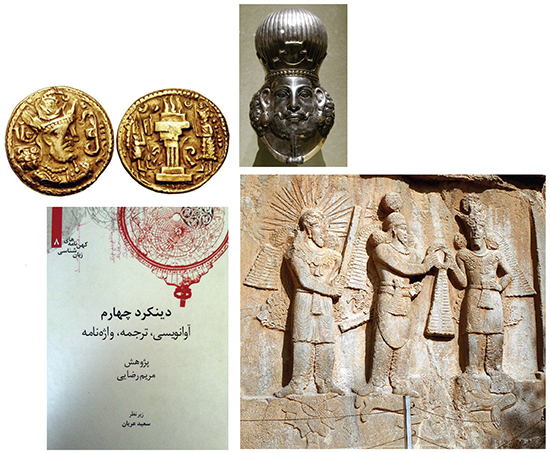
Clockwise from top: Gold coins and bust of Shahpūhr II;
Sassanian relief of the investiture of Ardashir II showing Mithra,
Shahpūhr II and Ahura Mazda above defeating Julian, lying prostrate
Photos: Wikipedia; Denkard IV Photo: Bibliographia Iranica Iranica
Coin of Khosrow I (left) and Kavadh I Photos: Wikipedia
Artwork of Khosrow’s war with the Mazdakites Photo: Wikiwand
Mazdak’s execution Photo: Wikipedia
A summarized history of some religious personalities who preceded Ādarbādh is registered in Dēnkard IV and other texts. They provide important clues to the transitional stages of the Mazdayasnian religion — from a brief note on the Achaemenians to its flowering under the Sasanians. Ādarbādh was not the religion’s originator (the Past) but its continuator (the Present of his times) and the first compiler of the 21 nasks for the guidance of future hērbadhs.
And so, to the centerpiece of this article: the illustrious Ādarbādh Mahraspānd, under whom the "orthodox” reaction set in and approved by his headstrong King Shahpūhr II. The earliest portions of the Dēnkard (its title means "Acts of the Religion”), known to his family for several generations, had distinguished three forms of Iranian religion: jādūgīh, "sorcery, trickery”; duš-hammōz-dēnīh, "religion of false doctrines”; and the glorious dēn i māzdēsn, "the religion of the Mazda worshippers” whose Creator Ōhrmazd is wholly beneficent and inclines mankind to goodness and wisdom. This last was determinedly promoted by Ādarbādh Mahraspānd who was well acquainted with the gāsānīg nērōg, the powerful Gathic teachings – as evidenced in the Dēnkard.
Shahpūhr II’s prolonged wars against Rome along Iran’s western borders had led to tensions within the Christian communities taken as prisoners of war. They were suspected of collaboration with Rome; Shahpūhr intended doubling their taxes to finance the conflict. The king’s army being sent near Ctesiphon / Tisfon for its collection, the Christians mobilized and unwisely slammed shut their city gates. An incensed Shahpūhr despatched his war elephants — the Sasanian equivalent of tank troops — to batter down the gates and city walls. Amidst great violence the captive populations were either deported or resettled.
Religious reconciliations were later attempted. An interfaith conference was convened to debate the merits and teachings of the various faiths, including some divergent Zoroastrian sects. The key representative for Mazdayasna was Ādarbādh Mahraspānd:
"The King of Kings, Shahpūhr, son of Ōhrmazd [Hormazd II, r. 302-309], summoned men from all lands to an unprejudiced disputation to examine and investigate all creeds. After Ādarbādh had been vindicated by the consistency of his argument, he issued a declaration before all those representatives of the different sects, doctrines, and schools in this wise: ‘Now that we have seen the religion upon earth, we shall not tolerate false religions and we shall be exceedingly zealous’. And thus did he do.”
At the nub of this Dēnkard account rests the definitive statement from an official résumé that Ādarbādh’s signal victory was through the consistency of his argument — the transcribed Pahlavi unambiguously reads: pad gowishn i passakht. On what was his argumentation based?
Here one must interject the belittling, altogether gross distortion of that great man’s achievement: he had victoriously emerged, unscathed, after submitting to the ordeal of molten brass being poured over his chest! This nonsense gained currency through repetition elsewhere before emerging as unassailable truth among untutored priests and popular mindsets.
Reasoning minds may query whether such exhibition sufficed to secure belief in Mazdayasna. Supplementary questions arise: did the "men from other lands and creeds” submit to similar ordeals? If so, what were the outcomes for them? There is no record in other sources of similar ordeals at times of such debates.
Paradoxically, this distortion provides invaluable clues to Ādarbādh’s sources — the timeless Gāthā verses of the religious reformer Zarathushtra Spitama. The prelate’s selections were two-fold: one derived directly from the time-unspecified core Gāthic message of the perfectability of mankind to gain a perfected world; the other, related, harked back to a mythological end-of-the-world conflagration – thrice employed in specific Gāthic contexts.
Concerning "molten metal” which engulfs this world at the end of time, Zarathushtra was borrowing from a widespread ancient Aryan myth without compromising any Mazdaic principles. His use of this final conflagration is carefully contexted — it is to illustrate the Final or General Judgement of all mankind.
Mazdayasna continued generally untroubled for 200 years after Ādarbādh and Shahpūhr II. A terrible fifth century climatic desiccation of Central Asia resulted in widespread famine and unimaginable hardships for the general populace. The rigid class structure of the times, however, so ensured the protection, well-being and security of the nobility that the harsh inequalities of power and privilege came to a head. A communistic priest, Mazdak i Bamdadān, rebelled with his unworkably egalitarian social ideology — wealth and women were henceforth to be held in common: property and blood-lines were no longer to be of consequence!
In those chaotic circumstances, the entire class structure became fragmented. It suited King Kawādh I (r. 488-531) for it curbed a nobility which had long manipulated the ruling power. He unwisely flirted with Mazdak’s ill-destined social levelling; chaos intensified throughout Iran with hope of stabilization vanished. A helpless Kawādh was deposed and imprisoned; he later remounted the throne — a chastened and wiser sovereign.
The continuing social upheavals were quashed with utmost severity by Crown Prince Khōsrō; the arch-heretic Mazdak and his followers were exterminated. The arduous task of restoring stability and power to the ruling class and a grateful priesthood was gradually effected under Khōsrō who succeeded to the throne of all Iran as the glorious Khōsrō I, the Anushirwān.
Says the Dēnkard: "His present Majesty, the King of Kings Khōsrō, son of Kawādh, after he had put down irreligion and heresy with the greatest vindictiveness according to the revelation of the Religion in the matter of all heresy, vastly strengthened the system of the four castes and encouraged precise argumentation. And in an assembly of the provinces, he issued the following declaration: ‘The truth of the Mazdayasnian Religion has been recognized. Intelligent men can with confidence establish it in the world by discussion ... What the chief Magians of Ōhrmazd have proclaimed, do we proclaim; for among us they have been shown to possess spiritual insight ... Fortunately for the good governance of the country the realm of Iran has gone forward relying on the doctrines of the Mazdayasnian Religion ... We do hereby decree that the Avesta and Zand be studied zealously and ever afresh so that what is acquired therefrom may worthily increase and fertilize the knowledge of our subjects.’”
Why this lengthy diversion into later Sasanian religious history? Khōsrō Anushirwān’s mobadhān mobadh, Wēh-Shahpūhr, had collated and skilfully supervised the final revise of the 21 three-fold seven part nasks, basing it on Ādarbādh Mahraspānd’s indispensable first edition of some 200 years before and taking count of the accretions, changes and augmentations since.
Two hundred and fifty years after the downfall of the Sasanians, and writing during the ninth century intellectual renaissance to the Zoroastrians of Sīrakān, southern Iran, the Zoroastrian High Priest Manushchihr fulsomely acknowledged the tremendous achievement of Wēh-Shahpūhr’s, lauding him in the exact highest terms as his sovereign Khōsrō I Anushirwān: both were anoshag-ruwān — "of immortal soul!”
It is unarguably owing to Ādarbādh Mahraspānd’s undying glory that this grand master-work was resumed and finally completed during Khōsrō I’s long reign. May his marvel of religio-cultural achievement nobly continue to serve steadfast future generations of priests, scholars and serious enquirers among lay folk!
Born in Bombay into a Navsari high priest clan, Farrokh Vajifdar enjoyed his primary and secondary education there and acquired
his tertiary nurture in London, where he remained to settle, out-marry and procreate. He developed a deep and abiding interest in Indo-Iranian civilizations, with strong bias towards Zoroastrianism, its languages, literature, history and philosophy, and is a fellow of the Royal Asiatic Society. Occasional radio and TV broadcaster, lecturer, and midwife to aspiring and published authors, he, as independent researcher, continues as full-time writer and, as international consultant, has translated books and articles from French, German and Italian. He taught physical sciences at the National Association for Gifted Children.