Balancing work and home the Gimi family
made Selvel a household name
Prochy Mehta
Edited excerpts from Rusi B. Gimi by Prochy Noomi Mehta, edited by Tehnaz Bahadurji and published by Selvel One, reprinted here with permission from the author.
Where do I start writing about my father Rusi who died almost 30 years ago? He was ill and in hospital for two-and-a-half agonizing months. It was torture for him and emotionally draining for us to watch his life and energy slowly, painfully fade away.
They said I was the favorite of his three daughters Frenny, Tehnaz and myself. I personally did not think so and had my usual share of "Why can she do it and not me?” questions. It may have started with my sister Frenny’s inadequacy with maths. You can imagine the chaos in the house…. mom Zarin and dad both working from our home-cum-office, and we regularly disturbing them for assistance. Tehnaz came along much later, when the family was in a better financial position and she was saved from going to our parents for help as she had her own tutors.
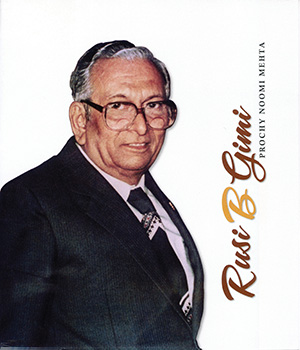
My dad was an educated, but not well-to-do child from Bharuch. Mom would tell us stories of their courting days when they would have one rupee to spend in the evening. It would always be an English movie and 25 paise would get a plate of "chow mein” which they would share. She would tell us about dad’s thick Gujarati accent and how he finally got rid of it. While watching movies he would listen intently to the actor’s accent and mannerisms and then go back to the Parsi Dharamsalla, where he stayed, and practice in front of the mirror. I wonder how many modern couples would court like this.
My paternal grandmother Dosibai was very fond of Rusi and when he left Bharuch for Calcutta to make his fortune, she wrote to Homai Jila (in charge of the Calcutta Dharamsalla and later to become his mother-in-law) to take good care of him. Dad had two brothers, Soli and Jal, and from his mother’s side he had two uncles, Phirozsha and Darasha. Phirozsha was settled in Singapore and mom and dad visited him often. (We have no knowledge of dad’s family from the paternal side.) The rest of the family lived in Bombay.
Rusi was an outsider in Calcutta and not well-to-do. Though not accepted by the community at first, his passion, drive and true Zoroastrian zeal to serve humanity overcame all objections and he was admired by all. Parsis were clannish in the 1950s and mom would always refer to a certain set of people belonging to the upper classes who would not normally interact with us. Rusi rose to become the vice president of the Calcutta Parsee Club and president of the Parsee Zoroastrian Association which was a vibrant, forward-looking body in his time. In his professional life also he faced discrimination. From not being allowed to attend meetings of the Advertising Association he became its president and was inducted into its Hall of Fame.
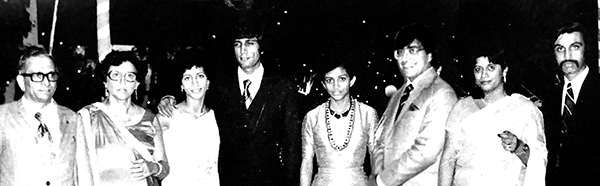
From l: Rusi and Zarin Gimi, Prochy and Noomi Mehta,
Tehnaz and Darius Bahadurji, Frenny and Rustom Daroga
Dad had two really close friends as a young man, Joe Mathias and Zarir Kothawala. Dad was married while the two were still bachelors. When I was born, I enjoyed the full benefit of their company. Zarir uncle married Zarine and they settled down in Poona; Uncle Joe married Pam and settled in Australia. Mom’s best friend was Homai Pardiwala and our two families were close. All nine of us would travel in dad’s Baby Hindustan car for weekend picnics at the lakes in which we enjoyed swimming. Often the Ginwalas and their children, Rusi and Roshan, who stayed in the same housing complex, would join us. When I was a baby, mom and dad were busy building Selvel and more often than not Roshan would rush back from school and take care of me. Later, when Tehnaz was born in 1962, mom claimed she had five daughters, Piloo Pardiwala, Roshan, Frenny, Prochy and Tehnaz.
Rusi’s best friend in the Lions Club was his co-worker Dawoodi Dawoodi. Our families would go on vacations together. Dawoodi uncle knew everything about everything. He was a walking encyclopedia. He did not drink alcohol but could tell by the smell what the brand was. Through him we got to know the Syedna of the Bohra community who contributed generously to all the programs dad dreamt of. More than that, we got to eat the famous pathar nu gos (meat cooked on stone) made to perfection on a special stone from Mecca.
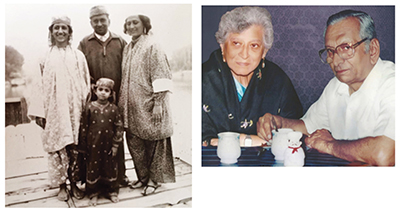
From l: Prochy, Tehnaz, Rusi and Zarin Gimi holidaying in Kashmir; right: Zarin and Rusi
Dad and mom happily invited a host of people to stay in our house from a few weeks to a year. I remember one morning when two gentlemen from Asansol came to the house with their suitcases and I rushed to him to complain, "Now who have you invited to stay?” I was reassured that they were on their way to Bombay and had just stopped by for a couple of hours!
Ours was an open house. Dad had given standing instructions, if any doctor comes to the house, first feed him. One never knows at what time he will reach home. On office days 11 o’clock was coffee time on the first floor and any visitor was invited into the house for coffee and chit chat. Many of our friends remember this and remind us of how they enjoyed these coffee table talks.
School summer vacations meant dad being in Calcutta for all his grandchildren. Sanaya, being the eldest grandchild in Calcutta, often used to take care of the youngest grandson, Rishad. Those were happy days of snuggling with baby Rishu and taking the gang to the Parsee Club to play. It was quite crazy with seven grandchildren up to mischief, but he enjoyed the experience and insisted on it.
Puja time was vacation time. My parents would take all of us children, grandchildren and Dawoodi uncle and his wife Gatobai aunty on holiday. Once while on vacation in Simla dad had a handsome woollen coat tailored; mom, noting there was leftover material, asked the tailor to make a matching coat for two-year-old Jahan. He was the naughtiest child and would drive dad crazy on these holidays. But once he wore that coat, Jahan became a gentleman and would strut about with his hands in his pockets. This miracle jacket was preserved and handed down to my sister Tehnaz’s two boys, Tushad and Rishad, who also wore it with pride.
Mornings were dedicated to reading the newspapers, half a dozen would be delivered to us every day. The Telegraph was always kept for young Jahan to read before he left for school. And, of course, the "ration packets” were all ready. Ration was dry fruits, and some sweets or chocolates all wrapped up in individual packets to eat on the way to school. All the children’s friends who would come over would also look forward to this "ration.”
Breakfast was always a light meal. Toast, butter, cheese and jam with tea. The one who enjoyed this meal the most was our Lhasa Apso poodle, Mickey. He loved toast with butter. Dad would tease him by first offering plain toast. Mickey would refuse to even come near it. Then a layer of butter would be added and held out. Mickey would come and gently take the buttered toast. He would sit awhile and enjoy the aroma before delicately eating the repast. Dad was not a fussy eater and always paid compliments for the food. His rectitude must have been sorely tested the first time Tehnaz began cooking. She placed her cookies on the table, and we all took one each and quietly ate it. Hearing no compliments, she was upset. Dad quickly said how great they were and immediately offered them to us again. To keep up the charade we all told her the cookies were tasty while dad, still praising her, discreetly avoided a second helping.
Dad was a bathroom singer, and memories rush back when I hear the song Ichak Dana Bichak Dana (one little seed, two little seeds). He would add his own words — "ék janvar jaisa (like an animal) Prochy Gimi jaisa” or Mera Joota Hai Japani (My shoes are Japanese), "Rusi phir bhi tu hai Hindustani (But Rusi you still are Hindustani)” was another favorite song. I really loved hearing him sing Bachpan ké din bhoolana déna (Let us not forget the days of our childhood) and still lapse into silence and have fond memories when I hear this song. A song can transport one back in time.
Dad was not the superhero type, but he was not afraid of anything and was ready to fight, literally, if he had to. He brought up his three girls in the same mold. One night, I awoke to see shadows on our window. Thinking it to be a thief, I crept to dad and woke him up. Both of us, armed with hockey sticks, went out to accost the intruder only to be relieved to see our neighbors, Mr Pattison and his sons, repairing their car!
The only time I have seen dad a nervous wreck is when mom fell ill with typhoid and we almost lost her. Dr Russi Anklesaria, his co-Lion and friend treated her and nurse Irene took care of all her needs. My parents’ bond of love was strong and it engulfed us all.
My dad was a prolific writer. After performing yoga and reading the newspaper he would spend the morning sitting on the carpet and writing. All of us would be involved in proofreading. In a way, it opened our eyes to the world as we read about fractionalization of blood, talking books and the Jaipur Foot. He hobnobbed with ministers and governors and generals and the who’s who of society but was just as much at home in the bustees of Khidderpore where he did much social work.
His office room was shared with me, and when I got married to Noomi (Mehta) a desk was brought into the room for him too. Strangely, my dad, who was hands on with a business model he had created, gradually left the working of the company to his sons-in-law and dedicated all his time and energy to social work. It was pandemonium in the office room. Dad would be meeting hundreds of people coming to him for help, and Noomi trying to handle the office work. But at 11 o’clock it was coffee time, time to go to the first floor with our friends and have varied conversations with dad as master of coffee time.
Dad would never walk up and down the steps; it would always be a quick run. One day I saw him walking slowly looking carefully all around. On enquiring, he informed me that mom, while handling all the medicine cartons coming for the refugees, had lost the diamond from her ring. He then bent down and picked it up. It totally amazed me. We were not well off, and that diamond must have been precious for him. But to just find it like that was surely providence.
On his 60th birthday his friends gave my dad a big party. Almost as if they knew he was not going to be there with them much longer. To be appreciated in one’s own lifetime is very rare. And he enjoyed the experience.
While he was ill in the Woodlands Nursing Home, Brother John from the Brahma Kumaris would visit him regularly and dad would tell me that once he was better we would all go on a pilgrimage to beautiful Mt Abu, headquarters of the Brahma Kumaris. But before we knew it, he had left us. Though the work he did lived on. In each organization he had identified and created a leader, a person who would continue the work started by him. I like to think he still lives in the 120 odd organizations he was connected with.
Dad always started or ended his writings with a famous quote. I too would like to emulate him:
"Lives of great men all remind us
We can make our lives sublime
And, departing, leave behind us,
Footprints on the sands of time.”
(A Psalm of Life by Henry Wadsworth Longfellow)