Apart from comparing chikoo rates, cricket was the favorite sport in this once green paradise
Katy Rustom
Dahanu evokes thoughts of chikoo wadis and sweet toddy and long walks along the casuarina stretches on the beach. It also holds childhood memories of many Irani Zoroastrians who have since left and moved to greener pastures and newer lands across the oceans. These Iranis will always have stories to tell about this small coastal town 120 km to the north of Bombay.
Holidays during our childhood days were always spent in Dahanu — our world began and ended there. It contained the sum total of our joys and maybe that’s why we could not look or even think of life beyond Dahanu. It was also a homecoming of sorts because most of the Zoroastrian children studied in the nearby cities of Bombay and Poona as there were no English medium schools in the taluka. Forty years ago, there was no road to Dahanu so we would always take the train and like flocks of migratory birds over 30 cousins, aunts, uncles and every kind of relative of all age groups would board it with bags and bistera (bedding), laden with greasy kheema (mince) cutlets in pao (bread) and Golden Wafers’ packets. I still have clear memories of gritty coal particles flying into our eyes every time we stuck our heads out of the windows of the Flying Ranee — a train that has had a long-standing relationship with Dahanu. It has been central to the lives of Iranis for many generations — being a meeting place of sorts. It is believed that the Flying Ranee started to make a stop at Dahanu only because an Irani gentleman named Meherwan built a huge water tank to supply its steam engine with water and it has been halting there ever since. Many a story has begun on this train, many a story has been exchanged on it and many a story meant to be kept under wraps continues to be revealed on the Flying Ranee.
Those were the days when happiness meant going to Dahanu and running wild in the farms, diving into wells from roughly hewed diving boards, herding a large gaggle of cackling geese, fishing on the river banks with only bread as bait, balancing huge pots of water on our heads and going for midnight picnics on the beach in bullock carts. Imagine taking a chameleon for a walk on a leash and watching it turn from green to pink; swinging from the roots of the banyan trees; hiding under bales of hay while playing hide and seek; having wars on the beach with cannon balls made of sand; running for cover while my father blasted wells with raw sticks of dynamite; stealing a ride on an engine and imitating the engine driver by shovelling coal or hanging on to the whistle. I could go on endlessly like this — in fact you could think of any adventure under the sun and it could be done in Dahanu thanks to the fact that television had not yet made its advent. We invented our own games and crafted our own toys.
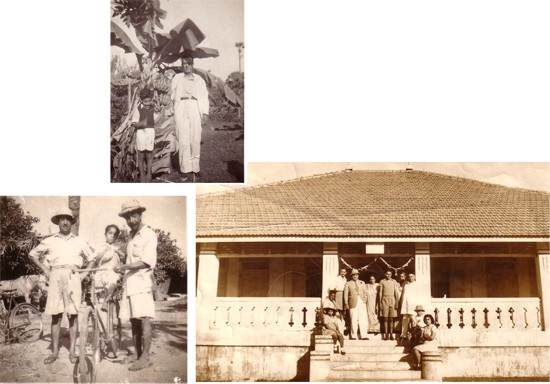
Clockwise from left: the writer’s grandfather on his farm; with friends at his house and in proper cycling attire, with Sola topis (hats)
There was no electricity in those days so we would light hurricane lanterns or phanas each evening. We would sleep on rows of mattresses on the verandah of my grandfather’s huge bungalow; because there were more than 30 of us and there would never be enough pillows for everyone, we would do without them. And while we slept we could hear the noisy crickets and screeching bats. Most nights we could hear the howling of the foxes which would make us huddle together in fear. Sometimes we would spot the pugmarks of leopards in the farms in the mornings. We would usually fall asleep counting the tiny lights of the glowworms as they hovered over our heads.
We would make our way around town by hiring bicyles or travelling in bullock carts. Sometimes my grandfather would take me to his chikoo farms on a horse driven carriage. My grandfather had come to India from Iran as a stowaway on a ship that was bringing Arabian horses to the continent and maybe that’s why he just loved horses. He always went to the different farms in a horse driven carriage and was known in Dahanu as the ‘Ghodawala Seth.’ He had the most handsome pair of stallions and always spoke to his horses. "Look,” he would tell me, "can you see that horse turn its ear when I am speaking to it? I don’t need a whip.” It never failed to amaze me to see the horses obey his commands effortlessly. One of his favorite horses was Dilpazir — a strikingly tall and dignified thoroughbred. Grandpa lovingly fed him soaked grams every morning. The town people would hire Dilpazir for weddings. Once someone had burst firecrackers and Dilpazir had bolted, leaving the entire wedding entourage running helter-skelter while the horse ran off with the groom!
Almost all Iranis had the surname Irani which created great confusion in Dahanu because if the first name was the same, one could never identify the person and no one knew who was being referred to in a conversation. So everybody started attaching a quality or trait or idiosyncracy after each person’s name and that has become a trend to this day in Dahanu. Everyone had a special pet name that followed the first name. So there was an Aspi Bundal (bundal because that Aspi was always telling tall tales) and an Aspi Majra (majra meaning blue eyed). There was a Soli Muchhad (for his massive ‘walrus like’ moustache) and a Soli Captain (a retired mariner), and many more unmentionables. The most noble one was Rusi Blood Bank because he had donated his blood ever so often — we were told he had almost made it to the Limca Book of Records before his untimely death. The most scary one was Minoo Mukao (a trigger-happy dog shooter).
Families in Dahanu were more like clans. There were two main families in Dahanu respectively called the M. K. Family and the H. K. Family. When I studied Shakespeare’s Romeo and Juliet in school I somehow used to think that the Montagues and Capulets were a lot like the M. K. and the H. K. families. Of course, there were many other smaller clans as well. And one thing that all families always did was to gather in the evenings and talk about the other families. All the clans met during gahanbars where they would down glasses of toddy. Later of course toddy was banned along with other liquor.
Families in Dahanu did many things together like going for movies in either Purnima Talkies or Chandra Talkies which had rows of benches that moved in unison when shaken. We never ever could hear the dialogs in the films because there would be loud screams or thunderous claps and ear deafening shrill whistles every time the hero got the better of the villain or every time the hero broke into a song for the heroine. And whenever there was a scene when the identity of the murderer was being revealed you would be nudged strongly into passing around a packet of mutton cutlet sandwiches. Movies were like picnics and all sorts of food would be taken there and all sorts of animals also found their way into the movie houses — rats, bandicoots, cats, cockroaches, fleas and stray dogs. And if the loud screams emanated from the back benches you could be rest assured that it was because one or all of these creatures were making the most of the darkness. Women hitched up their saris and clambered onto the wooden benches screaming and shrieking loudly and shaking entire rows of seats, adding to the action and excitement of the film.
Apart from comparing chikoo rates, cricket was the all-time favorite sport of Dahanu. Weekends had the Dahanu Irani teams, all in white, on a makeshift cricket field near the beach road. Raucous families would watch the match from across the road under the shade of casuarina trees sitting on their bullock carts or in horse drawn carriages. My father always got bowled because he could not run fast enough between the wickets. Cricket injuries were common in those days as there was no protective gear — a bloody nose, a broken thumb and a damaged rib were all part of the game.
Navroz was the all-time favorite festival. Navroz on March 21 would be ushered in with thunderous gun shots — well things get done differently in Dahanu! Tables laden with innumerable varieties of dry fruits and all items beginning with the letters sh and s like sherbet (sweet drink with falooda seeds), shaker (sugar), sharab (alcohol), sheer (milk), shem (candle), surka (vinegar), seeb (apple), sikka (coin), suzan (needle), sauzi (green leafy vegetable), sopra (table cloth) etc. would be placed near the prayer place. Everybody would make a mad rush for red roses for families would exchange New Year greetings with red roses and gulab noo pani (rose water). New Year wishes could not be completed without looking at your face in a hand held mirror. Some eager Zoroastrians would put up a play for the rest of the community followed by a homemade snack of sheekh kebab (mince meat) or paneer, boiled eggs, spring onions and mint, all rolled in a naan.
Tides of change have slowly eroded the shores of Dahanu. The town battles to retain its old-world charm even as it is flooded with growing numbers of unfamiliar faces each day. The skies and soil lie polluted from a coal based power plant with ad hoc development adding to the despair. Faced with falling crops and diminishing returns from the land, entire families have now migrated to more distant lands. Hope lies unkindled. Only memories remain…
Kitayun (Katy) Rustom is the co-founder and Deputy Director of the Centre for Environmental Research and Education (CERE), a Bombay based NGO. An educationist and author of children’s books, she was recognized as a social entrepreneur for change in 2005 and was awarded the Ashoka Fellowship.