Bridges and bonds built at the 12th World Zoroastrian
Congress are meant to be unifying
Parinaz M. Gandhi
Holding a sheaf of papers Anahaita Kotval represented "the old.” With his laptop on the podium, her son Zal Kotval Shroff represented "the new.” Between them they shared a script, disclosing their religious perspectives, observations, reflections and possible takeaways from the 12th World Zoroastrian Congress. Entrusted with "the daunting task of providing the closing remarks,” woven into their presentation on July 4, 2022 were the results of the online survey titled "Our Beliefs” that sought to ascertain the religious leanings of the delegates.
Anahaita Kotval (l) and Zal Kotval Shroff Photo: Jasmine D. Driver;
Born and raised in the US, Anahaita stated that "while my fabric would proclaim made in America, it is heavily embroidered with Indian and Parsi culture and values as also Zoroastrian principles and values.” Chief executive officer of Lifting Up Westchester, Inc, a nonprofit organization that provides community based services to residents experiencing homelessness and hunger, she started her career as a prosecutor for the Enforcement Division of the US Securities and Exchange Commission. After working at the Royal Bank of Scotland for 13 years where she was managing director and general counsel of its investment bank in the Americas she transitioned to the nonprofit sector in 2011. "Comfortable with my identity from a very young age” although aware that it was different, she always felt that she "belonged” to both the Indian and American communities. Her "durability and strength,” she felt, "were influenced by my parents’ personal values that included being intellectually curious, being proud of who we were but humble enough to acknowledge the tremendous strengths and contributions of other communities.” She was taught "to acquire knowledge not as a status symbol but as a tool to engage and uplift others.”
After attending the three-day Congress she questioned, "If those of us who are in sync are so proud of who we are, does it leave room for others to explore their own uncertainties? Even if we are open and warm, do we try to create a standard that others feel they have to live up to?” She urged Zoroastrian parents "to create an environment so that we can be kind towards our children as they work to be comfortable under their own skin.”
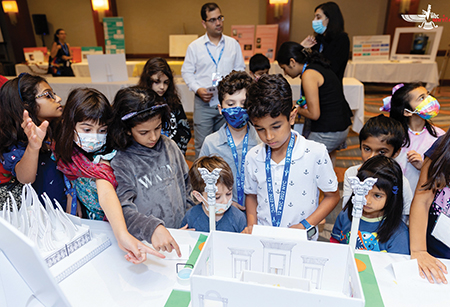
Creative learning for children Photo: 12WZC 2022
"As a civil rights litigator I work on racial justice and my Zoroastrian values animate almost everything I do in that field,” commented Zal who is a senior staff attorney at the Lawyers’ Committee for Civil Rights of the San Francisco Bay Area and prior to that was a clinical lecturer-in-law at the Yale Law School. He was disappointed though that the "exclusionary systems” that he was seeking to destroy in the broader American scene in his pursuit of social justice were evident in his own community.
He gave credit to his "rockstar grandparents” sitting in the audience who broke the molds set for them when they left India, and his Parsi parents who were both born and brought up in the US and embraced the multicultural societies they grew up in. He was taught "personal morality, exacting sense of right and wrong, self-betterment, empathy and service to others not only as Zoroastrian values but as natural values that should guide all of us regardless of whether faith is the center of our lives,” he stated.
Even though his Zoroastrian identity was his "foundational identity… a critical part of who I am is often celebrated far more with strangers than with people in this room, because I identify as a queer man,” he revealed. He commended the Congress organizers for having "created space for us to come together and our perspectives to be heard and honored… Questions of inclusiveness and belongingness have been the most courageous aspects of the Congress. Many of us have experiences that make us doubt whether we belong here,” he admitted.
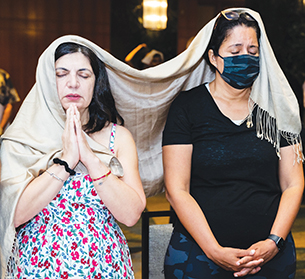
Absorbed in prayer at the Congress Photo: 12WZC 2022
Survey signals
Among the 20 belief statements included in the survey that was conducted in the days leading up to the Congress, one read, "Zoroastrianism should make no differentiation between sex, regions of residence, sexual orientation or any other criterion of divisiveness.” The Congress registrants had the option of responding with strongly agree/agree/neutral/disagree/strongly disagree/prefer not to answer. Considering that 90% agreed to this statement "implies this community wants you here,” he reassured those feeling alienated.
Fourteen of the belief statements were supported by more than 80% who responded; the percentage of those who disagreed or strongly disagreed varied from a low of one percent to a high of 12%. On an average two percent chose not to answer a particular question. "Nearly 300 of the 1,100 Congress registrants responded to the survey. With a 30% response rate, the survey can be considered statistically significant,” summed up Anahaita. Further, since it was evenly split between men and women and across age groups meant it was representative of the community as a whole. Almost all the respondents were adults with only a handful of those aged 17 years or under.
The Gathas are the first source of learning about Zoroastrianism was another statement in the survey to which 74% agreed and six percent disagreed. A number of speakers at the Congress pointed to the Gathas for our core beliefs and clear intent of Zarathushtra to accept new believers into the faith, to reiterate our respect for the earth and environmental conservation as an important Zoroastrian tenet, to value women as independent and equal members of our community. "Rules dehumanizing menstruating women were created by male members of the community with no basis in our original religious texts,” mentioned Anahaita. Such add-on belief systems need to be reevaluated if our faith has to survive in these modern times.
Eighty-four percent in the survey agreed that our belief systems should be periodically reviewed. "How do we separate the quintessential values of our faith, those which are timeless and without which we would not be Zoroastrian from those elements that are secondary and should evolve with time and context? How do we distinguish core beliefs from other less significant aspects of our practice and traditions?” are questions that continue to vex adherents.
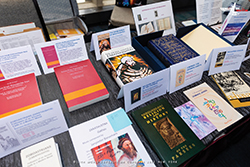
Array of books at the Congress Photo: 12WZC 2022
"Adults should be taught Zarathushtra’s teachings with an emphasis on daily living,” agreed 87% of the respondents. One of those who strongly disagreed with this statement commented that the prophet’s message should not be taught but discussed and pondered over. As reiterated at the Congress, books on Zoroastrianism should be purchased and read to deepen one’s understanding of the faith instead of depending on hearsay and interpretations that could be inaccurate.
Zarathushtra’s teachings are meant for all mankind and acceptance of the faith through the navjote ceremony is more important than birth to Zoroastrian parents. This statement was agreed to by 70%. Outside of North America only 49% supported this statement and 30% stated they were neutral. Reminded one respondent, Zarathushtis by choice (converts) are far more informed of the prophet’s teachings than those born to Zoroastrians. "They are more profound seekers and should be encouraged in every respect.” Other comments read, "History should not be erased or diluted to include everyone” and "Family linkage is important…” Across diverse sessions at the Congress, Zoroastrians by choice and those with ethnic ties expressed what the faith means to them. The session on digitizing our sacred texts indicated how scriptures can now be easily accessible.
What is this community prepared to do to indicate that it is welcoming of all Zoroastrians? Future atash kadehs should be open to all members who have embraced the faith by undergoing the navjote ritual and observe the rules of conduct, agreed 72%.
The generosity of the Zoroastrian community should encompass both Zoroastrians and non-Zoroastrians who need help, agreed 79% of the respondents. Ninety percent agreed that coercion of any form should be rejected. This implies that no organization or institution should impose its will on others. Gradual transition should be the ideal, done with sensitivity.
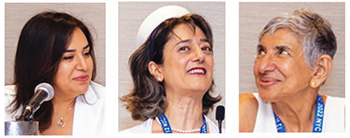
From l: Panteha Soroushpour, Armita Jahanian Dalal, Teshtar Irani Photo: 12WZC 2022
Reflectors and deflectors
As gatekeepers, how do we decide who belongs? Who speaks? We need to empower the youth, by sharing power with them as co-chairs, allowing them to take the stage, making a presentation. The observations and recommendations by the mother-son duo were meant to guide future congresses. These included:
Create a sense of belonging for those members of the community who feel marginalized or unheard. It is not enough to open the door; we need to create a connection so that they feel truly wanted. Ensure every decision-making body has representation from those who are missing. Give them a chance to say something and listen to their views. Be an ally or support for their cause. Knowing that our subconscious biases may contribute to certain voices being excluded, take conscious and effective steps to counter these biases.
Religion is derived from a Latin word, religare, that means to bind. It is meant to keep all of us together. Invest in mobeds across the globe and their education. Invest in priesthood. Ensure their inclusion in decision-making to make them feel respected and valued as our spiritual leaders. Allow lady mobedyars to become full-fledged priests instead of barring them from performing navjote or wedding ceremonies.
Religious educators from around the world, many of them teachers and professors by profession, have adopted creative, new approaches to teaching history and religion depending on how children’s brains process information at different ages. Rote memorization that characterized our parents’ and grandparents’ education has been replaced with a multisensory experience. The concurrent sessions at the Congress creatively engaged children of different age groups in activities where learning about their religion was a fun exercise.
Happiness may seem like a frivolous pursuit but we cannot contribute to the wellbeing of our community unless we are strong, grounded and happy with who we are and how we are living our lives. It is important to select a calling that we love and is meaningful to us. When pursuing our personal goals we should keep in mind the needs of the larger community in which we live. Those struggling with mental health issues need tools to restore their health and build resilience.
The Zoroastrian concept of happiness is not linked to material wealth but to our relationship with others. The Congress has shown us the joys of being together, connecting, laughing, praying, of getting to know one another anew.
This concludes Parsiana’s coverage of the 12th World Zoroastrian Congress.