Died: Dr Noshir Hormusji Wadia, 91, founder of contemporary Indian neurology, following cardiac arrest on April 10, 2016 at the Jaslok Hospital and Research Centre in Bombay where he was director and subsequently director emeritus, department of neurology.
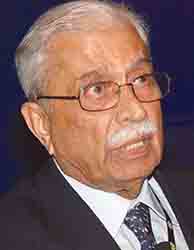
"The medical profession gives ample opportunity to contribute if one wants, beyond the routine of examining patients, treating them and charging fees. Ours is a vocation and not a trade though some practice it that way. It is said that there are few pursuits in life where daily charity, utility and novelty are combined as in the medical profession. A caring doctor is amongst the privileged few who gets paid to do what he enjoys doing most, whilst millions strive simply and even boringly to earn their daily bread,” Wadia had expressed in Ashavans: A legacy of Leadership.
"Compassion for patients should come naturally to a doctor; it helps in their recovery,” reiterated Wadia who for 27 years had served as an honorary neurologist on the staff of the J. J. Hospital (JJ) where the indigent are treated free of cost and was equally committed to the free beds at the Jaslok Hospital.
The only Indian neurologist to be elected as Fellow of both the Indian National Science Academy and the Indian Academy of Sciences, Wadia was also elected a Fellow of the Royal College of Physicians of London, made honorary member of the American Neurological Association and honorary foreign member of the Association of Neurologists, as notes his curriculum vitae. He was invited by renowned international medical and scientific societies to serve on their expert committees.
In 1957 he joined his alma mater as lecturer in neurology at Grant Medical College (GMC) and as honorary assistant neurologist at the JJ Group of Hospitals. As he had written in A Saga of Indian Neurology, "Those were the heady days of …a recently independent India and the urge within me was to contribute in whatever way I could.” He was given the mandate to develop the department of neurology at JJ when there were only five or six neurologists in the country. A few months later Dr Gajendra Sinh and Dr Jimmy Sidhva joined the JJ to establish the department of neurosurgery and neuroradiology respectively.
The department’s reputation led the Indian Council of Medical Research to transfer its neuropathology unit to JJ, making it a comprehensive department of neurosciences in India. While still at the JJ, Wadia set up a neurology department at Jaslok too. Recognition also came from abroad and he was invited to the US in 1961 as special consultant to the National Institute of Neurological Diseases and Blindness, the National Institutes of Health, USA and as founder member of the Commission of Tropical Neurology and the World Federation of Neurology (WFN) at Buenos Aires, Argentina.
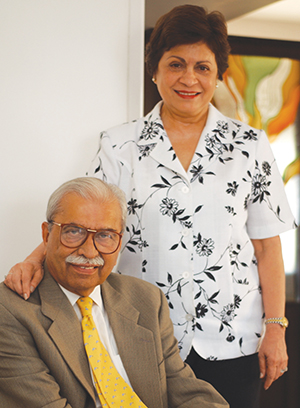
Drs Noshir and Piroja Wadia
Dr Noshir Wadia receiving Padma Bhushan from then President of India Pratibha Patil
When flying back home from South America via Portugal in 1961 after a meeting of the WFN, the police of Dr Salazar’s dictatorial government off loaded him from the aeroplane when it landed in Lisbon and held him hostage in retaliation for the Indian annexation of Goa that year. He was compelled to spend two months as a prisoner of war at the high security Caxias jail in Lisbon. Calls for his release were made by Amnesty International and many medical members from Europe, USA and Chile. His freedom was finally secured when then Prime Minister of India Jawaharlal Nehru consented to a 400-year-old statue of Lord Jesus Christ enshrined in a church in Goa be given to Dr Salazar in exchange for Wadia.
In the early days before neurosurgery as a superspecialty emerged, when no CT/MR scans were available and equipment was rudimentary, Wadia was able to use his clinical skills to arrive at a diagnosis and guide general surgeons in the operation theater. He lucidly wrote in A Saga of Indian Neurology: "To perform a direct stab carotid angiography, I had to improvise. It was done on a standard flat x ray table with one x ray plate under the patient’s head. This done, a plate was held on the side of the patient’s head by an attendant for a lateral picture, to be whisked off quickly and replaced with another for a second picture. This way we imaged tumors, aneurysms, arteriovenous malformations, cerebral abscesses, subdural haematomas, etc.”
As a professor Wadia was known to be "animated and engaging and he effortlessly proceeded to bring a difficult subject to life. He peppered his lectures with self effacing humor and the hour passed by like a flash,” recalled V. Peter Misra, consultant physician at the National Hospital for Neurology and Neurosurgery and at Imperial College London, in an obituary write-up on Wadia that appeared in the May 9, 2016 edition of the British Medical Journal. "I am often asked by my patients,” said Misra, "‘What led you to become a neurologist?’ To which I answer, ‘Hero worship!’ As a young man, I fell under the spell of a very special man who for me was the world’s best teacher, friend and neurologist; and to this day he remains my hero.”
Yet another student Shanti Vijayaraghavan who is a consultant physician specializing in diabetes and endocrinology (diagnosis and treatment of ailments related to hormones) at Newham University Hospital in East London recalled being in awe of Wadia’s charm, bedside manner and consideration for patients, particularly those among the most disadvantaged in India. Even though Vijayaraghavan opted to specialize in endocrinology, she continued to train with Wadia for she felt that she "would learn a lot about becoming a good doctor from him.” Both these ex students had penned a joint tribute to their mentor for The Guardian of UK.
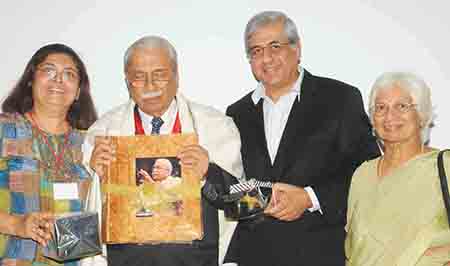
From left: Anita Vesuvala, Wadia, Firdose Vandrevala and
Sheela Chitnis at the first World Multiple Sclerosis Day in 2009
Besides teaching, Wadia also served as examiner for postgraduate students of neurology in several universities and as a member on the committees of the Indian Council of Medical Research and the Department of Science and Technology. For 25 years he was governing council member and the last seven as president /chancellor of Sree Chitra Tirunal Institute of Medical Sciences and Technology, a national level postgraduate institute training students in the specialties of neurology, neurosurgery, cardiology and cardiothoracic surgery. Taking a personal interest in the progress of his students, he was always willing to give them his time and advice and even use his connections to get them scholarships for higher studies overseas.
One of five children born to Hormusji, a timber merchant, and Dinamai, Wadia attended St Xavier’s School and completed his graduation and postgraduation from GMC. After obtaining membership of the Royal College of Physicians he studied neurology in UK, spending nearly five years as registrar to pioneering neurologist Lord Russell Brian.
Wadia was associated with various organizations for the welfare of persons with neurological diseases like multiple sclerosis (MS), muscular dystrophy, cerebral palsy, motor neuron disease, Parkinson’s disease and epilepsy. Having played a crucial role in the formation of the Multiple Sclerosis Society of India in 1985, Wadia was convinced "each disease requires a support group.”
His 40 years of research are evident in the 750-page book he authored, Neurological Practice: an Indian Perspective where he also invited contributions from other Indians. In the course of his clinical research, he realized that certain neurological diseases were more prevalent among Indians as compared to peoples of the West. His studies ranged from the neurological complications of manganese poisoning in Indian miners to craniovertebral anomalies in Indians. He also identified two unique Indian diseases — later observed elsewhere too — a new variant of hereditary ataxia with a slowing of rapid eye movements that came to be labeled as Wadia-type ataxia; and adult poliomyelitis due to a new virus associated with conjunctivitis, after he and his wife Dr Piroja, a pioneer of clinical neurophysiology in India, noticed a paralysis in the limbs of Indian patients who had suffered from acute hemorrhagic conjunctivitis.
Among Indians, MS was more prevalent among Parsis than any other Indian community, almost on par with Iranians and several southern European white populations, he had stressed at the Ninth World Zoroastrian Congress in Dubai in 2009 (see "Medicos lend momentum,” Parsiana, February 7, 2010 and "Immunity, infertility, insecurity,” March 21, 2010). On the occasion of the first World MS Day on May 27, 2009, Wadia was presented a specially compiled book of memoirs incorporating letters of gratitude and appreciation from the medical fraternity, patients, caregivers, family and friends with neurologist Dr Sarosh Katrak creating an audiovisual presentation on Wadia (see "I have MS, MS doesn’t have me,” Parsiana, June 21, 2009). For over five decades he had served as consultant neurologist at The B. D. Petit Parsee General Hospital.
In 2012 the government of India honored him with the Padma Bhushan award in recognition of his exceptional and distinguished service in the field of medicine. Three years prior he was conferred the first Gold Medal for Service to International Neurology by the WFN with which he was associated for 40 years, serving as its vice president for four years. He was the first recipient of the Rameshwardas Birla National Award and the Wockhardt-Harvard international lifetime achievement award. But what he valued more were two awards from the Indian National Science Academy — the Shanti Swarup Bhatnagar Medal and the Shree Dhanwantari Prize.
Fond of sports, music and reading, Wadia had earlier declared in Ashavans, "I can claim to be a good Zoroastrian as I believe I have followed the teachings of Zarathushtra – good thoughts, words and deeds. Of course, even in practising these there have been lapses at times, more in thoughts than in words or deeds. But by and large, I have followed the precept and practice of these commands, in my dealings with others as a human being, a family man, a doctor and a teacher.”
The distinguished neurologist is survived by his wife Dr Piroja, step sons Ruiynton and Kaikushroo, and brothers Jimmy and Behram.