In the centenary year of the Byramjee Jeejeebhoy Home for Children
there are plans to expand its existing infrastructure
Parinaz Gandhi
"These children have taught me the lesson of life and living. With all their pain, they continue to smile. Their positive attitude is very impressive,” remarked Maneck Davar, chairman and trustee of The Byramjee Jeejeebhoy (B. J.) Home for Children run by The Society for The Protection of Children in Western India (SPCWI) at the Bombay based institute’s centenary celebration on January 21, 2017.
With good donor support and capable management, the over 100 destitute children under their care are sent to a private school, Raja Shivaji Vidyalaya, and not a municipal school thanks to the efforts and vision of vice president Roshni Damania, appreciated Davar. After the age of 12, the wards are transferred to other institutions as they do not have adequate infrastructure, regretted the chairman who felt that construction of another building on their premises in Matunga was imperative.
Complimenting the management and staff for creating an environment conducive to a healthy, happy childhood, chief guest Piyush Goyal, minister of state for power, coal, new and renewable energy and mines, offered help to make the Home bigger so that in the next 100 years at least a lakh children pass through its gates, according to a report on the event and historical sketch sent to Parsiana by the trustees. Goyal recommended that a course of action for the new building be drawn up by May 1, 2017 and appealed to the audience to "make the future of these children your top priority. By serving these children you would be serving society.”
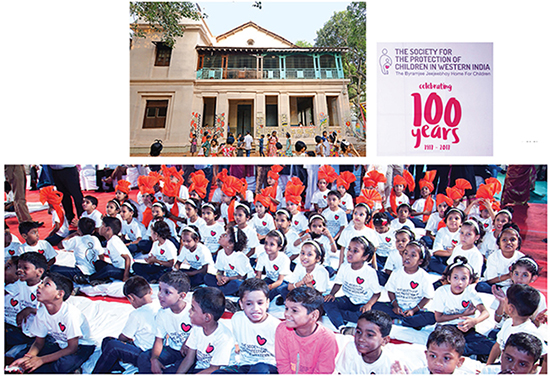
The Byramjee Jeejeebhoy Home and the children under their care
Maneck Davar, Rustom Jeejeebhoy, Piyush Goyal, Boman Irani and Roshni Damania
"I am immensely impressed by the confidence with which the children performed, which was at par with children who have every opportunity,” observed cinestar Boman Irani referring to the evening program that included a skit by the B. J. Home children depicting the history of the institution, a mallakhamb performance by the visually impaired children of the Victoria Memorial Jubilee School and a magic show by the children of Prerna, a nongovernmental organization. Remarking that he would have liked to go in the midst of all these children and hug them, Irani recounted his personal experiences and reminded them that no work, no person, no venture was too small. He told the children that they had tremendous potential to make the institution and the nation proud.
Insights into the running of the Home were offered by Jaya Mehta whose father J. Subramanian had served as superintendent for many years. In addition to formal education and co-curricular activities like physical training and music, the children at the Home were also given vocational training like weaving, stitching, printing and binding. The napkins and towels made by the older children were sold to the Taj Mahal Hotel and the annual report of the Home was printed by the children themselves.
Besides the office bearers, the other dignitaries present on the occasion were members of the Jeejeebhoy family: Jamshed Jeejeebhoy who was representing trustee and president Byram N. Jeejeebhoy, and vice president and trustee Rustom N. Jeejeebhoy. They all lit the traditional lamp with the chief guests. Honorary secretary Armaity Tirandaz read a letter from Byram Jeejeebhoy while honorary secretary Vutha Mohan proposed a vote of thanks.
From the streets to the shelter
The B. J. Home and the SPCWI have their genesis in an experimental children’s refuge and a crèche at Grant Road and Tardeo respectively founded by Sir R. P. Masani and Sir John Wardlaw Milne in 1916 to offer temporary accommodation to destitute children found on the streets before they were sent to the orphanages in existence at that time. With a view to solving the problems of neglected children, the following year the founders formed SPCWI with the Governor and Lady Willingdon consenting to become its patrons. The SPCWI took over the management of the refuge and also decided to set up another home on Lady Jamshedji Road at Dadar to separate the habitual vagrants from the educable and industrious children. In 1919 Milne left India on his retirement but when he visited the country again in 1939, he visited the Home and later in his will left GBP 14,594 (Rs 2,62,463) to the institution.
In 1919 Rustom Byramjee Jeejeebhoy consented to give Rs 51,000 for a plot of land at Matunga, near Kings Circle in the name of his grandfather Byramjee Jeejeebhoy. The construction of blocks for boys, girls, superintendents’ quarters, sick room and acquisition of land was completed at a cost of approximately Rs 3,00,000 for which the SPCWI had collected Rs 3,50,000, nearly three-fourth of the amount being raised by Lady Mary Carmichael. The refuge at Grant Road and the home at Dadar were shifted to the Matunga premises in 1921.
Facing legal problems in running the shelter, they made a representation to the government which passed the Bombay Children Act 1924. The Central Social Welfare Board, since its inception has given grant-in-aid, the main being the installation of a printing press. During the first 50 years of the institution, the children remained at the Home till they were adults and were trained to be technicians, electricians, foremen, tailors, weavers, nurses, teachers, or were employed in the government or private companies, and some even worked as staff members at the Home. In 1993-94, under the categorization of institutions by the Social Welfare Department, Maharashtra State, B. J. Home was classified as Kanishtha Balgruha (junior children’s home) and thereafter only children between six and 12 years were be admitted.
Over the last decade, they have installed a computer room with the initial five computers donated by Rustom Jeejeebhoy, a dispensary, a mini garden, washing machines, geysers and Aquaguard filters, plus a biometric machine donated by Davar to mark the attendance of children and staff. Five years ago, the B. J. Home was conferred the Punya Shlok Ahilyadevi Holkar Puraskar award by the State Government for valuable contribution in the field of women and child development in the Maharashtra and Konkan region.