We hear the death knell for Old Delhi’s
iconic and nearly 100-year-old Parsi cinema hall
Rusi Sorabji
Nearly two months ago the Delhi edition of The Times of India reported that Novelty cinema, one of the city’s oldest movie theaters which has not been in use for almost a decade, will make way for a novel "Spice Mall of Asia.”
Established in the early or mid-1920s, the Novelty theater was originally owned and/or managed by Madan and Company of Calcutta. It was then referred to as "Byes-Scope” by the locals. Should the Municipal Corporation of Delhi (MCD) wrecking ball get delayed by a few more years, this ‘silent movie theater’ would soon be a hundred years old.
Jamshedji Framji Madan, a Parsi actor turned wine merchant, was a pioneer in the film industry in India. He established theater companies in Bombay before the turn of the 19th century and then moved on to Calcutta as producer and distributor of silent films in 1901 or 1902. In fact in 1929, Madan Theatres Limited in Calcutta, were the first in India, nay in East Asia, to introduce "talking pictures” or "talkies” at their Elphinstone Picture Palace in Calcutta.

Wedding of Kumi Irani and Ruttonshaw Batiwala being performed on the stage of Novelty theater in 1929
By the 1930s, Madan and Company had established over 100 such talkie cinemas in the old Indian sub-continent which then included Pakistan, Burma and Ceylon. It was said to be the largest chain of theaters owned by anybody in the first three decades of the 20th century. Besides Novelty, some of the other cinemas that later came up in Delhi were also established and/or managed by Madan and Company. At least four of them had Parsi managers.
Since the movies were ‘silent’, a band of musicians that used to be called an "orchestra” sat below the edge of the stage providing musical accompaniment in sync with the scene projected on the screen. With the introduction of sound or "talkie movies” in 1931, the orchestra disappeared. In 1931 Novelty became a proper cinema, with the screening of Ardeshir Irani’s first full length sound movie, Alam Ara.
As a favor to the community, Madan and Company would let out the cinema hall to the Parsis for special functions such as Navroz, weddings, navjotes, etc, especially during the cold winter season at a nominal charge or for free.
My parents, Kumi Jal Irani and Ruttonshaw Sorabji Batiwala got married on the stage of this Novelty theater on January 26, 1929 (21 years later this day was celebrated as India’s first Republic Day). In an old, badly scratched and faded picture of their wedding, we can see two tall persons in the middle clad in long, flowing white dresses, the Irani Zarathushti priest from Bombay and another Kadmi priest from Karachi. Close relations and friends are seated on the stage, while the rest of the invitees watched the ceremony from the front rows of the cinema hall. The young lady squatting on the floor near the groom’s feet is his sister-in-law, about to perform some typical Parsi shoe ritual to extract a nice monetary gift on the spot, from the new brother-in-law.
The photograph was taken by Munchersha Mody, a Madan and Company representative from Calcutta who settled in Delhi to become Delhi Parsis’ first official photographer. He was fondly referred to as "Dhar-rus-Mody,” for he sported a big beard.
While the Parsis of Delhi may have now reached the "vanishing point,” in the 1920s there was a big concentration of the community within a two or three minutes’ walk from Novelty. Most of the Parsis seen in the picture and many other families then resided west of the Novelty cinema on the corner of Burn Bastion Road and the road leading to the Delhi Power Station at Lahori Gate. The famous municipal councilor and ophthalmologist Dr S. P. Shroff also had a dispensary on the same street. In one of the first five or six three storied buildings starting at the corner of this road, resided India’s pioneering trade unionist Savaxshah Jhabvala. Of the few family names I can recall as I write were, brothers Jal and Boman D. B. Irani, who arrived in Delhi in 1906 as electrical engineers. They were involved in the construction and operation of Delhi’s first diesel operated electric power station at Lahori Gate. Others were Bejonji Heera, Sohrab Kheshwalla, Cavas Kheshwalla, Pheroze Vania, James Irani, Hormazji Batliwalla. Empress Aerated Soda Water Factory, owned and managed by Delhi’s first lady entrepreneur Dinabai J. D. Irani, was based on the ground floor. Due west behind these buildings and across the railway tracts on the corner of Pul Methai lived Meherwanji Mehta.
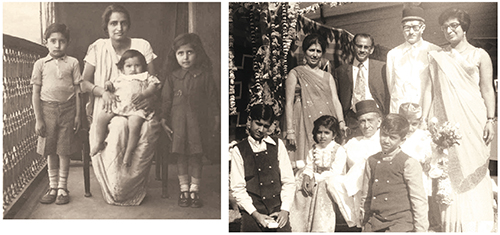
Above, l-r: Rusi Sorabji worried about the camera flash gun, mother Kumi with Rusi’s brother Soli in her lap,
sister Mani, 1935; (r) father Ruttonshaw (seated) surrounded by grandchildren,
standing, l-r, Mani Sorabji Thakur, Roshan Thakur, Rusi and wife Villy, 1971
My father, then station master, Delhi with the North Western Railway lived across the road from the Novelty cinema in the railway bungalow which currently houses the Railway Hospital. Four other Parsis had their places of work around the corner east of the cinema on Church Mission Road. These were Hormasji Sethna, well-known as "cut-piece-walla Sethna” and his manager. His shop was behind the red 18th century St Stevens Church in Gadodia Market. Further along the Church Mission Road was Delhi’s first Parsi doctor, Rustom Kapadia’s (eldest son of Delhi Parsi Anjuman’s first president Nowroji Kapadia) dispensary. He was assisted by a Parsi compounder.
Meherwanji Virji, another employee of Madan, also came from Calcutta to Delhi around this time. He became manager of the nearby Wine and General Provision store, situated over the Dufferin Bridge in the middle of the row of buildings that lined the right hand side of the road leading to Mori Gate. Rai Sahib Bhola Ram and Sons was the other such provision shop then in the Mori Gate area.
Three buildings west of the cinema and at the end of the road was The Railway Clearing Accounts Office, called the "Peelee Kothi” which was then the tallest building in Delhi, just five stories high. It was burnt down during the Quit India Movement riots in August 1942.
It was the first week of that fateful month, my younger sister, brother, our domestic help Unus and I were at Novelty enjoying the Wadia Movietone film Miss Frontier Mail-ki-Vapsi featuring John Cavas and fearless Nadia. Just after the interval, the movie was stopped and all were asked to leave as the city was under a curfew. As we walked out of the cinema our "sola-topis” (hats) were snatched and thrown into a bonfire by those fighting for Indian independence from British rule. Since the rioters had taken over the roads we had to walk home, a mile and a half, along the railway line.
A Parsi owned wine and provision store, I was informed, existed in either Chandni Chowk or Khari Baoli during the reign of the last Moghul Emperor Bahadur Shah Zafar. The shop mostly served the requirements of the British Resident, other English and European employees, besides their small army company stationed at Khyber Market at the northern end of Alipore Road and at the site of the Delhi University and further north-west to what was later known as Kingsway Camp.
Some years earlier it was reported in the media that MCD plans to redevelop Novelty cinema into a commercial building. An article in the Delhi edition of the Hindustan Times stated,
"Old timers believed that the conversion of the Novelty building into a commercial center will mean the loss of a prominent Old Delhi land mark. They are not exaggerating. In the 1930s, cinema halls such as Novelty, were popular weekend destinations for Delhiites.
"‘The Novelty was the place where we used to watch films in our college days. The MCD wants to renovate old havelis, but there is such a lack of concern for the city’s old cinema halls,’ said Satish Sundra, 74, owner Ram Chandra and Sons, the city’s oldest toyshop (adding), ‘If Connaught Place can be renovated, why can’t they renovate the city’s… oldest cinema?’”
There is no doubt that with Netflix/YouTube streaming movies on demand on your cell phones, ipads and laptops, single screen cinemas like Novelty, are not commercially sustainable and need to be phased out. For those with a wish or mission to preserve old neighborhoods or historical structures, would it not be satisfying if the MCD would call the proposed new mall as the "Novelty Spice Mall of Asia?” Imagine a 21st century spice mall just a quarter of a mile north of Emperor Shah Jahan’s and the nation’s, nay Asia’s, largest spice market of Khari Baoli.