Fear of strangers lurks in our collective conciousness
Berjis Desai
Xenophobia is a morbid dislike of strangers (Greek, xenos = stranger). Worldwide, the mood is xenophobic. From Trump’s America to Putin’s Russia to Erdogan’s assault on the Kurds; the rise of far right populist parties in aristocratic Austria and egalitarian France; Brexit and other potential exits from the European Union; the Shia-Sunni conflicts and many more, the planet is looking inwards. As a community and ethnic group, do we harbor fear of the foreigner and the stranger?
We forbid all those, however close, who are not Parsi Zoroastrians from viewing the face of the dead after the last ablutions. We do not permit children of Parsi mothers married to non-Parsis from entering our fire temples. We keep our hospitals empty but do not permit their secular use. Even for our ancient dhansak clubs, we restrict membership to Parsis. Our charities may have run out of beneficiaries to help, however, the funds will not be utilized for non-Parsis. We largely patronize Parsi service providers including doctors, lawyers, accountants and architects, irrespective of merit. Although the Prophet wanted the faith to be a universal religion, we continue to maintain that a non-Parsi cannot be a Zoroastrian. We will not open the doors to anyone, howsoever genuine and deserving, even if it means certain extinction in the foreseeable future. Clearly, fumes the liberal, we are indeed racist, paranoid and xenophobic.
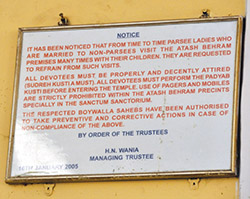
Sign at the entrance of the Banaji Atash Behram at Charni Road
The traditionalist disagrees. We do not wear religion on our sleeves. We neither entice nor compel others to convert. We are polite, docile, compassionate, easygoing and non-aggressive. We do take interest in the affairs of others. We certainly do not dislike strangers nor are we fearful of them. It follows that we harbor no xenophobia.
Our bonhomie and joie de vivre and graciousness and fabled sense of humor notwithstanding, most of us do harbor a clear notion that we are different from the original natives of the land. We do still fear being swamped and inundated. There is a core area, which is out of bounds for non-Parsis, and where we would like to see only our own. This is effected in a rather subtle and non-offending manner; and others have learned to accept our area of exclusivity.
Our track record in preserving our unique identity intact, in the most dismal circumstances, is remarkable. The proposition that had we been less vigilant in creating entry barriers, the floodgates would have opened and our identity submerged, is indeed correct. Our ability to endear ourselves to the rulers, whether local satraps or the British, bought us protection from external onslaught. Our pioneering entrepreneurship, laced though it was with opium, made us rich and influential. Our small size was a shield which made others believe we posed no danger. Our innate ability to be politically tactful and correct and harbor no ambitions made us non-threatening to the powers that be. A well honed survival instinct ensured that there should not be any attempt to preach, propagate or proselytize our faith. This was not the time or the environment to sell Zoroastrianism. Undoubtedly, repugnant to the Prophet’s message of universality, the early migrants decided wisely and sagaciously that a low profile alone can guarantee survival.
Parsi funerals, with the face of the deceased exposed, meandered through the streets of Bombay until the rise of communal tensions meant that funerals were defiled. Quickly, the funerals and the ceremonies became a closed door affair. Entry to fire temples was restricted to Parsis for the same reason. When you are terribly outnumbered, those who fight are not heroes but fools. The pain of expulsion from the Iranian fatherland was indelibly etched in the collective consciousness of the community. Strangers had caused great harm; strangers were strong; strangers were to be feared; strangers had to be kept at the gates. When your existence is at stake, xenophobia is a legitimate weapon.
A closed door approach, however, always extricates a price. Marrying cousins, the greatest blunder we ever made, resulted in irreversible genetic decline which led to a demographic disaster. At some stage, this blunder became evident, albeit unconsciously. When Parsi men married or ‘mistressed’ interfaith women (from French madames to the tribals of Gujarat), a much needed boost of gene diversity resulted. On the other hand, Parsi women marrying non-Parsi spouses meant a loss of precious resources. When more equal times came, this gender injustice appeared odious. By then, the gender bias had been sanctioned by law. The orthodox erroneously believe that this is what the religion had decreed. As they controlled community institutions and trusts, a survival tactic was elevated to a tenet of the faith.
When the Constitution of India came into force, had we gradually eliminated this gender bias, our numbers would have looked much better. Children of interfaith marriages are not strangers. Nor are their spouses, who could have been partially assimilated without ruffling too many feathers. Xenophobia can rapidly turn into a weapon of self destruction. Is it then, demographically speaking, too late to reverse the entrenched position? Perhaps, yes. Nevertheless it is the need of the hour. When it is inevitable that closed doors will result in death by suffocation, better open a window.
The apocryphal promise, of dissolving like sugar in milk, was never kept; and rightly so. Loss of unique identity has always been our biggest fear. We have preferred to float like an indissoluble almond in a corner of that milk jar.
Berjis M. Desai, Senior Partner of J. Sagar Associates, advocates and solicitors, is a writer and community activist.