Parsi Gujarati, with its own vocabulary, grammar and syntax, should not be allowed to die out
Aban Mukherji
Parsi Gujarati has been dismissed as "an inaccurate variety” of Gujarati by no less a person than K. M. Munshi, the renowned writer, critic and founder of the Bharatiya Vidya Bhavan. Mahatma Gandhi, in his foreword to Munshi’s Gujarat and its Literature: from early times to 1852, is scathing in his criticism of Parsi Gujarati. "It is unfortunate that there is Parsi Gujarati. It is confined to novels and stories of the shilling shocker style. They are meant merely for passing the idle hour. The language is tortured out of shape.”
The result of such criticisms was that the immense contribution of Parsi writers to the development of modern Gujarati literature was ignored. I too grew up with this belief. It was only when delving back into the past and coming across 19th century Gujarati books written by Parsis on a variety of subjects that I realized the importance of their contribution.
Parsis were prolific writers of novels dealing with contemporary society, histories, travel accounts, essays, religious books, plays and poems, apart from contributing to newspapers and magazines.
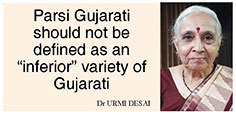
It was the eminent scholar of linguistics, Dr Urmi Desai, 88 years young and still writing books, who first opened my eyes to the fact that Parsi Gujarati should not be defined as an "inferior” variety of Gujarati. It was a language/dialect with its own rules of grammar and syntax and its own vocabulary too.
Ovaaryu taara parthi
Illustration by Farzana Cooper, Parsi Bol
When Desai was research assistant at the University of Bombay from 1966-74 she prepared a book on the subject, Parsi Gujarati: a Descriptive Analysis, which delved into the distinctive nature of the language. She first selected a Parsi, fluent in Parsi Gujarati. She made a list of 1,000 English words and 1,000 English sentences according to grammatical patterns. These were translated by the Parsi into her own Parsi Gujarati language. She was then asked to relate in Parsi Gujarati around 10 stories, sing 10 songs and list out proverbs frequently used (31 proverbs were supplied). On the basis of the data collected, Desai linguistically analyzed the structure of the language.
When Parsis settled in Sanjan they adopted the local Gujarati dialect, which was different from standard Gujarati. They also introduced to it many words from their own mother tongue, Farsi, as well as Avestan words relating to Zoroastrianism. These gave a distinctive flavor to their speech and Parsi Gujarati was soon accepted as one of the many dialects of the region. Later, Parsis migrated to other cities and provinces of India, and Parsi Gujarati began to be spoken in various regions of the country.
If we turn to the phonology (sound system) we find that Parsi Gujarati has certain peculiarities of its own and to some extent it retains the characteristics of old Gujarati. In many dialects of Gujarati the "sha” and "s” sounds at the beginning of the word are replaced by "ha,” e.g. shaak (vegetable) becomes haak; saaru (good) becomes haaru, but Parsi Gujarati retains the original "sh/sa” sounds and often changes the "sha” to "sa,” e.g. sakvu (do), saané (why), sookan (auspicious).
To the amusement of Gujaratis, Parsis often exchange the retroflex "tta” sound for the dental "ta,” e.g. talvaar (sword) becomes ttalvaar. Often the retroflex "da” sound is replaced by the "ra” sound and chopdi (book) becomes chopri. Because of the influence of Farsi the "f” and "z” sounds are used quite often and the indigenous "pha” sound is non-existent in Parsi Gujarati. The "gha” and "ga” sounds are often interchanged so that geedh (vulture) becomes gheedh and gusso (anger) becomes ghusso. Often the consonant in the middle of the word is doubled and we get khottu (false), soonnu (gold), etc.
Parsi Gujarati pronouns differ from standard Gujarati ones: hun (me) becomes oon, aa (this) becomes aay, pote (oneself) changes to potte. In Parsi Gujarati one does not say shaa maaté? for "why.” Instead the word kaai is used. The imperatives: aavné (come), karné (do), bolné (speak) become aavni, karni, bolni in Parsi Gujarati.
Often the gender of the word is changed. In Parsi Gujarati the neuter word toran (garland) takes on the feminine gender, while the masculine gender machhar (mosquito) and kaagaj (paper) take on the neuter gender.
The common meanings of certain words change too. Samajvu (to understand) is taken in the sense "to listen” (which would be saambhalvu in standard Gujarati) and bhanvu (to study) is often used by Parsis to mean "to pray.” Certain Avestan words like asha/ashoi (purity) and druj (the lie) are also prevalent in Parsi Gujarati.
But what endears Parsi Gujarati to all the other Gujarati speaking communities is the exuberance of humor, its "rosy nature,” the abundance of "endearing” cuss words, the clever punning, and the colorful idioms that Parsi Gujarati uses. I don’t think Parsi Gujarati nataks lack an appreciative audience.
Chalk design sukhi raho by Kainaz Ukaji
Unfortunately, the curtain seems to be coming down on this language that has gained a lot of popularity in the Gujarati speaking world. Very few Parsis realize that the Parsipanu they are so proud of is tied to their Parsi Gujarati language, and if they really want to preserve their Parsipanu the language should not be allowed to die out due to apathy and neglect.
Colorful expressions
Kutra pos bilara pos
Pan jamaina janiyane varma khos.
Rear dogs and cats, but throw in the fence the children of the son-in-law.
Jéné chori laj
Ténu nhanu serkhu raj.
One who is shameless receives a small kingdom (i.e. prospers).
Paalélo kutro pag kadde.
A pet dog bites your leg.
Laakri aagal bakri naaché.
It is the stick that makes a she-goat dance.
Pijé pijhé né runo ru.
However much you card cotton, it remains cotton.
Sutharnu man bavariyama
Ne bilarinu man chichrama.
A carpenter’s mind is always on the baval tree while a cat’s mind is on the skin of the meat.
Kaanani vakhaan kaanaani mayéj karé.
It is only the mother of the one-eyed who praises him.
Laakraana dewné khaasraani puja.
The wooden idol of a god receives the worship of footwear (you get what you deserve).
U’nu khaj ubare sue
Te’ni nar vaid na’i jue.
A doctor is not required to check the pulse of a man who eats fresh food in the evening and sleeps in the open.
Kar né jé ainuaij.
Work and you reap its fruit here only.
Khadaniyama mathu nakhi
Dhapkarathi bivu nai.
If you put your head in the mortar, do not be afraid of blows.
Aro gharo né
Nhalli vau per aviné paro.
Whatever happens, the youngest daughter-in-law is held responsible.
Gherno dhani hu
Ne bar nikar tu.
I am the master of the house and you better get out.
Pag taré baré né lanka olavva jay.
There is burning under your feet (there is fire in the house) and you are out to extinguish the fire in Lanka.
Ta’r jay rue
Ne adat jay mue.
Cold goes with weather and habit with death.
Moné marvat
Né pétma karvat.
Kindness in speech but a saw in the stomach.
Sai gaya né saini saram léta gaya.
The sage has gone and with him has disappeared the control exercised by him.
Motté ghérni motti vat
Ne ardhi rotli per akkhi rat.
Idle boast in a rich house but only half a loaf of bread for the entire night. (The rich boast a lot but there is hardly anything to eat at home.)
Bharosani bhésé paro janiyo.
The dependable she-buffalo has given birth to a male buffalo. (A person in whom you had faith has let you down.)
Kuwama pari kutri
Ne sam gaya utri.
The bitch has fallen in the well, so saying the person is released from the oath.
Kaado khainé monu konné sugharva jay?
Having eaten an onion how can one go near another person because of the foul smell.
Pannini hay kadi khali né jay.
The sighs of a wife will never go waste (have some effect).
Miyo mado né tangi unchi.
The Muslim is ill, but his leg, he says, is raised high. (Whatever happens, he will not admit defeat.)
Gherni ghéli né barni dai.
Crazy at home but wise outside.
Tukki gardan né pori pesani
Ne haramjadani nisani.
Short neck, wide shoulders. These are two characteristics of a villain.
Koinu baré pét né pasru
Né koiné avé kharkhar haswu.
One person’s stomach and ribs are burning while somebody else is laughing.
Bap-beta (mai-dikri, ver-bairi) ék na ék né vachma paré teéné khasrani ses.
The father-son (mother-daughter, husband-wife) will unite again and the intermediary will receive the gift of a beating with shoes. (Blood is thicker than water.)
Naktiné naak nai
Ané sakné saram nai.
The nose-cut has no nose and the co-wife has no sense of shame.
Goré martané jhéré maarwo nai.
Why offer poison to a man who is dying by jaggery? (Why use stronger means when milder ones would do.)
Bharam bhol né ma ne pol.
Show outside but hollow inside.
Dhobhino bhai patthar
Nai ghérno nai ghaatno.
The washing slab of a washer-man belongs neither to home nor to the washing place.