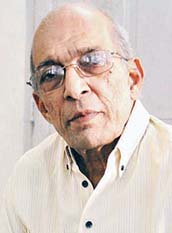
 As an 11-year-old Rusi Surti showed promise when playing for the Dadar Parsee Club. In one of the practice matches, using a new ball, he clean bowled the opening batsman of the Parsi Cyclists Sports Club with an in-swinger.
Nari Contractor had spotted him when he was playing for Bombay Schools. In the Times of India Tourney, Surti played for Tatas along with Behram Irani, Vasant Amladi, Rege; and in the Ranji Trophy for Gujarat under Keki Khambatta along with Vinoo Mankad, Polly Umrigar and Contractor.
Surti had represented India in 26 Test matches between 1960 and 1969, scored 1,263 runs, the highest in a match being 99. He was a brilliant all-rounder, batted at number three, bowled with the new ball and later on would revert to spin bowling. Another asset was his sharp fielding at short leg position, where he plucked many catches. Statistics regarding his catches are unavailable.
Surti was not merely a team man but also a captain’s man. This was proved during a tour of the West Indies when Contractor sensed hesitation on the part of his middle batsmen to go out at their assigned place. Two youngsters volunteered to go one down — Surti and Salim Durani.
Sports journalist Dicky Rutnagur narrated an incident in the West Indies involving Sir Conrad Hunte (a member of the Moral Rearmament movement) who edged the ball for a catch well taken but was not given out. Hunte stood his ground instead of walking out on ethical grounds. Surti was furious and shouted: "Hey! Where are your morals, man?" Surti even floored Fredy Trueman of Yorkshire by fledging him, which was a regular habit with Trueman.
In one local tournament played between Parsi Cyclists and Shivaji Park Gymkhana, Vijay Manjrekar who led the latter team cautioned his batsmen to avoid high rising strokes in the vicinity of Umrigar and Surti. A belligerent Shivaji Park batsman took a risk and skied (lofted) the ball where there was no fielder. Surti sprinted and took the catch, incurring Manjrekar’s wrath.
After the first Test debacle against Australia in Bombay in 1969, the chief selector chose a younger player as a replacement, dropping Surti. The latter requested Vijay Merchant to relieve him so that he could play in the Sheffield Shield in Australia. The request was granted and Surti went to Australia where he started a better life, making a very successful debut for Queensland. He scored a brilliant century against Dennis Lillee and Graham Mackenzie and a few weeks later took a hat trick against them.
Surti used to spend winters in Bombay and once participated in a double wicket tourney played in Bulsar, partnering Burzin Mehta for Parsi Cyclists, later presiding at the prize distribution function. He would say that though his body was in Australia his heart remained in Bombay.
Surti was admired by colleagues and friends for his humility. They regularly sought his company and invited him to functions at gymkhanas. On this visit he was destined to meet them for the last time (see "Stumped by Surti," In Memoriam, Parsiana, February 21, 2013). His worth was better appreciated abroad than at home. FALI S. SHROFF