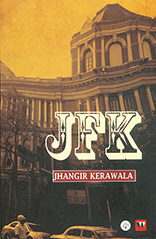
FK by Jhangir Kerawala. Published in 2012 by Grey Oak Publishers, Prestige Omega, No 104, EPIP Zone, Whitefield, Bangalore 560066 in association with Westland Limited, Venkat Towers, 165, P. H. Road, Maduravoyal, Madras 600095. Pp: 225. Price: Rs 199.
One often wonders what it is in the rigors of an education in commerce and accountancy which propels an individual to turn to creating fiction. One does not have to go as far back as Kafka, who was an insurance clerk by day and an outstanding novelist in his free time. We have some examples in our own community. Babsy Jain, a chartered accountant, wrote Lucky Everyday, Nina Godiwala, a thinly disguised autobiographical novel/memoir called Suits and Mehernosh Kapadia, M.Com., Llb (general), a member of the Institute of Company Secretaries, Society and Some Women Will Never Change.
And now we have JKF, a new novel by a Poona-based novelist, Jhangir Kerawala, a commerce graduate who has spent more than 10 years in accounting and five selling refrigerators. He has experimented with a comic series and created the character of Timpa inspired by that of Tintin. He received high praise from the personal physician of Hergé, the creator of the Tintin series, that his adaptation was the most "original and complete.” He has also produced stories for children before publishing this novel which has been described as a "fast-paced edge-of-the-seat-thriller.”

JFK has nothing to do with John Fitzgerald Kennedy as the title suggests. The letters are the initials of our hero or rather anti-hero Jatin F. Karunamoi. Far from being a Hercule Poirot or a Sherlock Homes, Jatin is a middle class, middle aged, unemployed man from Calcutta who suddenly finds himself trying to solve the murder of his best friend. The novel is set in the seamier side of Calcutta, which Kerawala certainly knows very well probably as a result of his profession of selling refrigerators in that city. The opening sequence is taut and well written and describes the chase and the murder of an old man, Ram Prasad Yadav. This is followed by the murder of Jatin’s friend Manish whose last uttered word is "JFK.” The two murders are linked as the same weapon was used.
Jatin, with the assistance of his friend Montu, like a later day Don Quixote accompanied by his Sancho Panza, sets off to solve the mystery of Manish’s murder and uncover the villain. In their quest, they are aided by Preeti who has been having an affair with Manish and who informs them that Manish was being blackmailed. Now they are in search of not only a murderer but also a blackmailer and the two are not one and the same individual. It is often difficult to comment on a detective novel without giving away too much of the plot but the entire blackmailing episode as well as the perpetrator seem to be a bit contrived and unsatisfying as well.
Investigating these murders takes Jatin out of the confines of his comfortable routine existence in Calcutta to Bhadoi in Uttar Pradesh where there is a greater evil of pedophilia to contend with. In an interview, Kerawala mentioned that he was appalled by the rate of child abuse in India and felt that it was only by discussing this unpalatable subject that "we will have taken the first step to controlling the evil.” However, this aspect of the novel often gets lost in the structure and the plot of the detective novel and if this was one of his main concerns in writing the novel then the point does not seem to have been made strongly enough as say in the case of Meher Pestonji’s novel Sadak Chaap.
The plot is mildly interesting and one does feel the necessity of turning the pages and get to the end. However, the characters in the novel do not really grab your attention. Though one may find some connect with them, they do not really remain in the imagination and one tends to forget them as soon as one has closed the book. There is however one exception: it is strange that it is neither the murderer nor the detective one remembers at the end of the novel but Montu, Jatin’s friend. He is one of the better developed characters in the novel: friendly and fun-loving, loyal and courageous, risking his life to find the villain. While one does not expect to encounter characters who are portrayed as completely virtuous — human beings are never black and white but come in shades of grey — the extent to which Montu goes to betray Manish, who is a good friend seems a bit unlikely and implausible.
It is not easy to write a novel and one must give credit to Kerawala for an honest and courageous attempt. It is refreshing to read a work of fiction by a Parsi novelist who has neither dealt with any Parsi eccentric characters nor dwelt upon Parsi rituals. One understands he has finished writing a historical novel and it would be interesting to see how his writing shapes in the future.