In your editorial "Others don’t need to learn” (Parsiana, December 21, 2016) you have rightly mentioned the need to educate others about our religion. The rigidly orthodox seem to be objecting to anything and everything.
To object to a non-Parsi presence at certain places and taking photographs of the consecrated fire is one thing, but objecting to printed photographs is not valid. Don’t we have photographs of our prophet and the farohar in our homes? Do we not have non-Parsi servants, neighbors, friends, et al coming to our homes and looking at these photographs? Objecting to pictures and videos published on Facebook and elsewhere is, in my opinion, taking things too far. These are objections just for the sake of objecting!
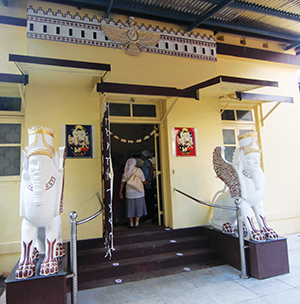
I strongly feel that write-ups and photographs such as of the Doongerwadi heritage walk and inauguration of the Behram Yazad shrine (pictured) at the Dadysett Atash Behram are a boon for those who were unable to attend the events. They enable such persons to know what happened.
Do the ignoramuses and pseudo orthodox who oppose the Behram Yazad shrine not know that we dedicate our highest places of worship to Behram Yazad — the atash-e-Behram? There is no sense in their objections.
BURJOR DABOO
burkhurdar@gmail.com
Your editorial "Others don’t need to learn” (Parsiana, December 21, 2016) prompted me to write this letter. Social evolution, like its biological counterpart, is usually a slow, often imperceptible, process. When, however, the pace of evolution increases, the change that is brought about is perceived as a revolution. This is what our community is presently going through: a fast-paced evolution, viewed with alarm as a catastrophic revolution.
While the majority views the changes taking place with apathy, there are several who vociferously express their indignation. And rightly so, as without debate there can be no progress. However, the intensity with which certain views are promulgated and others condemned often goes counter to the objectives of those who are angered. I am reminded of the story of the sun and the wind who competed in getting a cloak off the shoulders of a man on the street. The harder the wind blew, the tighter the man wrapped his cloak around himself. Then the sun came out, shining silently and benevolently, and spreading warmth, causing the man to take off his cloak.
There’s a huge lesson in that story for us: the harsher the criticism, the harder the resolve to fight it. Intolerance and denigration are negative ways to bring about, or halt, a situational change. What is needed is a positive approach: one of persuasion rather than coercion, of open-minded understanding rather than blind assertion. Instead of maligning what are viewed as "reformist” practices and the persons who support them, it would be much more effective if those who are genuinely aggrieved win over those whom they see in error by reasoned, rational argument on the basis of our scriptures, being at the same time prepared to be enlightened about the basis of the deviations they abhor.
Thesis and antithesis must be handled deftly with the sole view to bring about a synthesis, and a resumption of harmony in the community. We are much too small to be fragmented.
KERSHASP R. DADACHANJI
dadakr@gmail.com