‘JEH’: A Life of J. R. D. Tata by Bakhtiar K. Dadabhoy. Published in 2005 by Rupa and Company, 7/16, Ansari Road, Daryaganj, New Delhi 110002. Pp: 168. Price: Rs 495.
Inevitably, Bakhtiar K. Dadabhoy’s ‘JEH’: A Life of J. R. D. Tata, will be compared with R. M. Lala’s official biography, Beyond The Last Blue Mountain. And certainly Jeh stands up to the comparison. It is not unusual for more than one biography to be written about great thinkers and achievers. Why, certain historical and literary figures have had more than one biography written about them — Napoleon Bonaparte, Karl Marx, Leo Tolstoy, Winston Churchill, and our own Mahatma Gandhi, for each had at least three biographies written. Greatness eternally fascinates and demands continuous study and analysis. A single biography can hardly do justice to a man like JRD who played so many parts — an industrialist par excellence, a patron of the sciences and the arts, a philanthropist who believed in the trusteeship of wealth, a man with a passion for literature, fast cars, skiing and flying, and, above all else, an inspirer of men — and played them with distinction, though Lala did do an excellent job. JEH mentions certain incidents which did not find place in Lala’s work, probably due to the constraints of space. JEH covers the same ground, but offers new insights into several of JRD’s achievements. JEH also brings Tata achievements up-to-date, going beyond JRD’s death.
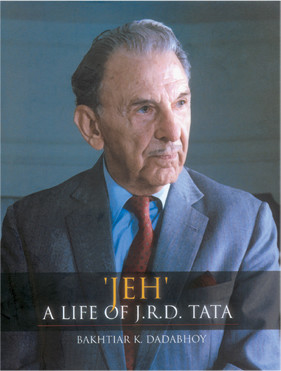
Notable, and perhaps unique among biographers, is the graciousness with which Lala extended a helping hand to Dadabhoy and the latter’s happy acknowledgement of it. Both authors have done a deeply researched, heart-felt job of interpreting the subject of their biographies. But Dadabhoy’s aim appears to be somewhat different from Lala’s. He has, as a sort of memorial to JRD, brought out a coffee-table volume, superbly designed and printed for which the credit must go to his publishers Rupa and Company. The photographs of JRD’s family members and of himself are a treat in themselves. My favorite photograph which, coincidentally, was also JRD’s, according to Dadabhoy, is of him as a young boy in a sailor suit, his eyes wide open to the wonderful new world, unaware still that he was one day to conquer it! There is also an exquisite Amul advertisement featuring a man himself flying and two little children enquiring, "Is it a bird? Is it a plane? It’s aapro Superman,” and ending, "Tata-ley Butterley Amul.” In marked contrast to the lavishness of the book’s production values is the simplicity and lucidity of Dadabhoy’s style of writing, shunning superlatives, always understating.
JEH is enlivened by interesting little nuggets of information. American author O’ Henry was one of JRD’s special favorites, along with Ernest Hemingway and Louis L’Amour. How the long battle to save Tata Steel impacting on the freedom struggle brought Ratan Tata and Motilal Nehru closer, the latter always staying at the old Tata home, Sunita, whenever he visited Bombay. After Ratan’s death, the beleaguered JRD could turn for advice only to Dinshaw Daji, a solicitor of repute in Crawford Bailey and Company. JRD, however, could never get along with Dorab Tata who in his later years became sick and irritable, and inclined to be impulsive in business matters. JRD was furious with him for selling off his Tata shares to Shapoorji Pallonji. Writes Dadabhoy: "This was something JRD did not talk about often — it was obviously a sad relationship in his life.”
JRD, undoubtedly a hero of corporate India, had his heroes too. The first was "a burly and amiable Scot,” John Peterson, director-in-charge of Tata Steel at Bombay, under whose tutelage RD wisely put his son, telling Peterson, "I would like you to look after my boy.” JRD recalled, "Every single paper going to his desk was routed through me. I studied it before I sent it up. And I studied his comments before I sent them out. I must say that this was a very formative and important time of my career, when I saw how a highly trained ICS (Indian Civil Services) administrator worked.” Another hero was Antoine De Saint Exupery, a pioneer aviator but better known as the author of the children’s classic, The Little Prince, whom JRD quoted to describe his first flight: "The pilot in full flight experienced neither giddiness nor any thrill. Only the mystery of metal turned into living flesh.” Aviation was always JRD’s first love and the happiest day of his life was when he received the Airways Certificate issued by the Royal Aero Club of India and Burma, on behalf of the Federation Aeronautic Internationale, bearing the signature of Sir Victor Sassoon, then chairman of the Federation: "It bore the Number 1,” recounts Dadabhoy, betokening the fact that he was the first one to have qualified in India. The phrase, "aircraft and engine perfect” that appeared often in JRD’s log books inspired the title of Mural Fyzee’s account of JRD’s aviation career: "It gives a sense of triumph against odds, human error and nature, and over many unrecorded problems. It also senses the kinship between JRD and his aeroplane.” Another favorite of JRD was Fred James, a maverick writer and compiler of All The World’s Fighting Ships and also of All The World’s Airships who prophesied that "Aviation will have arrived when people get used to being killed,” and coined a gem of a quote that impressed JRD greatly: "Mails may be lost, but never delayed. Passengers may be delayed, but never lost.”
JRD was a man of his word and often displayed the courage of his convictions. When his friend and mentor Neville Vincent joined Tatas, he was promised a third of the profits. But when the British government in 1938 decided on an "All-op Empire Arrival Scheme,” the profit of Tatas rocketed from Rs 66,000 to six lakhs and it was decided to work out a revised arrangement with Vincent. The latter was justifiably upset and wanted to quit. A troubled JRD went to the trusty Daji for advice. Daji told him that, legally, Vincent was not entitled to the original share, but morally he was. That sealed it for JRD. He asked Vincent to stay on and was able to convince his colleagues with the argument that Tatas had always respected the moral aspect. When during the War, TISCO’s (Tata Iron and Steel Company) capacity stagnated at eight million tonnes, JRD revealed to his shareholders that TISCO had provided approximately three million bars of steel to the war effort. But while other companies made great profits, JRD’s code of ethics did not allow him to profiteer and he continued to supply steel to the British government at pre-war prices. This won the encomium of the famous anthropologist and scholar Verrier Elvin, as he wrote in his The Story of Tata Steel. Incidentally, JRD helped this great champion of India’s tribal people by subsidizing the publication of his The Agrarian and The Murya and Their Ghoshed.
JRD was also strong-willed. Although both he and G. D. Birla collaborated on the Bombay Plan of 1944, theirs was an uneasy relationship. Says Dadabhoy: "The austere Marwari and the dapper JRD had little in common. Birla once wrote to JRD enclosing an article on the evils of smoking and drinking. JRD wrote back saying that he had given up smoking and hardly consumed alcohol or coffee. He said jokingly, that if he had to give up anything, he would like to give up work. Later, JRD told Lala that he finally kicked the smoking habit on December 31, 1967, when he smoked till midnight, and then never again.” Again, when JRD openly supported C. Rajagopalachari’s Swatantra Party, Naval Tata felt that this was imprudent since it was bound to antagonize Pandit Nehru, as indeed it did. But JRD went ahead nevertheless. In any case, JRD could never agree with Nehru’s advocacy of the so-called "socialism.” Nehru once told JRD that he hated the very mention of the word "profit,” finding it a dirty word. Since on this occasion JRD was talking to Nehru about the public sector making a profit, it seemed to annoy Nehru. JRD’s comment: "That he was out of tune with me is something I could deplore, but there was nothing I could do.” Ultimately, years after Nehru’s demise, "socialism” in India was discarded as a faulty philosophy.
Blessed with the spirit of enterprise and daring, this father of Indian civil aviation reenacted his historical First Airmail, Madras-Karachi flight for the second and a third time. A few weeks prior to the third reenactment, JRD had suffered a mild heart attack. Dadabhoy recalls how his cardiologist Dr Farokh Udwadia decided after due consideration to let him go on the flight, averring that the sustained strain and anxiety of not being allowed to do so might have been worse for JRD than the actual execution of the event. Keshub Mahindra recalls how he was despatched to go and talk to JRD who greeted him by saying: "Oh, you have arrived. They have sent you.” When he said that he had come only to see him, he replied, "I know why you are here.” Mahindra went back to Bombay House and told them, "Don’t stop him. You will kill him if you stop him.”
To those who met JRD socially, as this reviewer had the good fortune once, he gave the appearance of a sophisticated, suave gentleman with a rare sensitivity due to his French upbringing. He had a sense of humor too, a fact to which both the biographies give ample evidence. Just an example — after his second angioplasty, his cardiac specialist Dr Gool Contractor had to be strict with him as he was a difficult patient, which provoked JRD to introduce her to visitors as Saddam Hussein! JRD was also a man of prayer, though to him prayer was service, "one must play one’s role,” as he told Dr M. M. Balaguer, former principal of St Xavier’s College. He had reflected deeply on the subject of religion and God and had come to the conclusion, as he confided to Lala, "too much would be inexplicable if there was no God.” He also believed in reincarnation.
On his death bed, drawing his last breath, JRD is said to have murmured in French, "How sweet is death!”
As JRD was inspired by Jamsetji Tata, so was his successor Ratan Tata inspired by JRD to take Tata achievements to a new high. Tata Motors was one such major achievement. In August 2003, Tata Motors produced its three millionth vehicle. Ratan went on to establish several other enterprises, Tata Honeywell, Tata Telecom, Hitch Drilling, Tata Keltron, Tata Finance and Tata Tea.
Dadabhoy’s JEH does not seek to compete with Lala’s original biography, but rather to complement it. The two books constitute, as it were, a thesaurus of deeds, not words in tribute to an extraordinary human being. Perhaps the finest tribute to JRD was on the Air India hoarding at Marine Drive:
"He touched the sky and it smiled./ He stretched out his arms/and they encircled the globe./His vision made giants out of men and organizations.”
Dadabhoy concludes: "The message from Air India on JRD’s death couldn’t have been more poignant. The words pay homage not only to the person and aviator, but also aptly describe the passion and essence of JRD’s life.”