Rao Bahadur Ganpatrao Mhatre, who became a legend during his life-time, was an iconic sculptor in the early 20th century India. He was credited with many firsts in the field of fine arts. Mhatre sculpted the common sensibility to reflect Indian values and traditions. He was equally at ease with a variety of media including clay, plaster of paris, marble, bronze and even granite. To his credit are 267 busts, 64 full-size statues (including more than 40 memorial statues of Parsi men and women) and seven heroic sized equestrian statues as well as hundreds of oil and watercolor paintings. Mhatre was the most sought after sculptor for memorial statuary works in his time. He has immortalized in stone or bronze many famous Indian personalities, nobility and royalty. He was awarded the honorary title of Rao Bahadur in 1929 and appointed Justice of the Peace.
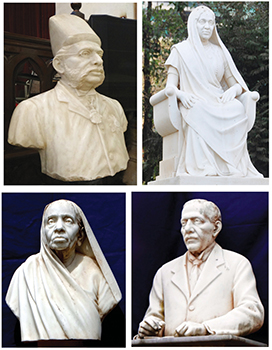
Clockwise, from top l: Busts and statues sculpted by Ganpatrao Mhatre
of Sir Pherozshah Mehta, Jerbai Masina, Kaikhushro Alpaiwalla
and Lady Pirozbai Shapoorji Broacha
In 1897 Ganpatrao became the first Indian artist to feature in the prestigious Magazine of Art published from London. To the Temple, his debut masterpiece is now entering its 125th year. A bronze replica of this epic sculpture proudly stands in the Lok Sabha Annexe, gifted by the Government of Maharashtra to the Government of India. Another bronze replica titled Mandirpathagamini (To the Temple), a life-size sculpture depicting a beautiful young Hindu Maharashtrian lady, is located in the entrance foyer of the Sir J. J. School of Arts. Whilst studying there he sculpted this masterpiece at the age of 17. The sculpture won Mhatre many honors and accolades.
Other pieces include those of Sir Shapoorji Burjorji Broacha, Ardaseer Nuserwanji Mody, Burjorjee Behramjee, Sir Cowasji Jahangir, Sorabji Limji Dinshaw Panday, Hormusjee Jamsetjee Rustomjee, Edulji Dinshaw, Nadirshah Dinshaw, Kamarkhanum Currimbhoy, and the gigantic statue of the poet Ferdowsi in Tehran, Iran. He also made a full-size marble bust of Zarathushtra for the family of Bomanji Dinshaw Petit, but its current location is not known.
I am Mhatre’s great-grandson and am writing a book on the life of the sculptor. Since many of the sculptures made by him are in private collections, I appeal for information about any additional information/photos of Parsi sculptures made by my great-grandfather so that I may include it in my upcoming book. Dr HEMANT PATHARE
Heart and lung transplant surgeon
Head of the department of heart transplant surgery and mechanical circulatory devices
Jaslok Hospital and Medical Research Centre,
hpathare@yahoo.com