The unstinting commitment of some
Parsi suffragettes enabled Indian women to vote
Parinaz M. Gandhi
"We have seen that it has taken English women more than 80 years of bitter agitation to get their rights. Surely, if we call ourselves human and rational beings, we ought to beware, and not make the same mistake as the English people… All the vague fears which were conjured up about women’s suffrage in England have proved to be illusions. So also will our Indian reactionaries see that their fears about granting women the vote are made of soap-bubble material.” A hundred years ago, Mithan Tata, who with her mother Herabai was in the forefront of the Indian suffragette movement, had expressed her views in Stri Dharma.
The important contribution of the mother-daughter duo "who were instrumental in some of the campaigns for women’s suffrage both in Bombay (and)… in Britain” was highlighted in a presentation by Dr Sumita Mukherjee under the auspices of the Zoroastrian All Party Parliamentary Group (ZAPPG) at the House of Lords on September 12, 2018. She also spoke of the contribution of Avabai Wadia and Hilla Faridoonji.
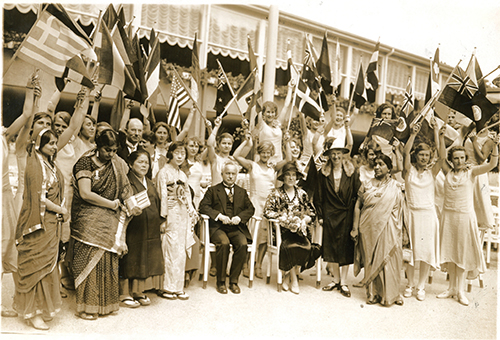
International Alliance of Women’s Suffrage, Berlin, 1929
Photo: LSE Library Collections
Gathering at the ZAPPG event at the House of Lords;
inset (from l): Malcolm Deboo, Gareth Thomas, Dr Sumita Mukherjee Photos: Raj Bakrania
"As in just about every field and endeavor, the Zoroastrian Parsi community played a prominent role in the Indian suffragette movement. Parsi women have led the way…” noted a message from Lord Karan Bilimoria, chair of the ZAPPG that was formed five years ago. Since Bilimoria was unable to attend the talk due to an emergency spinal operation the preceding week, co-chair Gareth Thomas, Member of Parliament (MP), presided over the session. He commented how ZAPPG has been wonderful for both the British Parliament and the Zoroastrian community by increasing public and parliamentary awareness of the religion, history, culture and achievements, noted a report of the event by Shazneen Munshi, joint Young Zoroastrians coordinator and joint communications officer for the Zoroastrian Trust Funds of Europe (ZTFE).
The august assembly comprising 50 parliamentarians, civil servants, academics, faith leaders, ZTFE members and interfaith friends, included the two vice chairs of ZAPPG Virendra Sharma MP and Lord Navnit Dholakia, ZAPPG secretary Stephen Pound MP, Lord Rajinder Loomba, Lord David Alton and Baroness Emma Nicholson.
Herabai and Mithan landed in London in the summer of 1919 and forwarded a statement to the Joint Select Committee (JSC) constituted for the 1919 Government of India Bill urging that Indian women should be given the right to vote, recalled Mukherjee. A historian and senior lecturer at the University of Bristol, Mukherjee’s book Indian Suffragettes: Female Identities and Transnational Networks was published by the Oxford University Press in 2018. According to her PowerPoint presentation shared with Parsiana, the groundwork for the journey to Britain was laid two years prior when a deputation of women approached the Government of India that they be included in the new Franchise Bill. But the Government appointed Royal Commission on Indian Reforms, chaired by Lord Southborough, excluded women from the franchise in India. The Bombay Women’s Committee, led by Jaiji Petit, decided that Herabai and Mithan should travel to London to submit a memorandum to the JSC. In the summer of 1919, the JSC heard the evidence of Dr Annie Besant and Sarojini Naidu.
In their statement, the Tatas described themselves as representatives of the Bombay Women’s Committee and the Women’s India Association. They argued that Indian women were treated equally over 5,000 years ago and that in the past few decades, with the rise of female education, their status was rising again. They vehemently criticized the Government committee for their total rejection of women from the electorate and for listening to base prejudices about women’s inferiority. They further pointed out that many Indian women were demonstrating a keen interest in political affairs and that conceding the vote to women would be a spur to female empowerment. It would be mainly educated, upper-class women who would cast their vote, they tried to reassure the government.
Among those who did not support suffrage for Indian women was Cornelia Sorabji, the first female graduate from Bombay University and the first woman to study law at Oxford University. She argued that Indian women were not yet on par with the English suffragettes when they began their fight for equality. According to Sorabji, education and other social issues were more pressing in India than the right to vote. Mithan however argued that even in olden days Indian women were rulers, philosophers and took part in village councils.
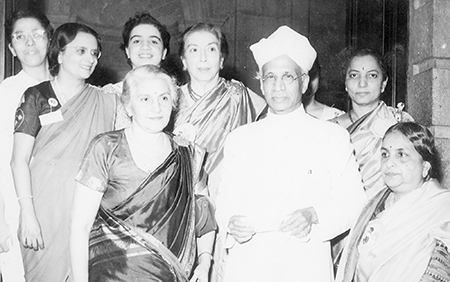
Avabai Wadia, Mithan Lam and Sarvepalli Radhakrishnan (2nd, 5th and 6th from l), 1952
Sophia Duleep Singh selling copies of
The Suffragette outside Hampton Court Palace, 1913
The Tatas then proceeded on a three-month tour of Britain meeting with various individuals and associations to garner support for the Indian women’s cause. They addressed women’s groups and educational institutions in Birkenhead, Bolton, Edinburgh, Glasgow, Harrowgate, Liverpool, Manchester and Newcastle. They even tried to persuade MPs in the House of Commons to amend the Government of India Bill to remove any discrimination against women in the franchise. When Mithan pursued her postgraduate course in economics at the London School of Economics and trained for the Bar, Herabai decided to stay back in Britain and they both continued to meet with prominent women activists over the next four years. Once the Inns of Court were opened to women in 1920, Mithan was the first woman called to the Bar on January 26, 1923.
The revolutionary nationalist, Mme Bhikhaiji Cama who had unfurled the Indian tricolor flag at the 1906 International Socialist Congress in Stuttgart was one of the women they met. As recollected by Mithan, "On being told that initially we had come to England to ask for votes for Indian women before the Southborough Committee on Indian Reforms, she just shook her head rather sadly and stated, ‘Work for India’s freedom and independence. When India is independent women will get not only the votes but all other rights.’”
Herabai simultaneously turned her attention to ongoing campaigns in India and urged her colleagues in Bombay to organize petitions to remove sex discrimination. As directed by the Government of India Act, it was up to members of provincial legislative councils to propose a resolution to enfranchise women, and then for the resolution to be passed by a majority. In April 1921, women in Madras were enfranchised on the same terms as men, and three months later, women in Bombay.
The efforts in Madras were coordinated by Margaret Cousins, a Theosophist who later initiated the All India Women’s Conference. With Herabai too being a Theosophist, the two had met at the international headquarters of the Theosophical Society in Adyar, Madras. At the age of 16, Herabai had married Ardeshir Bejonji Tata who belonged to the extended family of Jamsetji Tata and managed a textile mill. Mithan was born to the couple in 1898.
When the mother-daughter returned to India, Mithan enrolled in the Bombay High Court where she was the first woman barrister. She married Jamshed Sorabsha Lam, a solicitor in 1933. Their son Sorab, born the following year, became a high profile orthopedic surgeon in the south of England.
By 1935, all the provinces in British India had given women the right to vote. Alongside her legal career, Mithan continued to be involved in social reform: She was professor of social legislation at the Tata Institution of Social Work, a member of the commission to amend the Parsi Marriage and Divorce Act, the first Indian woman to be made sheriff of Bombay in 1947, was chair of the Government of Bombay Refugee Relief and Rehabilitation Committee from 1947-50, during the crucial years after Independence and Partition, and an Indian delegate at various seminars organized by the United Nations.
Among the notable Parsi ladies who were also involved in the suffragette movement was Avabai Wadia from Ceylon (now Sri Lanka). With her mother Pirojbai Mehta too being a Theosophist, Avabai had joined the Society’s Youth Lodge in Ceylon where she was appointed secretary and recorded minutes, learnt to write and give speeches at the age of 12. On the recommendation of the Society’s international president Dr Annie Besant, who advocated an education in Britain for young Avabai, she and her mother set sail for Britain. She attended the British Commonwealth League conference in 1929 with her mother, and was a member of the London branch of the Women’s Indian Association that held regular meetings on suffrage. In 1932, Avabai, then aged 18 years, spoke on "Women’s Suffrage in India.” After completing her schooling she joined Lincoln’s Inn, the first woman from Ceylon to do so. Their family moved to India in 1939 where she met the staunch nationalist Dr Bomanji Wadia whom she later married. Even in her 90s, she continued to dedicate her service to women’s rights and family planning.
Yet another high profile suffragette was Faridoonji who was vice president of the All India Women’s Conference. In a meeting with a government commission on suffrage in 1932, she reiterated that Indian women were progressive and urged the commission to enfranchise women at this critical time.
In the question-answer session that followed Mukherjee’s talk, Pound suggested that to raise awareness of the Indian and Parsi women in politics, a campaign be initiated to get a new statue in London of a Parsi suffragette! Since Herabai and Mithan resided for four years at 16, Tavistock Square, London, he felt a statue of a Parsi suffragette should be put up next to Mahatma Gandhi’s in the same Square. Dholakia deemed it important that Zoroastrian and Indian youth participate in British politics. Concurring with Dholakia, ZTFE president Malcolm Deboo recommended that Zoroastrian youth should be involved in social sciences, humanities, arts so that a new generation of academics could help keep the community heritage alive.
The 12th official event of ZAPPG ended with Purnima Raval escorting young Zoroastrians on an exclusive tour of the Parliament premises to acquaint them with influential leaders and their majestic surroundings. Employed with the Metropolitan Police Services she has worked at the Houses of Parliament for over 20 years.