Founder president of the Theatre Owners Association, the late Keki Modi strove to provide the best in entertainment to Indian audiences
"Everybody only looks at an actor. Nobody looks at an exhibitor/distributor,” remarked Roosi Modi when bringing to light the role played by his late father Keki who had a stake in over 100 cinema houses all over India in the 1940s. "In those days when the only entertainment was cinema,” Keki’s company Western India Theatres Limited acquired/leased/franchised single screen theaters and was given credit for being the first to introduce 3D, wide screen, and the Todd-AO (70mm) projection in India.
In Roosi’s office at the Liberty Building at Marine Lines, the same premises used by Keki, the walls are adorned with frames of his parents in the company of legendary producers, heads of nations and certificates commending Keki’s work. The quintessential grandfather clocks representing a bygone era literally brought conversation to a pause when they chimed in unison at noon on January 29, 2019. One of these clocks had featured in Sheesh Mahal, produced and directed by Keki’s elder brother Sohrab Modi who also starred in the 1950 film. Keki though ensured the clock came back to his office, recalled Roosi. Also on the desk featured a pen holder with Keki’s KMM monogram. The Parker 51 pens were awaited from Portugal where they had been specially sent for servicing.
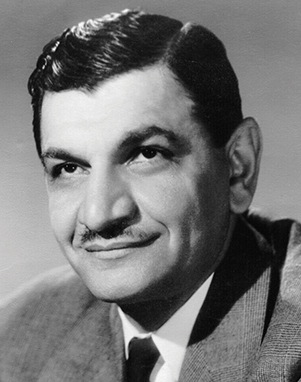
Left: Ellen and Keki Modi presented to Queen Elizabeth II; Right: inauguration of New Empire, Bombay
Keki and Ellen with Walt Disney
"Mr Hollywood of India,” was the moniker used for Keki who was the channel for all major foreign films into India. With his global contacts he represented Disney, The Rank Organisation, Fox, MGM, Warner Brothers and other big studios in India. Commenting on "his inimitable enthusiasm, his expert judgment, his flair for the selection of original and spectacular new media of entertainment,” an obituary following Keki’s demise on August 4, 1972 acknowledged, "He was a single-minded perfectionist always determined to give his audience the finest in entertainment.”
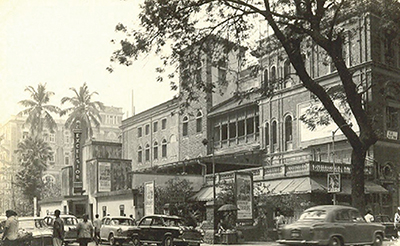
Founder president of the Theatre Owners Association (now known as the Cinema Owners and Exhibitors’ Association of India), Keki controlled popular cinema houses like Excelsior, New Empire, Strand, Minerva, Central in Bombay, Plaza in Delhi, Elphinstone in Madras, Minerva and Elite in Calcutta, West End and Nishat in Hyderabad, West End, Empire, Minerva, Shree Krishna and Capitol (now Victory) in Poona.
At the Excelsior he had presented the Scandinavian Ice Revue as also international artistes like violinist and conductor Yehudi Menuhin, operatic soprano Eleanor Steber, modern dancer and choreographer Martha Graham, British prima ballerina Svetlana Beriosova, magicians Virgil Poster and Cecil Lyle, and Shakespearean companies of Eric Elliot and Marius Goring. At the Strand every evening, joined by the city’s elite he would preview international films and determine which had commercial prospects in India.
With the New Empire cinema in particular, the family had an enduring association. Built as a theater for an orchestra in 1908 with impressive interiors and a domed ceiling, it was said to be the first theater in Asia with a cantilevered balcony. Keki bought it in 1935, had it renovated for the single screen in 1947-48 and during its heydays from the 1960s to ’80s, it was known to screen megabusters like Love Story, North to Alaska, Around the World in 80 Days… that ran for several weeks.
Although his forte was exhibition, Keki who was president of the Film Producers Guild is known to have made one film, Monsoon. Whether it was ever released, Roosi does not know. He is aware though that his father had a film studio in Tardeo, leased from Jehangir Jejeebhoy, that was returned to him after the expiry of the lease.
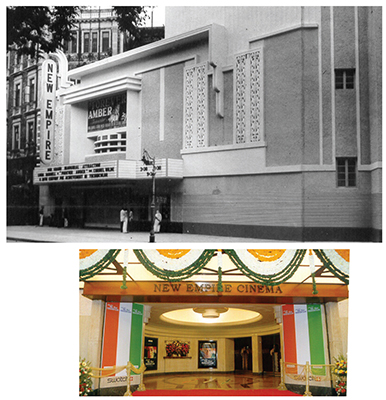
Bombay’s New Empire restored to its old glory in 1997
The youngest of 10 siblings, Keki’s association with exhibition of films commenced during World War I when as a lad of barely 16 he was employed by elder brother Rustom who had a theater company. Actually it was more of a touring cinema with a bedsheet kind of screen, projector, generator, battery and film reels that would be taken from one venue to another. Keki was assigned the duty to shuttle prints on his bicycle. Subsequently he was made operator and his earnings improved. Their father Merwan was an engine driver and was specially deputed to Kenya to work on steam engines. "They came from a humble family in Deolali. The sons were educated and spoke very good English. One of them, Pesi, used to teach at Mayo College in Ajmer to keep the home fires burning.” Sohrab earned recognition for his acting skills as also as producer and director. Pesiba, Soba, Kekiba was how the family respectfully addressed the members. Sohrab’s efforts to produce the first Technicolor film, Jhansi ki Rani, under the banner of his Minerva Movietone was a box office disaster compelling Keki as financer to liquidate many of his theater assets.
At the age of 42, Keki married Ellen Lawyer of Calcutta who was 18 years younger than him. Although Keki was an alumnus of Bharda School and Ellen was convent educated, there was never a cultural clash between his parents, observed the son. Roosi (named after his uncle Rustom who had died 10 months prior) was born when the father was 48 and daughter Maxie when Keki was 51. "He never raised his hand on us children.” One stern look that conveyed a ‘no’ was enough and the children knew where to draw the line. On global jaunts with his parents, Roosi realized that his father seemed to have "contacts all over the world.” By then Keki had already made inroads into representing Hollywood films. As children, they were privileged to experience Disney World as the guests of Walt and Roy Disney!
Keki made time to pursue other interests and activities. Invariably attired in a suit, for some years he was a regular at the Race Course and is known to have owned horses although most of the steeds were in Pesiba’s name as he wanted to indulge his elder brother. Fond of traveling, Keki and Ellen were on Air India’s inaugural flight from Bombay to London when J. R. D. Tata took a personal interest in ensuring everyone on board was comfortable, Roosi had learnt from his parents. Later, after Keki’s passing away, when Ellen called JRD seeking an appointment because she wanted to consult him, the Tata chairman waived off all formalities and reassured her that he would drop by at the Modis’ residence.
Honorary consul general for the Philippines, as part of the consular corps Keki was presented to Queen Elizabeth II in 1962 and a photograph of their meeting is one of the many cherished by the son. He had also been made officer of the Order of the British Empire. Whilst he was the consul general, a plane carrying Filipino nationals had crashed off the coast of Bombay in 1964. A special plaque presented to Keki by the National Council of the Boy Scouts of The Philippines lauded "his personal concern and unselfish assistance in the difficult task of recovering, identifying and transporting the remains of the ill-fated scouts and scouters… His solicitude for the welfare of parents, kin and friends of the deceased as well as scout officials brought immeasurable comfort in the face of the tragedy.”
Roosi remembers his father as being "extremely generous. He would help anybody who came to him.” After his death, when the priests had to be given monetary compensation for reciting prayers, Roosi recalls his mother instructing him to continue Keki’s practice and give them "more than what is necessary.” He would wear the sudreh kusti religiously and on auspicious occasions a family trip to the fire temple was routine. Many of Keki’s acts of kindness and largesse the son learnt of much later in life when related by recipients.
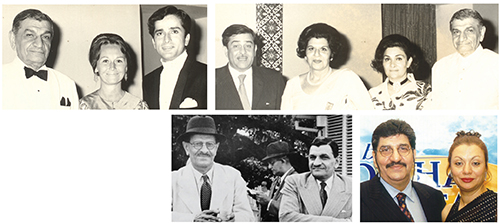
From l (top row): Keki, Jennifer Kendal, Shashi Kapoor; Raj Kapoor, Ellen,
Krishna Kapoor, Keki; (2nd row): Pesi and Keki; Roosi and Pheroza Modi
"I was 24 when my dad died,” noted Roosi. Although he never learnt the ropes of business from his father, and has little information to share on his business acumen, he knew his father to be "straightforward, never blew his own trumpet and being very, very humble, never showed off.” For the daily previews at Strand, the son was assigned five seats. Over the years Roosi has continued to maintain a diary of every movie he has seen since his school days, noting down the venue and expressing his views.
Roosi has been witness to other Parsi owned single screen theaters in Bombay like Eros, Edward, Novelty, Regal losing out on audiences and/or finally closing down. In an earlier interview with a journalist, Roosi had listed the travails of running a single screen theater: there are around 15 licences and certificates that are mandatory to obtain from the local police chowki, telephone department, fire department, environmental authorities, public works department, health and hygiene, with taxes to be paid for entertainment, property, neon sign, advertisements, false ceiling, among many others.
Whilst Roosi struggled to retain the family legacy against the rising convenience of home theaters made possible by satellite television and popularity of multiplexes, there came a time when New Empire was associated with sleazy films. "I used to be embarrassed. I told myself if my father had been alive he would never have permitted it. So on my 50th birthday in 1997, I pledged to restore it to its old glory, installing a modern air conditioning plant and superior sound equipment like Dolby.”
Unable to sustain the losses, his sister Maxie Cooper eventually shut down New Empire five years ago although the Elite that she owns in Calcutta is still functioning. The once iconic West End in Poona is owned by Roosi. Managing this theater from the new abode within Arora Towers, he has learnt over the years, "It is not that easy to resurrect a cinema and run it.”