Poet and author Adil Jussawalla
strove to give a voice to unheard Indian writers
Firdaus Gandavia
As a result of the seminar on "The Parsi Contribution to Indian Literature” which was held at the Sir Pherozeshah Mehta Bhavan on the Kalina campus of Bombay University on September 20, 2016 (see "The pen and the Parsis,” Parsiana, March 7, 2017) the Sahitya Akademi commissioned a book to record the papers which were read on this occasion. Dr Coomi Vevaina, former head of the English Department, Bombay University, requested Harish Nambiar to interview Adil Jussawalla for this book. Not only did Nambiar get Jussawalla to agree to an interview but he also persuaded him to record the interview on screen which makes it more valuable as Jussawalla greatly values his privacy. The recorded interview was screened at the Bombay Press Club on January 31, 2019.
Nambiar began by asking Jussawalla the origin of his surname. When he was researching his father’s life, hoping to perhaps write a biography, Jussawalla heard from his brother Firdausi that the family originally came from a village in Afghanistan called Jassa. Jussawalla dryly remarked, "Though both Firdausi and I have Afghani looks, many others in our family don’t.” However, a more plausible explanation was offered by Virchand Dharamsey, a neglected scholar and a member of the Asiatic Society, who discovered some of the Jussawalla family history in early journals which wrote about the Parsis. He maintained that an ancestor Jassaji Jeevanji came from Kalyan in the early 18th century. When the British made it mandatory for Indians to have a surname, his son Ratansa changed the name and took the surname of Jussawalla. Jussawalla means someone worthy of honor. "Jussa” is also a word for zinc. The Jussawallas are basically from North India, Rawalpindi, Karachi, and specialized in chain stores selling European goods.
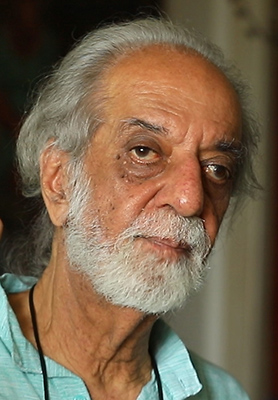
Adil Jussawalla: "I’m an Animist"
Harish Nambiar: valuable recording
When Nambiar asked him about the Penguin New Writing in India edited by Jussawalla and published in 1974, Jussawalla revealed that he travelled the length and breadth of India to meet writers in their homes or home states, collect their works, and have them translated by whomsoever they chose; this resulted in a seminal work which collected voices from all over India.
Why did the need for such an anthology arise? When Jussawalla was in England, he found that Indian writers were by and large invisible people. It was very important for him that he should expose readers to the new voices from the subcontinent. Other than the novels of Kamala Markandaya and R. K. Narayan, several noteworthy novelists needed to be introduced. Jussawalla gave an example of Menon Marath. Two of his novels, The Wound of Spring and The Sale of an Island were published but not one of the other five books he wrote. The same was the plight of Victor Anant’s Revolving Man. Jussawalla is concerned about what happens to all this unpublished work which is not even archived. He was anxious to present unknown Indian writers to the public not only in foreign countries but in India as well; several people have mentioned to him they were introduced to Qurratulain Hyder or Nirmal Verma thanks to his collection. This was the only book in the series published by Penguin that reportedly went into a reprint.
Soon after the success of New Writing in English there was a great interest for a sequel but the reason why this could not be done was social and practical: Jussawalla was married with family, his wife and step-daughter lived with him and he no longer had the freedom to travel as before. "I can’t see that kind of literary Bharat yatra (pilgrimage) happening now,” he says. "Not just by me but also the younger editors. The whole ‘India by language first’ has led to dangerous and flimsy kind of nativism. The undercurrent and hostility to Indian writing in English has grown over the years. There is a feeling that I am the best translator of my work. Openness and sharing with no strings attached has gone. We can’t have an Olympian view of all the writing in India. The selection of anthologies is personal and one cannot take umbrage over leaving out certain writers and including others.”
Jussawalla really misses Parsi Gujarati. "People think I’m joking but I do miss it. I can’t talk it to any of my Parsi friends because they start laughing immediately as they feel there is something wrong. Talking Parsi Gujarati in a group does me good. Unfortunately, it is not a literary language. Some of my friends do say that there are novels written in this language but generally when Parsis chose to write, they wrote in shudh (classical) Gujarati.” Jussawalla enjoys the humor and satire which is an essential element of Parsi writing. Robust, bad-mouthing, swear words, humor in Parsi speech most often reflected in the plays of Adi Marzban, though it is of the more genteel kind. He believes that communities under threat do develop a self-deprecating sense of humor. Humor did not originate in Iran; the bawdiness in the language probably arose from associating with the Gujarat peasantry.
Jussawalla feels threatened with greater invisibility as a Parsi. There is no real future for the community. "People who talk about sugar dissolved in milk don’t realize you are completely dissolved just as when we die, we get dispersed.” His anxiety is the disappearance of a history and a tradition and a culture which has been very badly recorded as well as poorly served by scholars. "There have not been enough of scholars within the community addressing this blank period when the first (Parsis) arrived and (the) first poem recording their arrival was written almost nine centuries later. What happened during this period? We have images of Parsis but no such thing as a Parsi dress; dress largely depended on in which area the Parsis settled.”
When asked about the reference to prayer in his poem Gulestan, Jussawalla said that prayer has been a continuous strand since his childhood and his interest in religion and mysticism is often intellectual. "I don’t feel intellectually I’m an atheist. My poems have objects, birds and beasts which have a language and a soul. I’m an Animist (one who subscribes to the belief that all plants, animals and objects have spirits). I’m not lonely because things seem to be talking to me, which in my case, I hope, is not a sign of madness.” He does not believe in the existence of heaven or hell in a physical sense but feels we disintegrate and get recycled into something else which continues. He hesitates to call it a soul. "Religion and prayer always had a place in the family and I find myself following my mother’s habit of prayer in times of need, though I don’t know to whom I am praying. I would like to have a belief in something more substantial than I have now but I don’t know if I will ever find it and this does not distress me.”