Feroze: The Forgotten Gandhi by Bertil Falk. Published in 2016 by The Lotus Collection, an imprint of Roli Books Private Limited, M-75, Greater Kailash II Market, New Delhi, 110048; email: info@rolibooks.com; website: www.rolibooks.com. Pp. xvi + 304. Price: Rs 695.
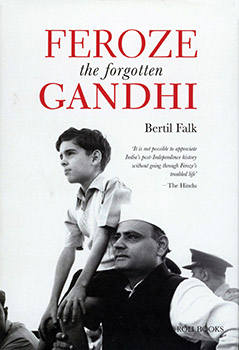
As the title of this insightful book notes, Feroze Gandhi is indeed the forgotten Gandhi in Indian politics. On the rare occasions when his name crops up in public debate, it is almost invariably as the late husband of Indira Gandhi rather than as a political figure of any significance in his own right. Bertil Falk considers this an injustice, and sets out to rectify the omission.
What are the author’s credentials to write this book? A Swedish journalist of long standing, Falk is better known for his science fiction writings, although his oeuvre extends to other genres as well. As for India, his connection with this country began in 1977 when, shortly after the end of the Emergency, he got an opportunity to interview Indira Gandhi. He was intrigued to discover that while other members of her family enjoyed public recognition and visibility, the one person about whom not much was spoken or written about was her husband Feroze.
"I decided to write an article about him,” he says, "…but the more I learned about him, I decided on a biography. Over the years I came back to India many times, looked for books where he was mentioned and began interviewing people who had known him or worked with him.” On mentioning his plans to a friend, Purushottam Das Tandon, an Allahabad-based journalist, he was strongly dissuaded from embarking on the project. This only hardened his resolve. "The more I am told that Feroze does not deserve a biography, the stronger my urge to write one grows,” he told his friend who then began helping him unstintingly with introductions and materials.
The book follows a largely chronological structure, and is written in a slightly idiosyncratic idiom which can probably be attributed to the fact that English is not the author’s first language. But it is based on painstaking research, including interviews with a sizeable number of people who had known Feroze, both in India and abroad. Falk also took the trouble of speaking to Feroze’s Parsi relatives in Bombay and Surat.
It is worth noting that Falk does not share his subject’s political leanings. "Feroze Gandhi was a socialist of a soft kind, but a democrat of pure gold. The kind of social democrat, who believed in democracy but also, like so many other people in those days, admired the Soviet Union. I on the other hand have a strong belief in a carefully defined liberalism and a market economy with social responsibility and a human face. My attitude is perhaps very close to the attitude of the converted Minoo Masani who, as one of his political enemies admitted, smelled the rat of rotting communism 20 years before the light dawned on many other Indian socialists.” Masani, incidentally, was one of Falk’s sources.
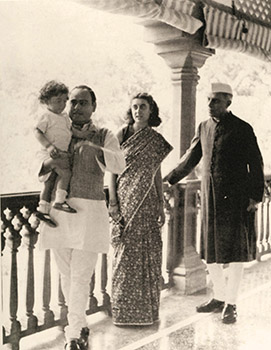
Feroze Gandhi, carrying elder son Rajiv with Indira Gandhi and Jawaharlal Nehru
Feroze and Indira at their marriage ceremony
Jehangir and Rattamai Gandhi; (left) young Feroze with elder sister Tehmina
Left: Nehru during the immersion of Feroze’s ashes at Allahabad;
right: gravestone at Allahabad’s Parsi cemetery
Bertil Falk with Indira Gandhi
Although the book sets out to be a serious evaluation of Feroze’s life — and it does succeed in large measure in being one — gossip is not altogether absent from its pages. Falk spends some time, for example, discussing the many rumors that have floated around Feroze’s paternity. One was that he was the son of a Muslim liquor merchant, Nawab Khan — a rumor that Falk gives short shrift to summarily. But he is less dismissive of another story that Feroze’s actual father was an Allahabad-based lawyer, Kamla Prasad Kakkar. When he asked Kakkar’s son about the veracity of this story, the son intriguingly replied: "I cannot say that it is incorrect,” which planted enough seeds of suspicion in Falk’s mind to make him carry out further investigations, including at the Parsi Lying-in Hospital in Bombay where the birth supposedly took place.
Those investigations did not yield the definitive results that he was seeking. "Are we now in the position to say with 100% assurance that the riddle (of Feroze’s parentage) is solved?” he asks in exasperated conclusion. "No, we cannot, but if the involved families decide on using DNA, this question mark could easily be straightened out into an exclamation mark once and for all.”
Falk reports that the "Parsi relatives of Feroze Gandhi have been very upset by statements about his lineage.” One of them, Tehmina Gandhy, was, in particular, at great pains to scotch the rumors and to assert that Gandhi was the son of Jehangir Faredoon and Rattamai Gandhi. In any case, notes the author, Feroze did go through a navjote ceremony which established his initiation into the Zoroastrian faith. He adds in another part of the book that Feroze had, in his will, described himself as a Parsi Zoroastrian.
Falk has another stab at retelling gossip when he refers to insinuations about a possible love affair between Feroze and Kamala Nehru. These insinuations, which featured in posters put up in Allahabad during one of Jawaharlal Nehru’s stints in prison, were apparently taken seriously enough by Nehru to lead to a private investigation being conducted, at his request, by Rafi Ahmed Kidwai. In the event, the posters were discovered to be the handiwork of a group of disgruntled local Congressmen, and there the matter ended.
The book is on much firmer ground when it discusses Feroze’s political activities, including his role in the Mundhra scandal and his passionate crusade for freedom of the Press. The story of Feroze’s advocacy in parliament of the Protection of Publication Bill (which gave the media immunity from prosecution for publishing fair and accurate reports of parliamentary proceedings, and which came to be known in common parlance as the "Press Law”) is told at some length and with great sympathy. Falk adds wryly: "We don’t know what his wife thought at the time of his strong support for the printed word. What we do know is that when she, 19 years later in 1975, turned her back to democracy and proclaimed the Emergency, she threw her husband’s Press Law into the dustbin…”
Arguably, the most readable chapter in the book is one entitled "Other Sides of Feroze” in which Falk offers glimpses of the personal qualities of his subject. Here, he lets many of Feroze’s friends speak about him, and the picture that emerges is of a man who is not only well read and hugely talented but also warm, compassionate, gentlemanly, modest and humorous.
Feroze’s Parsi ancestry does not feature prominently in the book, although there are references to it. Falk quotes Shanti Gandhi, a close confidante of both Indira and Feroze, as saying: "I don’t think that Feroze was an orthodox Parsi. I would be very surprised if he observed all the rules of religion. But not being religious does not mean the same thing as not being spiritual.”
The issue of his religion did, however, come to the fore at least a couple of times. When the plans of his marriage to Indira were announced, Mohandas Gandhi wrote in his journal, Harijan, that he had received several angry and abusive letters from Hindu fundamentalists opposing the union on the grounds that Feroze was a Parsi and Indira was a Brahmin. Gandhiji, of course, strongly objected to such protests and publicly expressed his support for the nuptials.
The second major occasion when Feroze’s Parsi/Zoroastrian heritage became a subject of discussion was when he died and the question of the manner of disposal of his body arose. In the event, a compromise was reached, which Falk describes as follows: "Even though his remains were not put into a Parsi Tower of Silence to be consumed by the drying sun and vultures and even though he was cremated in Delhi at a Hindu cremation ground along the Yamuna, and his ashes at least partly immersed in Triveni Sangam in a public ceremony peculiar to Hinduism, the fact is that a part of his ashes were buried in the Parsi graveyard of Allahabad, where his mazaar and gravestone still can be seen by the side of his Parsi relatives.”
Taken all in all, Falk has rendered a valuable service by publishing this book. It is an affectionate tribute to a public figure who, during his relatively short life, tried to further freedom and the rule of law in an India that was just emerging from the shadows of colonial rule. Falk ends his tribute to "Feroze Bhai” with this well-aimed jibe: "The Congress Party is no longer the obvious choice for a more enlightened electorate -- and Feroze Gandhi would most probably not have regretted this development. He was certainly not for a dynastic India.”