Shireen Virjee, one of India’s early students to study sculpture at the Royal College of Art in London, is remembered by a nephew and a niece
Farrokh Jijina
Seventy-five years ago, on a July day in Panchgani, political leader and prolific letter writer Mohandas K. Gandhi wrote at least three letters. One was to Muhammed Ali Jinnah, asking the Muslim leader to meet him whenever he chose. The second was to British Prime Minister Winston Churchill, stating "I …ask you to trust and use me for the sake of your people and mine…” The year was 1944. In the midst of what must have been a hectic time for him, Gandhi found time to reply to a letter from sculptor Shireen Virjee (1914 -1986).
Shireen Virjee (left) sculpting the bust of Lady Edwina Mountbatten (right)
Suffering from acute arthritis and bedridden in a cast since 1942, Virjee, reportedly among the first Indian women to be admitted to the Royal College of Art in the UK, was staying at her family home Maidstone in Panchgani. Gandhi, who was then recuperating from a previous incarceration in the hill station too, held regular prayer meetings each morning at the Batha School. The political leader’s letter dated July 17, 1944 to Virjee is in the possession of her nephew, filmmaker Cyrus Bharucha. The circumstances surrounding the letter are posted on the website of 80-year-old Panchgani-based institution Initiatives of Change (IoC) that evolved from the peace initiative "Moral Re-Armament.”
Gandhi’s missive in Gujarati to Virjee, whom he addressed as "Beti (daughter) Shireen,” chided the sculptor for writing in English, pointed out a spelling mistake in her letter to him, and confirmed he would not leave Panchgani before meeting her. The political leader had the letter hand delivered to Virjee through Khursheed Naoroji, granddaughter of thinker and political leader Dr Dadabhai Naoroji. Gandhi kept his word and visited the homebound Virjee. He even planted a gulmohar tree in the gardens around Maidstone. The artist took the opportunity to obtain Gandhi’s permission to sculpt his likeness. "Gandhi allowed her to take necessary measurements of him and cooperated fully while she did it,” notes the IoC website. The 26” bust is now on display at the IoC center in the hill station.
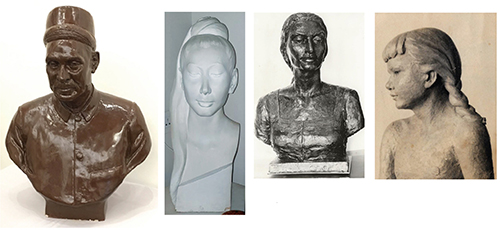
Virjee’s creations (from left): Khan Bahadur Kavasji Petigara (Photo: Kavas Petigara);
Win Min Than; Shireen Pandole, Gita Choksi
Mohandas Gandhi with gulmohar tree planted by him (l) and letter he wrote to Shireen
Bharucha and his sister Gita Choksi were children when the event occurred. He recalled, in emails from the US where he is now based, that they "visited (Gandhi) several times taking flowers from the garden… He came to the house a couple of times, I am told, to sit for the bust” that their "Shiaunty” was creating. Despite her crippling illness, Virjee went on to create "over 50 artworks,” including those of India’s last vicereine Lady Edwina Mountbatten, lawyer and feminist Mithan Lam and Maharani Gayatri Devi of Jaipur, among others.
"I recall her working on the head of Lady Mountbatten (at her Bombay studio)… I used to sit on a stool near the (vicerine) and chat with her. God knows what a six-year-old talked to her about but I do remember that very well,” stated Bharucha. An article in Eve’s Weekly (EW) of February 7, 1948 noted that Mountbatten’s likeness had "that genial friendly look which seemed to Shireen her most characteristic quality.” About Virjee’s working style which was "just her own,” the article noted that "she copied (her subject’s) photographs, requested them for a sitting and then reproduced them from memory.” Referring to the sitters who visited her studio, the article noted that "It was a case of Mohammed going over to the mountain.” The sculptor dabbled in painting too, noted Choksi, over tea on April 4, 2019. "She mostly did water colors of the Krishna river valley, and views around Maidstone.” Choksi recalled assisting Virjee in the baking of the clay artworks in a wood oven in their kitchen at their family home.
An alumna of Panchgani’s Kimmins Girls’ High School and the Sir J. J. School of Art, Virjee had passed the advanced examination in modeling (sculpture) at the art school in 1936. While still studying, Virjee won awards at the Bombay Art Society’s 1935 exhibition for a statue of her father Jal, and yet another, a year later for her statue of Biblical character Salome at the Poona Art Society’s exhibition, notes H. D. Darukhanawala’s Parsi Lustre on Indian Soil – II. Other works included "The Whistler,” a likeness of her younger brother Jimmy and a bust of the first Indian head of the Criminal Investigation Department Khan Bahadur Kavasji Petigara, which is now in the possession of the police official’s grandson Kavas Petigara. Standing first in the diploma examination of the Royal College of Art in London in August 1941, Darukhanawala’s volume notes that she is "the first Parsi or Indian woman to receive such distinction.” Also a student of the Welsh University at Aberystwyth, Parsi Lustre notes that the Indian government awarded her an overseas scholarship "in appreciation of her work for studying pottery.”
Virjee contracted arthritis during her stay in the UK "and had to be shipped out on a troopship to Bombay in 1941,” noted Bharucha. While in Dumfries in Scotland, where the art college students were evacuated from London to be away from the blitz, "Virjee went for a walk one evening, and did not return…An alarm bell went off among the students and residents nearby… A search party went out and in the wee hours of the morning, she was found partially buried under snow and unconscious,” he wrote. "We assume that was the beginning of the arthritis,” Choksi stated.
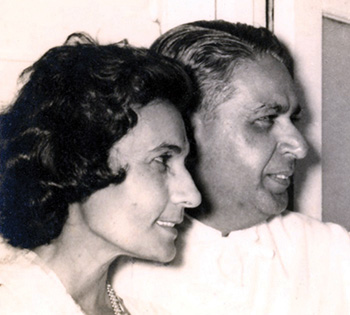
Shireen Virjee with husband Jassie Liloowalla
Bharucha recalls Virjee lying in a plaster cast on a bed in their Bombay flat and him giving her massages. "I used to copy an Austrian masseur…who came three times a week (to assist in Virjee’s rehabilitation).” During a subsequent return to London in 1948, she was operated upon by an English doctor. "Thereafter she was able to walk with two sticks for the rest of her life.” Virjee’s father had the sticks made for her by a Kashmiri craftsman, recalls Choksi. "As children, Cyrus and I had the task of keeping the brass ring that decorated it shining always,” narrated Choksi.
Among Virjee’s last works is a bust of Austrian-Burmese actor Win Min Than created partially in Burma where she was visiting her brother Pesi and his wife Daphne in 1952. Captured by the actor’s beauty, Virjee asked if she could make a bust of her, when they met socially. "It was first cast in clay, then plaster of Paris and finally in bronze,” noted Choksi, who had accompanied Virjee to Rangoon. Pesi made a special crate for the sculpture to be transported to India where it was cast in bronze. The sculptor entered it in a competition held by the Lalit Kala Akademi in Delhi. It won an award and was on display for decades. "It’s no longer on display and I am endeavoring to retrieve it from the Akademi archives,” Choksi noted.
A 1953 visit to the caves of Ajanta and Ellora with her family and friends (including future husband Jassie Liloowalla), "enthralled the sculptor and (she) decided that come what may, arthritis was not going to defeat her and she would begin sculpting again.” That was not to be. Virjee only managed a few clay images of her close family members, and small knickknacks after this. She spent the last two decades of her life between Bombay and Panchgani.
No major works of Virjee’s remain with the members of her extended family. "She had rented her Charni Road studio to a young Parsi man and he refused to move out when she wanted it back... The case took 22 years and finally when the court gave a search warrant, they found all her works had been thrown out or destroyed. She lost the case and a lot of money,” rues Bharucha. "We will never know why he (the Parsi man) did that… She had allowed him to stay in the premises as he was homeless,” added Choksi.
Bharucha recalls that Virjee returned to the UK in 1968 for another operation: "It was not successful…very sad and disappointing for her and the family.” He recalls taking her to the Tate and National galleries in London. "She felt very blocked off living in India and not knowing about the new trends in the West in the 1950s and 60s. "She said she had lost touch with her world,” rued Bharucha.