In the absence of a priest, the granddaughters of the founder zealously
serve the 125-year-old Bai Awabai Cooper Agiary in Lahore
Parinaz Gandhi
"Today’s function surpassed all our hopes and expectations. We are ever so grateful,” remarked 88-year-old trustee Rati Cooper at the 125th year celebrations of the Bai Awabai Cooper Agiary in Lahore on July 29, 2018. The third generation of Coopers, Rati and her 75-year-old sister Perin Boga, the honorary managing trustee, were joined in the celebration by the other trustees — Amy King, Sarosh Challa and Dr Jamshed Jassawalla — who have taken upon themselves the onerous responsibility of maintaining the Agiary in the absence of a priest.
Top: Rati Cooper (l) and Perin Boga Photo: Niloufer Bilimoria at the Bai Awabai Cooper Agiary in Lahore (above);
afarganiu gifted by Ardeshir Cooper’s sister Banoobai Dubash
"The highlight of the occasion was the devotion of all those who had come, including 88-year-old Gool Shahookar on a wheelchair,” noted an email from the sisters in response to Parsiana’s queries. Nearly a score of Zoroastrians from Lahore were joined by co-religionists from Karachi, Rawalpindi and Multan.
A khushali nu jashan (joyful thanksgiving) was performed at the Agiary at 11 a.m. by Ervads Shahrukh Sidhwa and 16-year-old Ardavan Solan who had specially come from Karachi for the occasion. The priests, their travel and the jashan were generously financed by the Feroze and Shernaz Bhandara Charitable Trust. After the jashan, the priests were presented ashodad and souvenirs. Rustom Dara and Meher Hormasji, two former residents of Lahore, now settled in Karachi, financed two maachis that day.
In her three-page vote of thanks, Rati named those who had supported the Agiary in various ways over the years. At each point she punctuated her thanks with "Ahura Mazda be praised.” Perin read an excerpt from the history of the Agiary compiled by the late Rustom Sidhwa, erstwhile judge of the Supreme Court of Pakistan (see "Atash for Awabai”).
King read former panthaky, Ervad Yazdiee Pavri’s felicitations for the occasion. "Having served our Atash for approximately three years, he terms this time as ‘the best period of my life,’” she informed Parsiana in a subsequent email. She further quoted two friends who conveyed their feelings at the time of the Agiary’s 125th anniversary: "The aura it radiated was one of inner contentment” and according to another ex-Lahoreite, "It was a place of peace and tranquility.”
The many portraits adorning the walls of the Agiary were garlanded by select individuals: The Karachi mobeds placed flowers around the photographs of Ervads Burjorji and Hormasji Antiya who had served the Agiary in an exemplary manner along with Hormasji’s wife Shirinbai and their daughters Hilla and Behroze. A Lahore based physician, Jassawalla garlanded the portrait of Dr Edulji P. Bharucha who had selflessly served the community in his time. Jassawalla’s daughters Sherry and Farah offered flowers before the photograph of their grandfather Dr Dinshaw Jassawalla who had also served the community selflessly. Amy and her brother Byram King who is the current caretaker of the Agiary garlanded the portrait of their uncle Siavaxsha Jarriwalla. Isphanyar Bhandara, the chief executive officer of Murree Brewery Company Limited in Rawalpindi and former member of parliament in Pakistan paid his respects before the portrait of his father and Agiary benefactor Minoo Bhandara while Isphanyar’s sons Zain and Zaal garlanded the photograph of their great-grandmother Tehmina Bhandara, also an Agiary patron.
To mark the occasion, a magnolia sapling was planted in the Agiary garden. This was followed by a community lunch at the prestigious Punjab Club, financed by Isphanyar and his family. The previous night, community members gathered for dinner at a Chinese restaurant, courtesy Hoshang Hormasji.
The Cooper family in Bombay celebrated the occasion with a jashan organized by 91-year-old Keki Cooper, grandson of the Agiary founder Ardeshir Cooper, at their Altamont Road home. Some of Ardeshir’s great-grandchildren, Farhad and Monaz Cooper, Jehangir and Behroz Rustomji, were present. His great-great-grandchildren, Jahangir and Mihir Cooper, aged three and five, sat solemnly and silently through the entire jashan, legs comfortably in swastik asana (pose), according to a report by Niloufer Bilimoria, great-granddaughter of Ardeshir.
All through the jashan, Keki kept pace with the mobeds from the H. B. Wadia Atash Behram, Avesta in hand, and announced at the end with great satisfaction that they had done a good job and not missed a single prayer, noted the report.
Atash for Awabai
Justice Rustam Sidhwa, who in the unavailability of a priest had performed jashan ceremonies at the Cooper Agiary during the Gatha days and other religiously significant days in the late 1980s even though he was not a navar or maratab, had compiled the history of the Agiary on the occasion of its centenary in 1993. Parsiana carries edited excerpts:
The Dar-e-Meher at Lahore is the result of the philanthropy of a great Parsi resident of Lahore whose love for his religion and dedication to its principles prompted him to establish a small dadgah in his house which ultimately was to blossom forth into a regular temple of worship to serve the whole Parsi community from the Punjab to the North West Frontier Province. Ardeshir Byramji Limboowala Cooper came to the Punjab in bullock carts before the railway lines were even laid. He established a successful wine and general provision business in Lahore and for many years almost held a monopoly in the field. He contributed generously to all Parsi charities, assisted members of his community in need, and organized and supported community services. He was the father figure of the community to whom all looked for leadership and guidance.
His grandson Dara Hirjibhoy Cooper ran for many years a cinema in Lahore named Excelsior (later renamed Ritz) and organized Navroz and Pateti functions therein regularly in which Parsi dramas and skits in Gujarati were staged and sports and games were held.
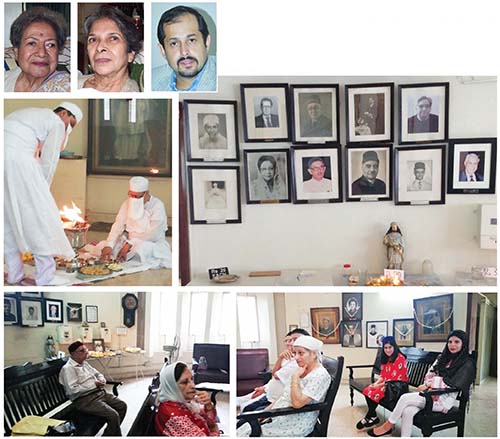
From l, 1st row: Rati Cooper, Perin Boga, Isphanyar Bhandara; 2nd row: jashan on 125th anniversary;
gallery of stalwarts Photo: Niloufer Bilimoria; 3rd row: Byram King, Amy King; Hoshang Bomanji from Multan,
Sarosh and Aban Challa, Sherry and Farah Jassawalla with Cooper family portraits in the background
(Above) Keki and (top, from l) Jahangir, Farhad and Mihir Cooper at the concurrent jashan in Bombay
The family residence of Ardeshir was at the Lower Mall in the building of the old Alliance Bank of Simla. This is the place where Ardeshir established his family dadgah in an exclusive room which he opened to the community just after he lost his first wife Awabai. After performing the full death ceremonies of Awabai, he retained the mobed whom he had called for that purpose and after a short while in 1893, roz Srosh, mah Bahman YZ 1262, he had the sacred atash formally consecrated in that exclusive room and appointed Ervad Nusserwanji Kaikobadji Dastoor (Meherji Rana) to look after it.
A Gujarati book by Mancherji Hoshangji Jagosh, proprietor of Vartman Press, relates that in the year 1893 Ardeshir had invited Dastur Jamaspji Minocherji Jamaspasana to Lahore to preside at the consecration of the sacred fire where the Zoroastrian community had honored him with a man patra (address of welcome). The superintendent of police (railway), under the orders of his superiors, had gone to Raiwind to receive the Dastur. The Lahore railway station was decorated with flags and buntings and a small police contingent was also present at the railway station. On July 29, 1893, the dar-e-meher was consecrated under his supervision. Ardeshir presented a shawl to the Dastur and appointed him the Dastur of the dar-e-meher. At the same ceremony, the Parsi community also presented him a shawl and declared him to be the vada dastur of the Punjab. The same day a dinner was given in his honor by the Parsi Anjuman.
In 1909-10 when Ardeshir shifted his residence to a bungalow on Lahore Road, the dadgah was also shifted to that bungalow. Six years before his demise on October 30, 1919, Ardeshir expressed his earnest desire to transfer the whole of the premises housing the dadgah to the Parsi community of the Punjab to be held by them in trust as a dar-e-meher. Accordingly on March 30, 1913, at a jashan held in the said premises, the Parsi Zoroastrian community presented an address to Ardeshir thanking him for his kind gesture. Of the seven trustees in charge, five would be nominated by him and his heirs, with the remaining two being elected by the members of the Lahore Parsi Anjuman. Ardeshir agreed to contribute Rs 75 per mensem towards the maintenance of the Agiary.
In 1913 Ervad Burjorji Antiya took over the panthak. In 1950 he submitted his resignation due to old age and in May 1952 the panthak was formally offered to his son Hormusji who looked after the sacred fire till 1968. After the passing away of Hormusji’s wife Shirinbai, he left for India. No mobed could be found to fill his vacancy. Members of the community voluntarily took turns to look after the sacred fire but the dar-e-meher being situated at a distance from their residences, it was difficult to continue with this arrangement.
In 1964, then chairman of the board of trustees, Dinshaw Challa offered to build a dharamshala on the dar-e-meher property but as the open space was limited and the project was not feasible he donated towards the construction of the dharamshala in New Delhi which was then being constructed.
In the meanwhile a number of Parsi families shifted into one or more of the 10 flats at the Dr Edulji Pestonji Bharucha Memorial Building, inaugurated on March 23, 1968 by Tehmina Bhandara, president of the Lahore Anjuman.. The fire was temporarily shifted to a room in one of the ground floor flats of this building in October 1968 until Jamshedi Navroz 1971 when the new dar-e-meher was formally inaugurated in Gulberg after the premises of the old dar-e-meher were sold. Dadi Surti was the architect who planned the dar-e-meher and the whole complex and who offered his services free. Construction was undertaken by Khodadad Irani with Fali Engineer and Dadabhoy Junglewalla supervising the construction voluntarily. From August 1970 to June 1987 Ervad Sohrabji Moghal looked after the sacred fire; and from April 1989 until the centenary, Ervad Rustamji Pavri was the panthaky.
At the time of the centenary celebrations, Ardeshir’s great-granddaughter Laisha Cooper, who resembles her great-grandmother Awabai, had come with her family from Bombay to be navjoted at the Agiary in Lahore, recall Rati and Perin.
Tending the fire
Houston based novelist Bapsi Sidhwa (daughter of Tehmina and Peshotan, and sister of Minoo and Feroze Bhandara) commented from Houston, "When I last visited Lahore’s Agiary, Rati Cooper lit the fire for me. This was when I visited Lahore for the first Lahore Literary Festival… Rati and Perin are particularly dear to me. They take flowers to my parents’ graves on their death anniversaries. Our fathers were staunch friends, and my mother adored both sisters, particularly Perin.”
Born in India, Amy King, who has lived in Lahore since her early days, stated, "I distinctly remember going to the Agiary as a child and have many happy memories of that time. Even after the Agiary was shifted to its present site in Gulberg due to recurring floods, we had a resident priest, and our small community was actively involved in all religious matters. Unfortunately, however, we found it progressively difficult to find a priest as our numbers began to dwindle when many families migrated to the West.
"At that time, members of the community volunteered to take turns to tend the fire and do whatever was necessary. I used to go twice a week, and I have no words with which to describe the feeling of peace and well-being that pervaded my life during that time. My family and I faced our share of problems in life which seemed to get resolved one by one. Even today, I am enveloped by a great sense of peace the moment I enter the Agiary. This is a special quality of our atash, and I hope and pray that in spite of all our restraints, we never have to close its doors permanently.”
Happy to receive around 10 munificent contributions on the quasquicentennial occasion, in response to Parsiana’s queries, Rati and Perin stated, "The main challenge the trustees face is the financial cost of maintaining the Agiary with expenses running higher and higher each year. The kathi is procured locally. The sandalwood comes from Karachi or from visitors who come from Bombay or Karachi. Alas, we have been without a mobed for around half a decade… (For) the muktads, without a priest the best we can do is place tube roses and roses in around 22 vases on a muktad table… and the reading of a humbandagi with about five of us present… The community and all that pertains to it is treated with great respect and consideration which we hope to enjoy for all time to come.”